
Digital screens are now everywhere. You see them in shopping malls, offices, restaurants, airports, roadsides, and building fronts. These screens are used to show ads, promotions, directions, menus, and brand messages. But not all digital screens are the same.
There are two main types of digital screens:
- Indoor digital screens
- Outdoor digital screens
Many people get confused about which one to choose. In this guide, we will clearly explain the difference between indoor and outdoor digital screens in very simple English. By the end, you will know which screen is best for your business.
What Are Digital Screens?
Digital screens are electronic displays that show content like images, videos, text, and animations. They are also known as:
- Digital signage screens
- LED displays
- Commercial display screens
These screens are controlled using media players or software, which allows content to change anytime.
What Is an Indoor Digital Screen?
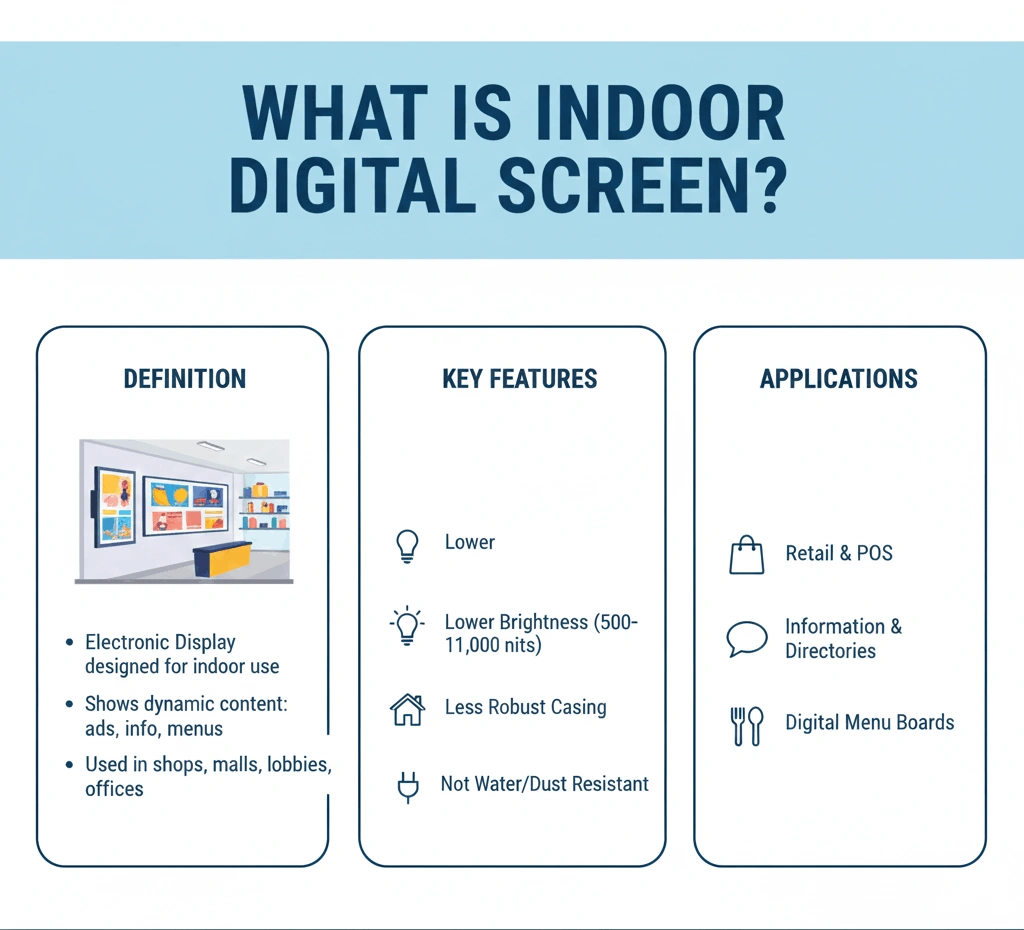
Indoor digital screens are designed to be used inside buildings. They are commonly found in places like:
- Shopping malls
- Offices
- Restaurants
- Hospitals
- Showrooms
- Schools
These screens are not made to face rain, dust, or direct sunlight.
Features of Indoor Digital Screens
Indoor screens are built for controlled environments. Here are their key features:
1. Lower Brightness
Indoor screens have moderate brightness because indoor lighting is already controlled. Very high brightness is not needed.
2. High Resolution
Indoor screens often have very clear picture quality. Text and images look sharp, even from a close distance.
3. Slim and Stylish Design
They are thin, lightweight, and look modern. This helps them blend well with interior design.
4. Lower Power Use
Indoor screens use less electricity compared to outdoor screens.
Common Uses of Indoor Digital Screens
Indoor digital screens are used for many purposes:
- Menu boards in restaurants
- Promotional screens in malls
- Reception area displays
- Office communication screens
- Product ads in showrooms
A popular indoor solution is the DS DIGITAL Poster stand, which is often used in retail stores and exhibitions for promotions and announcements.
What Is an Outdoor Digital Screen?
Outdoor digital screens are designed to be used outside buildings. They are made to handle tough weather and bright sunlight.
You usually see outdoor screens at:
- Roadsides
- Building fronts
- Parking areas
- Outdoor shopping areas
- Public places
Features of Outdoor Digital Screens
Outdoor screens are built very differently from indoor screens.
1. Very High Brightness
Outdoor screens must be bright enough to be visible in direct sunlight. This is one of the biggest differences.
2. Weather Resistance
They are protected against rain, dust, heat, and humidity.
3. Strong Body
Outdoor screens have strong metal cabinets and safety glass to protect them from damage.
4. Long Viewing Distance
Outdoor screens are designed to be seen from far away.
Main Difference Between Indoor and Outdoor Digital Screens
Let’s break down the difference in a simple way.
1. Brightness Level
Indoor screens have lower brightness.
Outdoor screens have very high brightness.
2. Weather Protection
Indoor screens do not need weather protection.
Outdoor screens are fully weatherproof.
3. Cost
Indoor screens are more affordable.
Outdoor screens are more expensive due to stronger materials.
4. Usage Environment
Indoor screens are for closed spaces.
Outdoor screens are for open spaces.
Picture Quality Comparison
Indoor screens usually have better close-view picture quality. This is because people stand near them.
Outdoor screens focus more on visibility from distance, not close detail.
So, if your audience is close, indoor screens work better.
If your audience is far away, outdoor screens are the right choice.
Installation Differences
Indoor Screen Installation
- Easy to install
- Wall-mounted, floor stand, or ceiling-mounted
- Less wiring required
Outdoor Screen Installation
- Requires strong support structure
- Needs proper electrical safety
- Installation takes more time
Content Type for Indoor vs Outdoor Screens
The content shown on screens also matters.
Indoor Screen Content
- Product details
- Price lists
- Menus
- Brand videos
- Announcements
Outdoor Screen Content
- Brand logos
- Short ads
- Big text
- Moving visuals
Outdoor content must be simple and readable quickly.
Lifespan of Indoor and Outdoor Digital Screens
Indoor digital screens usually last longer because they are protected from weather.
Outdoor screens are built strong but still face heat, dust, and rain daily. Regular maintenance is important for long life.
Maintenance Requirements
Indoor Screens
- Basic cleaning
- Software updates
- Low maintenance cost
Outdoor Screens
- Regular cleaning
- Weather checks
- Higher maintenance cost
Energy Consumption
Indoor screens consume less power.
Outdoor screens consume more electricity because of high brightness and cooling systems.
This is an important factor when planning long-term use.
Indoor Digital Screens for Businesses
Indoor screens help businesses communicate better with customers.
Benefits include:
- Better customer engagement
- Modern brand image
- Easy content updates
- More attention than posters
They are perfect for retail, offices, and hospitality businesses.
Outdoor Digital Screens for Advertising
Outdoor screens are powerful advertising tools.
Benefits include:
- High visibility
- 24/7 promotion
- Strong brand impact
- Large audience reach
They are widely used in city centers and busy roads.
Choosing Between Indoor and Outdoor Digital Screens
Ask yourself these questions:
- Where will the screen be placed?
- Will it face sunlight or rain?
- How far will viewers stand?
- What is your budget?
Answering these questions makes the decision easy.
Indoor Digital Screen Sizes
Indoor screens come in many sizes:
- Small screens for counters
- Medium screens for walls
- Large screens for halls
Floor-standing options like poster screens are also popular.
Outdoor Digital Screen Sizes
Outdoor screens are usually larger:
- Billboards
- Building-mounted screens
- Roadside displays
The size depends on viewing distance.
Digital Screen Technology Used
Both indoor and outdoor screens use technologies like:
- LED displays
- LCD commercial panels
LED is more common for outdoor use due to brightness.
Indoor vs Outdoor Screens in Retail
Retail stores often use both types.
Indoor screens:
- Show offers
- Highlight products
Outdoor screens:
- Attract customers from outside
- Display brand identity
This combination increases foot traffic.
Role of Professional Digital Signage Providers
Choosing the right screen is easier with professional help. Experts in signage digital dubai understand location, environment, and business needs before recommending a solution.
They help with:
- Screen selection
- Installation
- Content planning
- Maintenance support
Cost Comparison Summary
Indoor digital screens:
- Lower initial cost
- Lower running cost
Outdoor digital screens:
- Higher initial cost
- Higher maintenance cost
But outdoor screens offer wider reach.
Future of Digital Screens
Digital screens are becoming smarter.
Future trends include:
- Interactive screens
- Touch displays
- AI-based content
- Smart scheduling
Both indoor and outdoor screens will continue to grow in demand.
Common Questions People Ask
Can indoor screens be used outside?
No. They are not made for sunlight or rain.
Are outdoor screens visible at night?
Yes. Brightness can be adjusted for day and night.
Which screen is better for ads?
Outdoor screens are better for mass advertising.
Indoor screens are better for detailed messages.