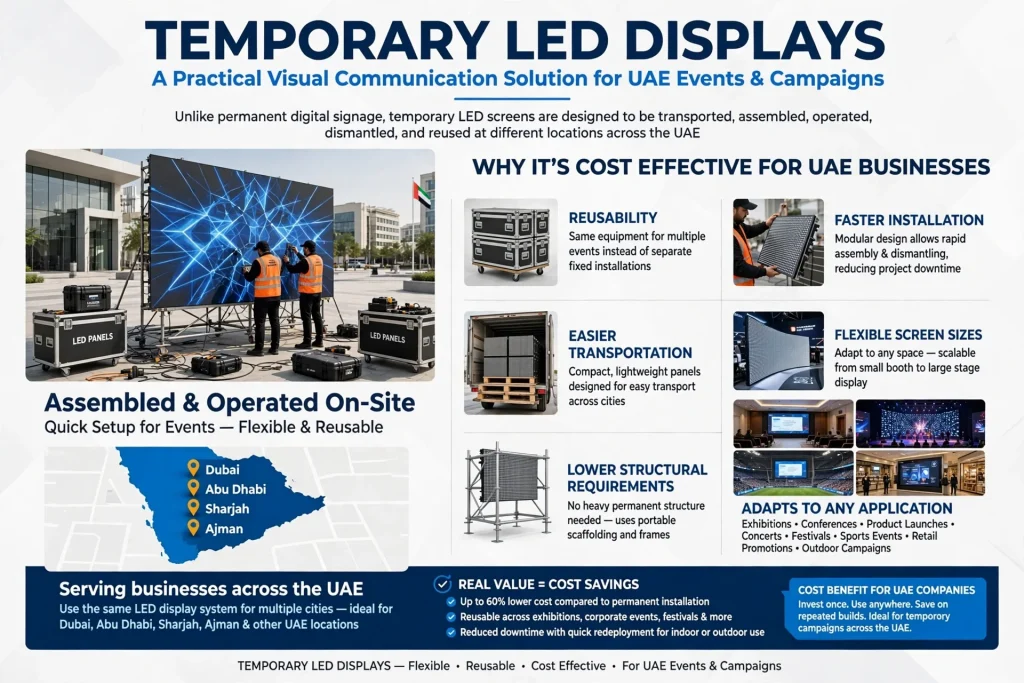
Temporary LED displays have become a practical visual communication solution for exhibitions, conferences, corporate events, product launches, concerts, festivals, sports events, retail promotions, and temporary outdoor campaigns. Unlike permanent digital signage installations, temporary LED screens are designed to be transported, assembled, operated, dismantled, and reused at different locations.
For businesses in the United Arab Emirates, this flexibility can make temporary LED displays more cost effective than building a permanent digital screen installation for every event or campaign. Companies in Dubai, Abu Dhabi, Sharjah, Ajman, and other UAE locations can use the same LED display equipment for multiple events instead of investing in separate fixed installations.
The real value is not simply the initial purchase price. Cost effectiveness comes from reusability, faster installation, lower structural requirements, flexible screen sizes, easier transportation, reduced downtime, and the ability to adapt one display system to different applications.
What Are Temporary LED Displays?
Temporary LED displays are modular LED video screens designed for short-term or frequently changing installations. They are normally built from lightweight LED panels or cabinets that can be connected to create different screen dimensions.
A typical temporary LED display system may include LED modules, cabinets, receiving cards, sending cards, video processors, power distribution equipment, control systems, rigging or support structures, cables, and protective transportation cases.
Unlike a permanent LED billboard or fixed digital signage system, a temporary display can be assembled for a specific event and removed when the event finishes.
This makes temporary LED technology particularly useful when the same equipment needs to serve multiple venues.
For example, a company may use an LED screen at Dubai World Trade Centre for an exhibition, move it to Dubai Marina for a brand activation, and later use the same system at a corporate conference in Abu Dhabi.
Why Temporary LED Displays Can Cost Less
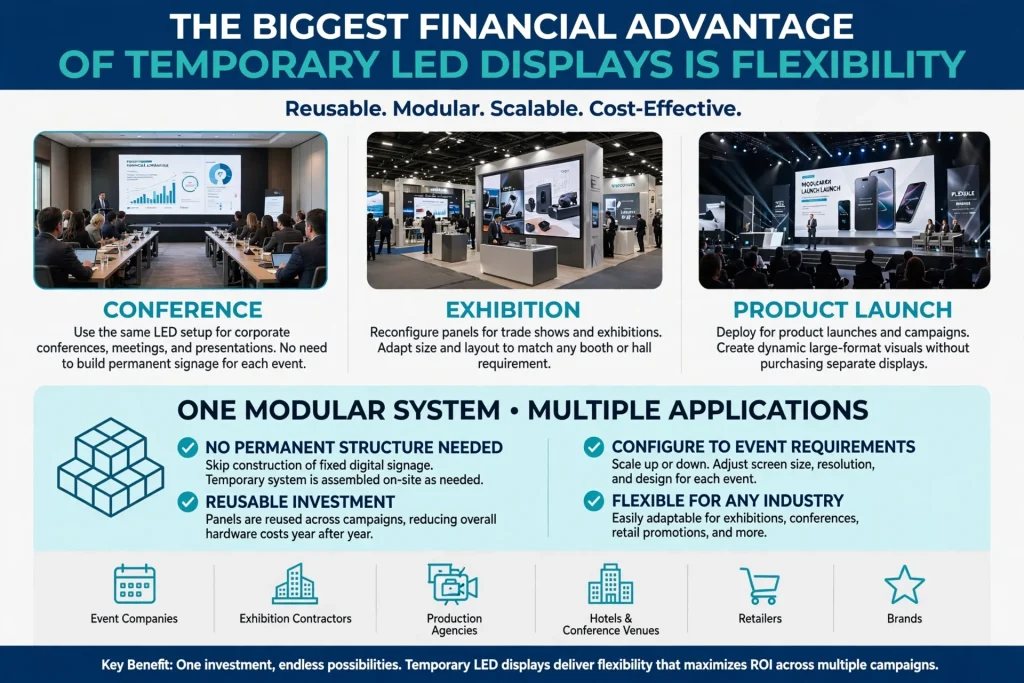
The biggest financial advantage of temporary LED displays is flexibility. A business does not necessarily need to construct a permanent digital signage structure every time it wants a large-format visual communication solution.
A temporary system can be configured according to the event’s requirements.
Instead of purchasing a separate display for a conference, another for an exhibition, and another for a product launch, companies can use modular LED panels for multiple applications.
The investment therefore becomes reusable.
This is especially important for event companies, exhibition contractors, production agencies, hotels, conference venues, retailers, and brands that organize multiple campaigns throughout the year.
Reusability Reduces Long-Term Costs
One of the strongest advantages of temporary LED displays is their ability to be reused.
A modular LED screen can be dismantled after an event and transported to another location. Depending on the cabinet design and application, the same panels can be configured into different screen sizes.
For example, a 6-metre-wide display might be suitable for a conference today, while the same panels can be rearranged into a larger display for an exhibition next month.
This means the equipment can generate value across multiple events rather than being associated with only one location.
For businesses that frequently organize events in Dubai, Abu Dhabi, Sharjah, or Ras Al Khaimah, repeated use can significantly improve the return on investment.
No Need for a Permanent Installation
Permanent LED displays can require more extensive infrastructure. Depending on the location, a fixed installation may involve structural supports, mounting systems, electrical work, civil work, weather protection, engineering approvals, and permanent integration with the building.
Temporary LED displays can reduce the need for many of these requirements because the screen is installed for a limited period.
For an exhibition stand at Dubai World Trade Centre, for example, the objective may simply be to create a high-impact digital backdrop for several days.
Building a permanent screen structure for such a short-term requirement would not normally make financial sense.
A temporary LED wall can provide the visual impact without turning a short campaign into a permanent construction project.
Lower Installation and Dismantling Requirements
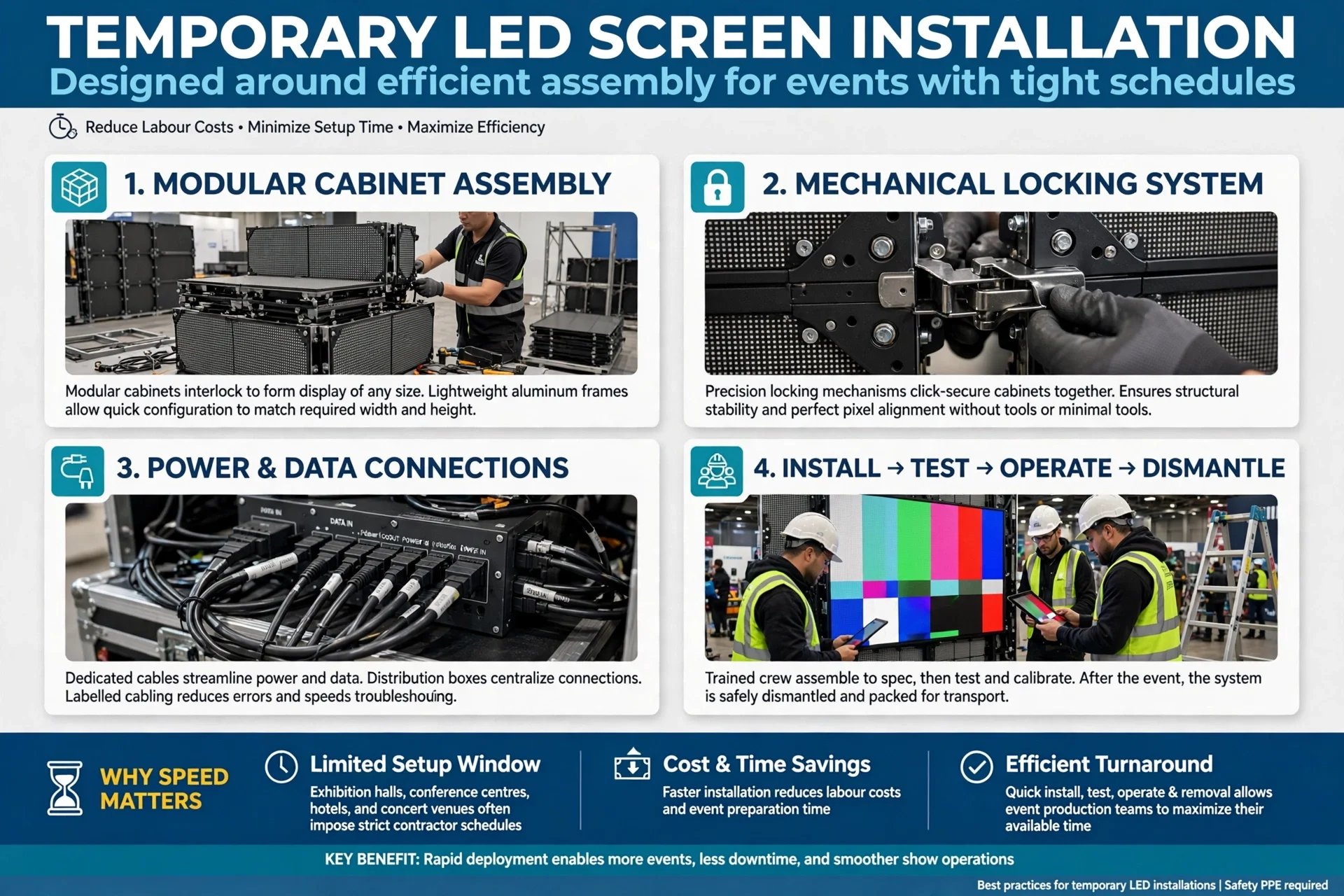
Temporary LED screens are designed around efficient assembly.
Modular cabinets can be connected using mechanical locking systems, while power and data connections can be organized through dedicated cables and distribution equipment.
A professional installation team can assemble the display according to the required configuration and dismantle it after the event.
Faster installation can reduce labour costs and event preparation time.
This becomes particularly important when an event venue provides a limited setup window. Exhibition halls, conference centres, hotels, and concert venues often have strict schedules for contractors.
The faster a screen can be installed, tested, operated, and removed, the more efficiently the event production team can use its available time.
Flexible Screen Sizes
Temporary LED displays are modular, which means screen dimensions can be adapted according to the application.
A relatively small LED wall may be sufficient for a corporate meeting, while a large outdoor screen may be required for a concert or festival.
The modular nature of LED cabinets allows production teams to create different configurations without purchasing a completely new display system for every event.
This flexibility can reduce equipment costs over time.
It also prevents businesses from being locked into a single screen size that may not suit future campaigns.
Better Value for Events and Exhibitions
Exhibitions are one of the clearest applications for temporary LED displays.
Businesses participating in events such as GITEX Global, Gulfood, Arab Health, Dubai International Boat Show, The Big 5 Global, and other major exhibitions often need strong visual communication within a limited footprint.
An LED wall can display product demonstrations, company videos, animations, promotional messages, presentations, social media content, and live feeds.
Instead of printing large quantities of graphics for every campaign, exhibitors can use digital content that can be changed throughout the event.
A single LED screen can therefore support several messages during the same exhibition.
Reduced Printing and Graphic Replacement Costs
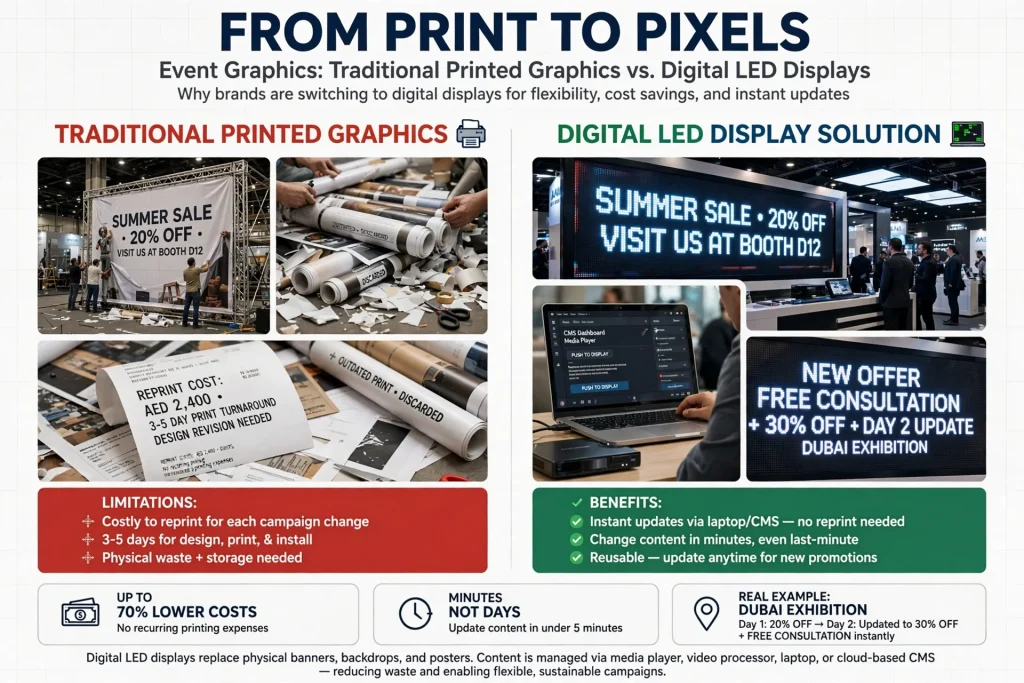
Traditional event graphics often involve printing large-format banners, backdrops, posters, fabric graphics, and promotional panels.
When the campaign changes, the physical graphics may need to be redesigned and printed again.
LED displays replace much of this physical content with digital media.
A company can update the content using a media player, video processor, laptop, or dedicated content management system.
For businesses running frequent promotions, this can reduce recurring printing costs.
It also makes last-minute changes easier.
For example, a brand participating in an exhibition in Dubai may want to change its promotional offer on the second day. A digital LED display allows the content team to replace the message without physically replacing a printed backdrop.
High Visual Impact From a Compact System
LED displays produce bright, high-contrast images that can attract attention in busy environments.
This is particularly valuable in exhibition halls where dozens or hundreds of brands compete for visitor attention.
Pixel pitch is an important consideration when selecting an LED display.
Fine-pitch LED displays are generally suitable for close viewing distances, while larger pixel pitches can be appropriate for audiences positioned farther away.
Choosing the correct pixel pitch prevents businesses from unnecessarily paying for extremely fine resolution where it is not required.
The most cost-effective solution is therefore not always the LED screen with the smallest pixel pitch. It is the display that provides appropriate image quality for the viewing distance and application.
Choosing the Correct Pixel Pitch Saves Money
Pixel pitch refers to the distance between individual LED pixels, usually measured in millimetres.
Common LED display categories include options such as P1.5, P2, P2.5, P3, P3.9, P4, P4.8, P5, and larger pitches.
A P2.5 LED screen may be suitable for an indoor corporate event where viewers are relatively close to the screen.
An outdoor event with a larger viewing distance may not require the same fine pixel pitch.
Selecting the right specification avoids unnecessary equipment costs.
A professional supplier should consider viewing distance, screen size, ambient lighting, content type, venue dimensions, camera requirements, and audience position before recommending pixel pitch.
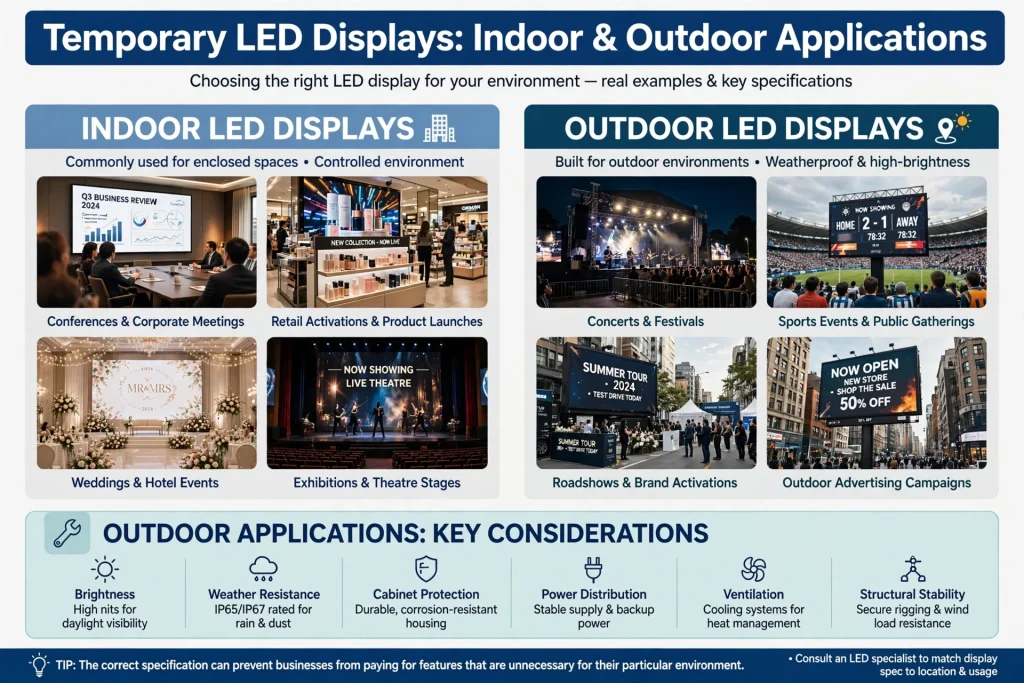
Indoor and Outdoor Applications
Temporary LED displays are available for both indoor and outdoor applications.
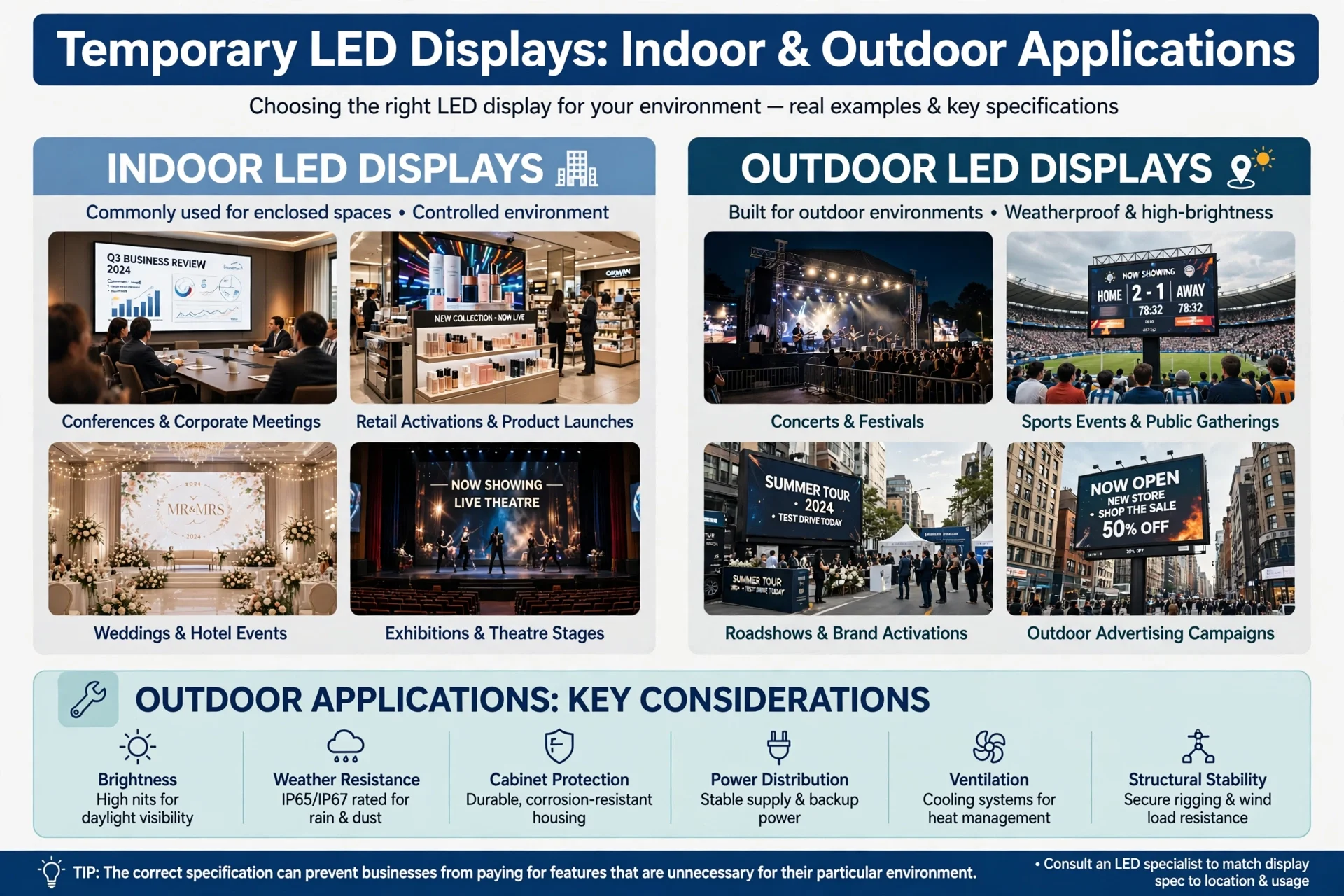
Indoor LED displays are commonly used for conferences, exhibitions, hotel events, retail activations, corporate meetings, wedding stages, theatres, and product launches.
Outdoor LED systems may be used for concerts, festivals, sports events, public gatherings, roadshows, brand activations, and outdoor advertising campaigns.
Outdoor applications require additional considerations such as brightness, weather resistance, cabinet protection, power distribution, ventilation, and structural stability.
The correct specification can prevent businesses from paying for features that are unnecessary for their particular environment.
Cost Efficiency for Corporate Events
Corporate conferences often require large visual backgrounds for keynote presentations, panel discussions, awards ceremonies, and product announcements.
A temporary LED display can replace traditional projection screens or printed stage backdrops while providing dynamic content.
Presentations, speaker graphics, videos, company branding, live camera feeds, charts, and animations can all be displayed on the same screen.
For companies that organize events regularly, reusable LED equipment can provide better long-term value than repeatedly purchasing temporary printed materials.
LED Displays and Video Processing
A temporary LED display is more than a collection of LED panels.
Video processing equipment plays an important role in converting and managing content.
Video processors and controllers can handle different input sources such as HDMI, DisplayPort, SDI, cameras, laptops, media servers, and presentation systems.
Professional systems may also support scaling, switching, picture-in-picture layouts, redundancy, and synchronization.
For large conferences or live productions, these capabilities can reduce the need for multiple separate visual systems.
Lower Content Change Costs
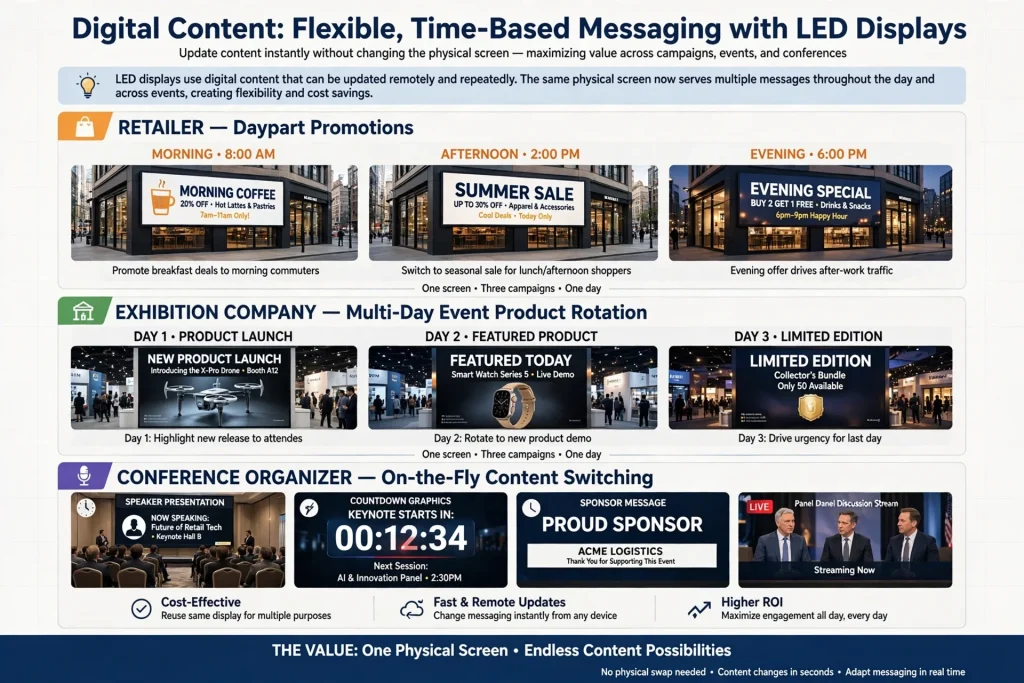
Digital content can be updated without changing the physical screen.
This makes temporary LED displays useful for campaigns where the message changes frequently.
A retailer might display one promotion during the morning, another during the afternoon, and a different campaign in the evening.
An exhibition company might display different products throughout a multi-day event.
A conference organizer can switch between speaker presentations, sponsor messages, countdown graphics, and live video.
This flexibility creates additional value from the same physical equipment.
Energy Efficiency and Operating Costs
Modern LED technology can provide good energy efficiency compared with older display technologies, although actual consumption depends on screen size, brightness, pixel pitch, content, refresh rate, and operating conditions.
Brightness management can also help reduce unnecessary power consumption.
For indoor events, the LED display does not always need to operate at maximum brightness.
Proper configuration can balance visibility and energy use.
For outdoor UAE events, brightness requirements may be higher because of strong daylight conditions. A suitable outdoor LED system should therefore be selected according to the actual environment rather than using a one-size-fits-all specification.
Why Temporary LED Displays Work Well in the UAE
The UAE has a highly active events, exhibitions, hospitality, retail, entertainment, and corporate sector.
Dubai hosts major international exhibitions and conferences throughout the year, while Abu Dhabi has significant activity across business, government, culture, sports, and entertainment.
Sharjah is also an important centre for exhibitions, education, culture, and business events.
Temporary LED displays can support this constantly changing environment because businesses often need visual systems for specific dates rather than permanent installations.
The UAE climate also makes equipment selection important. Outdoor LED displays should be designed for high ambient temperatures, dust, sunlight, and changing environmental conditions.
Dubai Events and Exhibition Applications
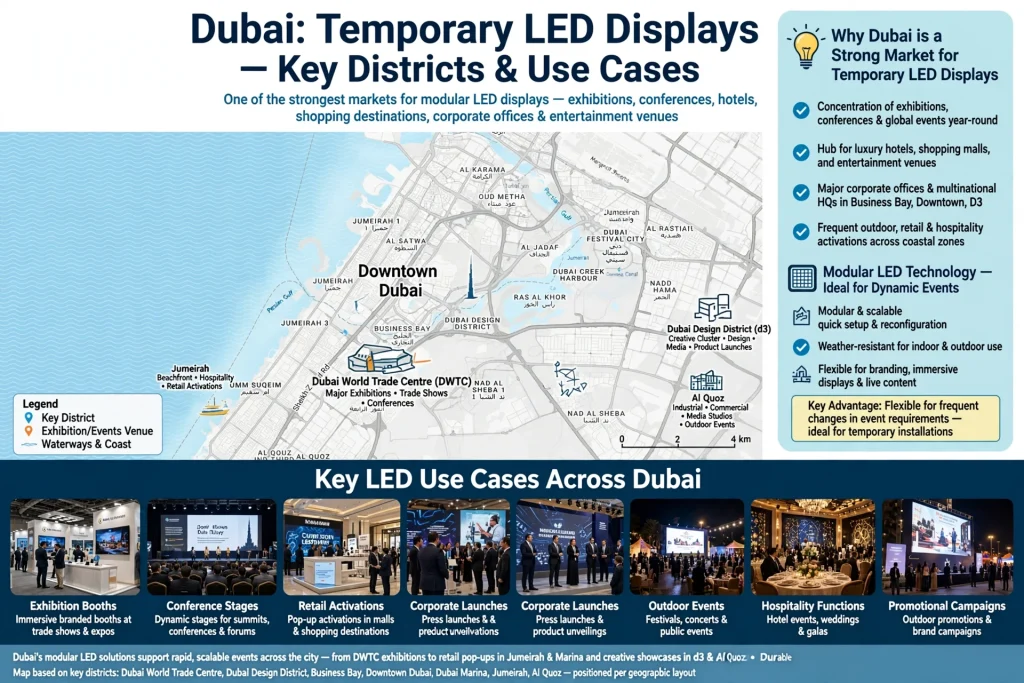
Dubai is one of the strongest markets for temporary LED displays because of its concentration of exhibitions, conferences, hotels, shopping destinations, corporate offices, and entertainment venues.
Areas such as Dubai World Trade Centre, Dubai Design District, Business Bay, Downtown Dubai, Dubai Marina, Jumeirah, and Al Quoz host a wide range of corporate and commercial activities.
Temporary LED displays can be used for exhibition booths, conference stages, retail activations, corporate launches, outdoor events, hospitality functions, and promotional campaigns.
Because event requirements change frequently, modular LED technology provides a practical solution.
Abu Dhabi and Sharjah Applications
Abu Dhabi has growing demand for LED displays across conferences, government events, cultural programmes, sports, hospitality, and commercial activities.
Areas around Yas Island, Saadiyat Island, Abu Dhabi city centre, and major exhibition and conference venues can require temporary visual installations for specific events.
Sharjah also presents opportunities for temporary LED displays through cultural events, exhibitions, educational conferences, retail campaigns, and business functions.
For event companies operating across multiple emirates, reusable equipment can reduce the need to maintain separate display systems for every venue.
Temporary LED Displays for Roadshows
Roadshows are another application where temporary LED technology provides financial value.
A roadshow may visit multiple cities or venues over several weeks.
Instead of installing a fixed display at each location, the same LED cabinets can travel with the production team.
The system can be assembled, operated, dismantled, transported, and installed again.
This makes temporary LED displays particularly useful for automotive launches, financial campaigns, telecom promotions, retail brands, government awareness programmes, and corporate roadshows.
Retail and Brand Activations
Retail brands frequently need temporary displays for product launches, seasonal promotions, shopping mall campaigns, and special events.
Shopping destinations such as Dubai Mall, Mall of the Emirates, Yas Mall, and other major UAE retail environments provide opportunities for digital brand experiences.
An LED display can create a dynamic visual backdrop without requiring permanent construction.
Once the campaign ends, the system can be removed and replaced with another activation.
Temporary LED Displays for Concerts and Festivals
Concerts and festivals often require large video walls for stage visuals, artist content, live camera feeds, sponsor branding, and audience engagement.
Temporary LED screens are particularly appropriate because the event infrastructure itself is temporary.
LED panels can be integrated with stage structures, trusses, ground supports, and other event production equipment.
Outdoor concert applications require careful planning for structural stability, weather conditions, viewing distance, brightness, power distribution, and signal reliability.
Rental Versus Purchase
Businesses should also consider whether they need to purchase temporary LED equipment or rent it.
Rental can be more cost effective for companies that only need LED displays occasionally.
Purchase can make sense for event companies, production agencies, exhibition contractors, and businesses that have frequent requirements.
The decision should consider annual usage, storage, transportation, maintenance, technician requirements, expected equipment lifespan, and future event schedules.
A company organizing one major event per year may have a very different financial calculation from an event production company operating LED screens every week.
Storage and Transportation Considerations
Temporary LED systems are designed with transportation in mind.
Protective flight cases can help transport LED cabinets, cables, processors, and accessories between venues.
However, storage and logistics still contribute to the overall cost.
Businesses should consider warehouse space, transportation vehicles, loading requirements, protective cases, handling equipment, and technician availability.
A well-organized logistics plan can prevent unnecessary damage and reduce setup delays.
Maintenance and Equipment Lifespan
The long-term cost effectiveness of temporary LED displays also depends on maintenance.
LED modules, power supplies, receiving cards, cables, connectors, and other components should be inspected regularly.
Dust, heat, physical handling, moisture, and repeated transportation can affect equipment performance.
Routine testing before and after events can identify damaged modules or connections before they become serious problems.
Keeping spare LED modules, power supplies, cables, and other critical components can also reduce downtime during live events.
Choosing a Temporary LED Displays Supplier
Selecting the right supplier is important because the cheapest equipment or quotation is not necessarily the most cost effective option.
A professional supplier should be able to recommend suitable pixel pitch, brightness, cabinet size, viewing distance, processing equipment, power requirements, support structure, and installation method.
The supplier should also understand the specific requirements of UAE venues and event environments.
Businesses should consider equipment quality, technical support, installation experience, transportation, maintenance, replacement parts, testing procedures, and emergency support.
A reliable Temporary LED Displays Supplier can help match the LED system to the event rather than simply supplying a standard screen.
How to Calculate the Real Cost
The real cost of a temporary LED display should be evaluated beyond the initial rental or purchase price.
Businesses should consider equipment cost, installation, dismantling, transportation, technicians, power consumption, content production, maintenance, storage, replacement parts, and potential downtime.
For purchased systems, the calculation should also consider how many events the equipment will serve.
For example, equipment used for 30 events per year may provide considerably better value per event than equipment used only twice.
This is why utilization is one of the most important factors when assessing temporary LED technology.
Temporary LED Displays Versus Projectors
Projectors can still be useful for certain applications, but LED displays have several advantages for high-ambient-light environments.
Projector performance can be affected by ambient lighting and projection distance. LED displays generate their own light and can provide strong brightness and contrast.
LED screens can also provide a clean visual surface without requiring a projection path.
For UAE events where strong lighting is common, LED technology can provide a more consistent visual experience.
However, the best choice depends on the venue, audience distance, screen size, content, budget, and technical requirements.
Temporary LED Displays Versus Printed Backdrops
Printed backdrops can be inexpensive for simple branding, but they cannot provide dynamic content.
An LED display can show videos, animation, live feeds, presentations, graphics, sponsor content, and changing promotional messages.
This means one screen can serve multiple communication purposes.
For businesses running several campaigns, the ability to update content digitally can improve the long-term value of the investment.
Improving ROI With Better Content
The financial value of an LED display also depends on how effectively the screen is used.
High-quality motion graphics, product videos, readable typography, strong branding, live camera feeds, interactive content, and carefully designed presentations can increase audience engagement.
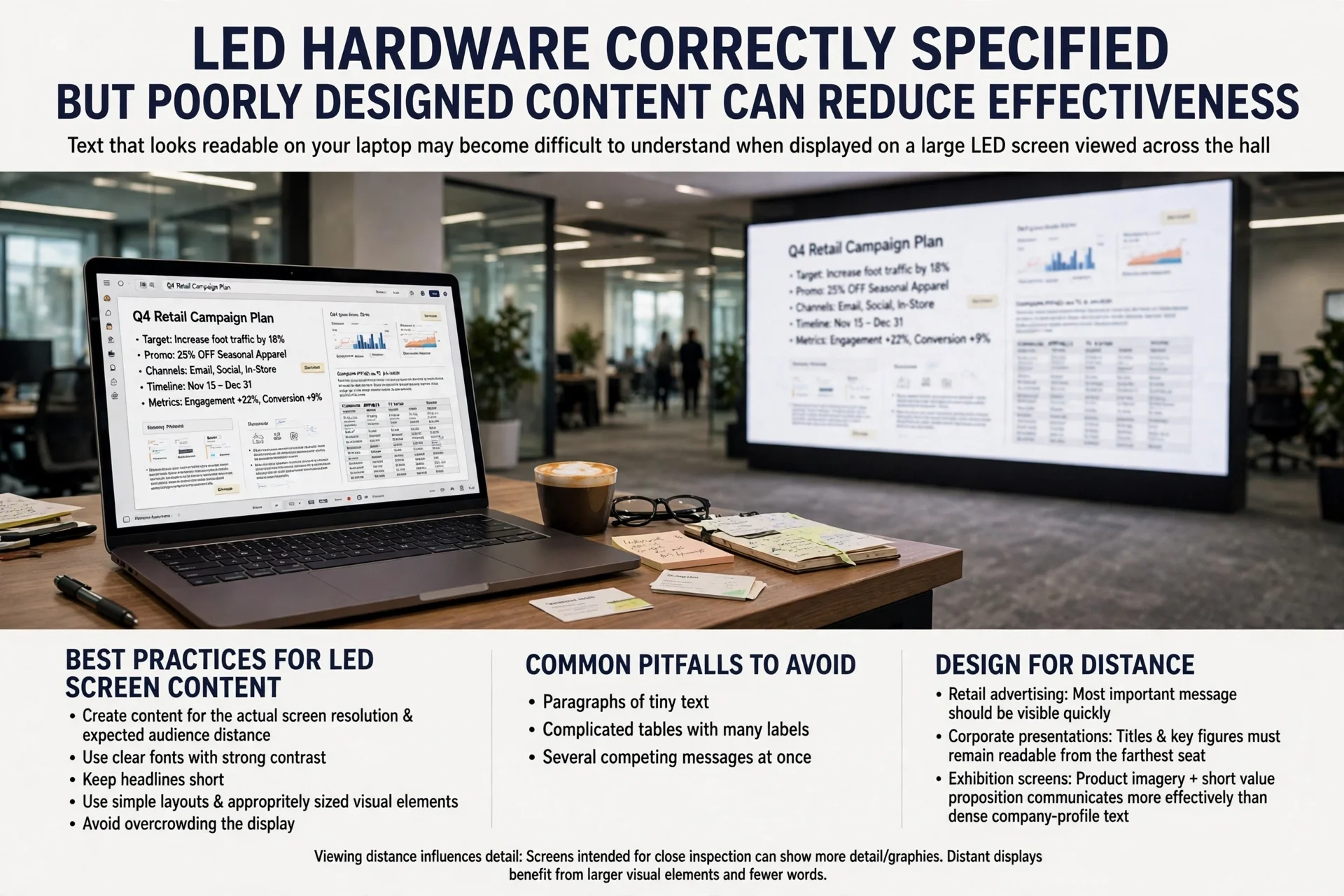
Content should be designed for the LED screen’s aspect ratio and viewing distance.
Text should remain readable from the intended audience position, while important visual elements should not be placed too close to cabinet boundaries or screen edges.
Temporary LED Displays Support Flexible Event Strategies
Modern businesses need marketing systems that can adapt quickly.
Events can change locations, schedules, branding, sponsors, product offerings, and audiences.
Temporary LED displays support this flexibility because the physical equipment does not need to remain attached to one building.
A company can use the same technology for a conference in Dubai, a product launch in Abu Dhabi, an exhibition in Sharjah, and a roadshow in Ajman.
This adaptability is one of the strongest reasons temporary LED technology can provide excellent long-term value.
Final Thoughts
Temporary LED displays are cost effective because they combine high visual impact with flexibility, reusability, modular construction, fast installation, and digital content management.
Their value becomes particularly clear for businesses that participate in exhibitions, organize conferences, conduct roadshows, launch products, operate brand activations, or manage entertainment events across multiple locations.
In the UAE, where Dubai, Abu Dhabi, Sharjah, Ajman, and other emirates have active exhibition, hospitality, retail, corporate, and entertainment markets, temporary LED technology can provide a flexible alternative to permanent installations.
The right system should always be selected according to viewing distance, pixel pitch, brightness, indoor or outdoor conditions, screen dimensions, content requirements, event duration, transportation, installation, and expected usage.
When these factors are evaluated together, temporary LED displays can become more than an event screen. They can become a reusable visual communication asset that supports multiple campaigns and delivers value across many events.