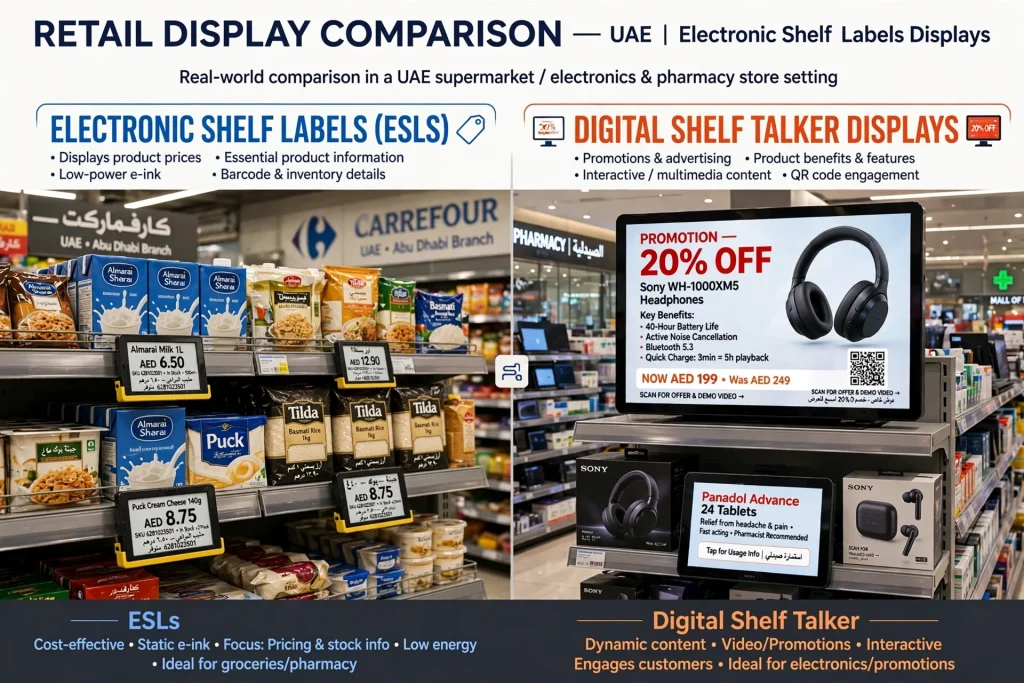
Retail stores are adopting digital technologies to improve price accuracy, product visibility, promotional communication, and customer engagement. Two technologies gaining attention in modern retail environments are electronic shelf labels (ESLs) and digital shelf talker displays. Although both are installed near products on retail shelves, they serve different purposes. Electronic shelf labels primarily display product prices and essential product information, while digital shelf talker displays use digital screens to communicate promotions, product benefits, advertising messages, and interactive content.
Understanding the difference between these technologies helps retailers, supermarket operators, electronics stores, pharmacies, and other businesses select the right solution for their merchandising objectives. In the UAE, where supermarkets, shopping malls, convenience stores, and specialty retailers compete for customer attention, choosing an appropriate shelf display system can improve the in-store shopping experience and support more effective retail marketing.
What Are Electronic Shelf Labels (ESLs)?
Electronic shelf labels are small electronic displays attached to retail shelves to show product prices, product identification, barcodes, and other essential information. They are commonly used in supermarkets, grocery stores, pharmacies, electronics retailers, and large-format retail outlets. Most electronic shelf labels use electronic paper (e-paper) or similar low-power display technology to maintain readable information while consuming very little energy.
An electronic shelf label system typically includes digital labels, wireless communication infrastructure, management software, and integration with a retailer’s point-of-sale (POS) or enterprise resource planning (ERP) system. When a product price changes in the central system, the updated information can be transmitted to the corresponding shelf label, reducing the need for employees to replace paper price tags manually.
For retailers managing thousands of stock-keeping units (SKUs), electronic shelf labels can improve price consistency between the checkout system and the shelf. They can also display product codes, unit prices, promotional indicators, and selected inventory information, depending on the model and software configuration.
What Are Digital Shelf Talker Displays?
Digital shelf talker displays are compact digital screens positioned beside, beneath, or directly in front of products to communicate information that attracts shoppers’ attention. Unlike conventional paper shelf talkers, which usually contain a printed promotional message, digital versions can display changing visual content such as product videos, animated graphics, promotional offers, brand messages, and product demonstrations.
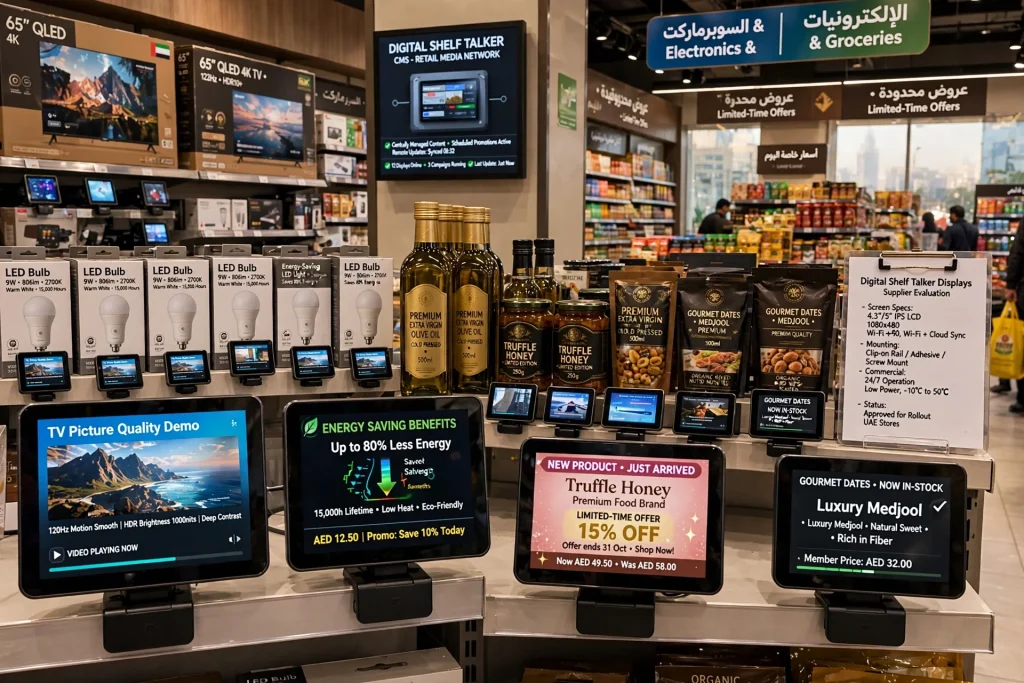
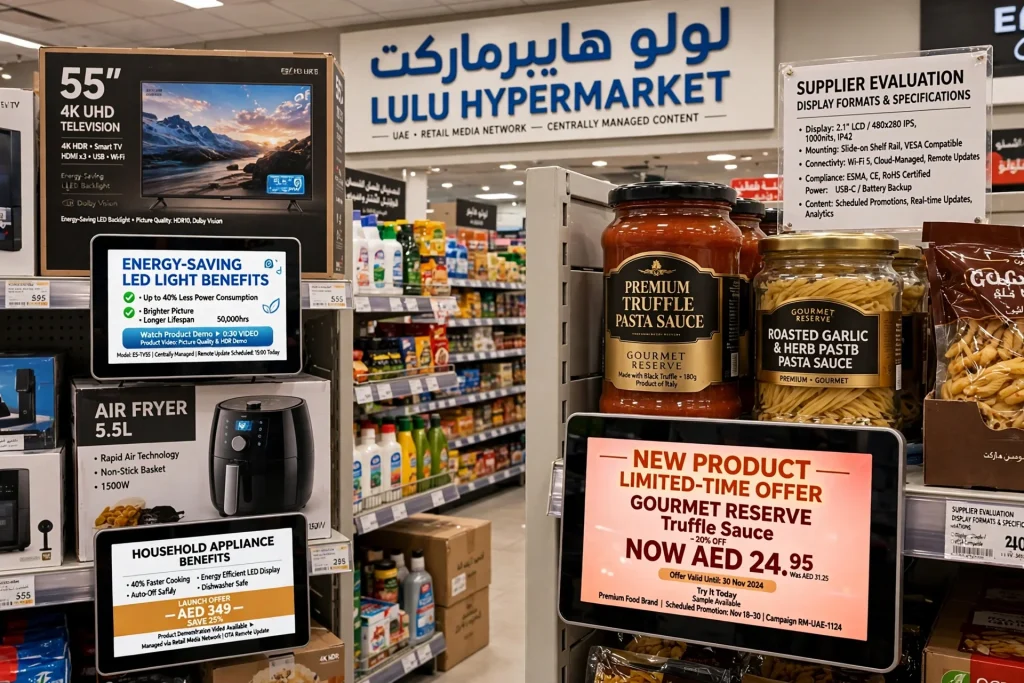
These displays help retailers communicate the reasons to buy a product rather than simply showing its price. For example, a digital shelf talker in an electronics store can demonstrate a television’s picture quality, highlight energy-saving features of an LED light, or explain the benefits of a particular household appliance. In a supermarket, it can promote a new product, highlight a limited-time offer, or introduce a premium food brand.
Digital shelf talker displays may use LCD, LED, or other digital screen technologies, depending on their size, brightness, resolution, and intended application. Some systems support centrally managed content, scheduled promotions, remote updates, and integration with retail media networks.
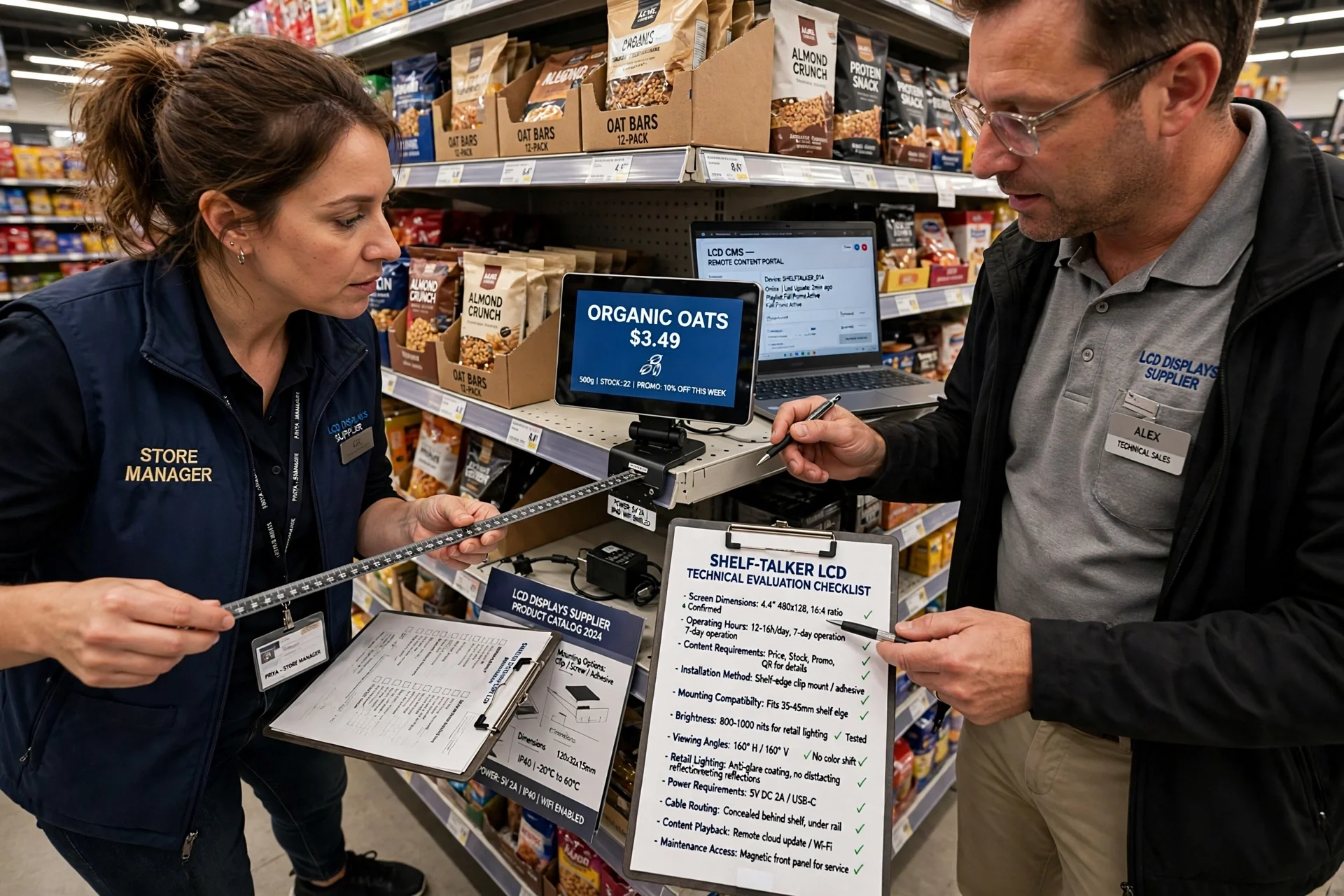
For businesses looking to introduce this technology, working with a Digital Shelf Talker Displays Supplier can help with evaluating suitable display formats, screen specifications, mounting options, and commercial requirements for a particular retail environment.
Electronic Shelf Labels vs Digital Shelf Talker Displays: Key Differences
The primary difference between electronic shelf labels and digital shelf talker displays is their purpose. ESLs are designed mainly for price communication and operational accuracy, whereas digital shelf talkers are designed primarily for visual merchandising, advertising, and shopper engagement.
Electronic shelf labels generally display concise, frequently updated information using low-power screens. Digital shelf talkers can deliver richer visual communication through colour, motion, graphics, and video, depending on the display technology.
The following comparison explains how the two systems differ across common retail applications.
| Feature | Electronic Shelf Labels | Digital Shelf Talker Displays |
|---|---|---|
| Primary purpose | Display prices and product information | Promote products and engage shoppers |
| Typical content | Price, SKU, unit price, barcode | Promotions, videos, product benefits, brand messages |
| Display technology | Commonly e-paper or LCD | Commonly LCD, LED, or other digital screens |
| Visual presentation | Primarily text and simple graphics | Rich graphics, colour, animation, and video where supported |
| Price updates | Often integrated with pricing software | May display prices, but integration depends on the system |
| Power requirements | Often battery-powered, depending on design | Usually requires a continuous power source |
| Content management | Pricing and product information workflows | Promotional and advertising content workflows |
| Best application | Accurate shelf pricing across large inventories | Product promotion and in-store communication |
| Customer engagement | Primarily informational | Primarily promotional and visual |
| Retail media potential | Limited on conventional ESLs | Greater potential for advertising and sponsored content |
| Installation | Shelf-edge rails or dedicated label holders | Shelf mounts, brackets, or dedicated display fixtures |
| Common objective | Operational efficiency | Merchandising performance and customer attention |
The exact capabilities vary by manufacturer and model. Some advanced electronic shelf labels offer colour graphics, while some digital shelf talkers focus on static promotional messages rather than video.
How Electronic Shelf Labels Work in Retail Stores
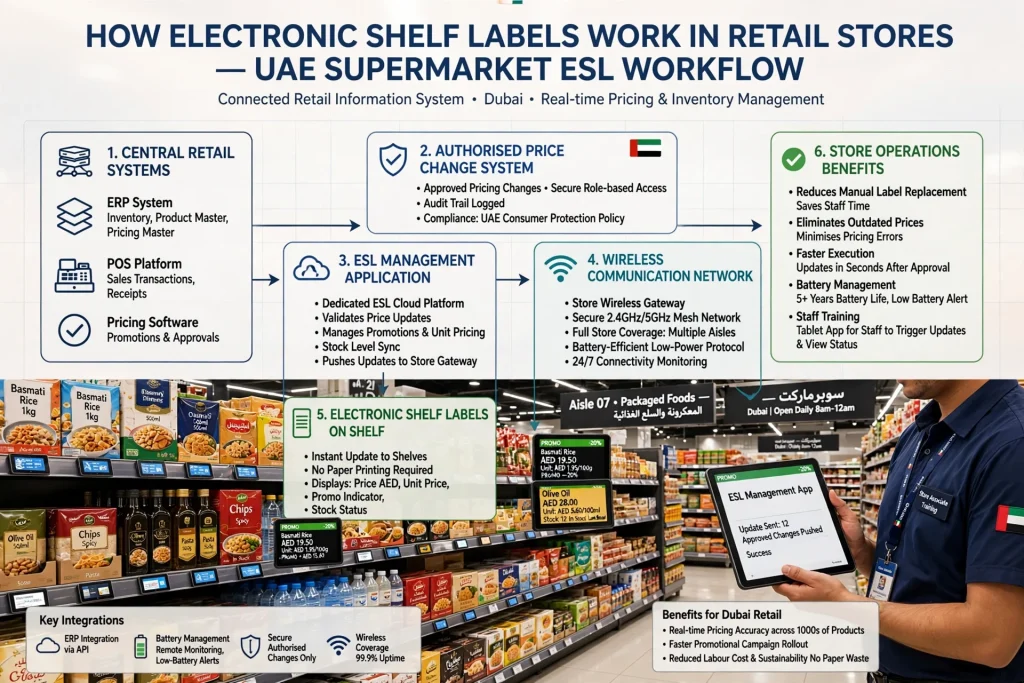
Electronic shelf labels operate through a connected retail information system. Product prices and other relevant details are maintained in pricing software, a POS platform, an ERP system, or a dedicated ESL management application. When an authorised price change occurs, the system communicates the updated information to the appropriate electronic labels.
For example, a supermarket in Dubai may have thousands of packaged food products distributed across multiple aisles. When management changes the price of a particular product, an integrated electronic shelf label system can update the corresponding shelf display without requiring staff to print and replace individual paper labels.
This approach can reduce repetitive manual work, minimise the risk of outdated shelf prices, and support faster execution of approved pricing changes. Retailers can also use electronic labels to display unit pricing, promotional indicators, product identifiers, and selected stock information where the system supports these features.
However, electronic shelf labels do not eliminate the need for accurate product data, system monitoring, or legal compliance. Retailers must ensure that shelf information, promotional conditions, and checkout prices remain consistent. Integration quality, wireless coverage, battery management, and staff training all influence the effectiveness of an ESL deployment.
How Digital Shelf Talker Displays Improve In-Store Marketing
Digital shelf talker displays work as compact digital merchandising tools that bring promotional communication directly to the point of purchase. Instead of relying entirely on packaging or printed signs, retailers can present visual information where shoppers are already evaluating competing products.
A display beside a household appliance could highlight energy efficiency, warranty information, key specifications, or a special offer. A screen near a cosmetics product could communicate application instructions, product benefits, or a new product launch. In an electronics department, digital content could compare product features or explain technical specifications in a more accessible format.
Digital shelf talkers are particularly useful when product differentiation matters. If several products have similar packaging, a well-designed display can explain why one option may be suitable for a particular customer need.
Retailers can also schedule content for different campaigns, subject to the capabilities of their display management system. For example, a store may promote seasonal products during a holiday period and replace that content with a different campaign afterward. Remote content management can reduce the need for repeated physical sign replacement, although displays still require maintenance and content oversight.
The strongest results typically come from relevant messaging, readable screen layouts, clear calls to action, and promotional claims that customers can easily verify.
Which Technology Is Better for Supermarkets and Grocery Stores?
For supermarkets, electronic shelf labels are particularly valuable when price accuracy and large-scale product management are the main priorities. Grocery retailers frequently handle high product volumes, price changes, promotional schedules, and products sold in different quantities. Electronic labels can help centralise shelf-price updates and reduce dependence on manually printed labels.
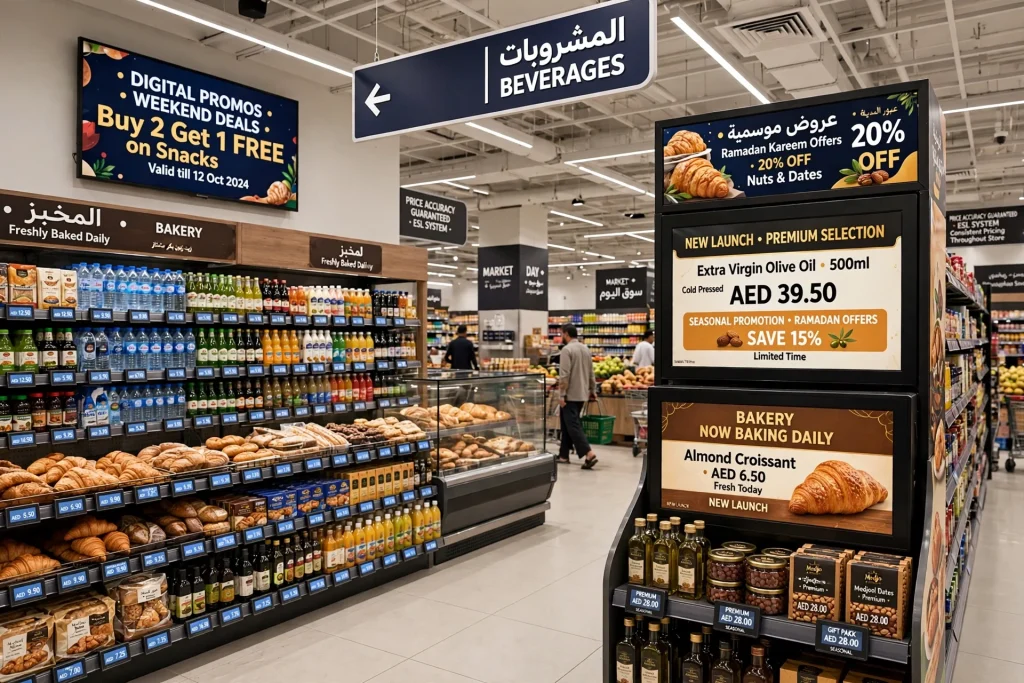
Digital shelf talker displays serve a different role in the same environment. They can draw attention to premium products, seasonal promotions, new launches, bakery items, beverages, and selected promotional endcaps. A digital screen can explain a product’s features or communicate an offer more prominently than a small price label.
A supermarket may therefore benefit from using both technologies. ESLs can provide consistent pricing information throughout the store, while digital shelf talkers can be placed selectively in high-value categories or promotional areas.
The best deployment depends on store size, product turnover, available infrastructure, merchandising objectives, and budget. A small convenience store may prioritise electronic price labels for frequently changing products, whereas a larger supermarket may combine shelf labels with digital promotional screens in selected aisles.
Which Technology Is Better for Electronics and Lighting Retailers?
Electronics and lighting retailers often need to explain technical specifications, product compatibility, energy consumption, warranty coverage, and differences between competing models. Electronic shelf labels can display essential details such as price, model number, or selected specifications, helping shoppers identify the correct product.
Digital shelf talker displays can communicate more detailed product benefits. In an LED lighting showroom, for example, a screen could explain colour temperature, lumen output, beam angle, colour rendering index (CRI), energy efficiency, and suitable applications for different lighting products.
For televisions, a display could highlight resolution, screen size, smart features, and connectivity. For electrical accessories, it could communicate installation requirements, compatibility, or safety-related product information.
This makes digital shelf talkers particularly useful in product categories where shoppers compare specifications before purchasing. The retailer can present concise, visually organised information without relying exclusively on sales staff or lengthy printed product cards.
In Dubai and Sharjah, electronics showrooms, lighting suppliers, and specialist retailers can evaluate these displays for product demonstrations, showroom merchandising, and brand communication. The choice should reflect the amount of information customers need, the available shelf space, and the level of visual interaction appropriate to the product.
Electronic Shelf Labels vs Digital Shelf Talkers: Cost and Return on Investment
The total cost of ownership differs between electronic shelf labels and digital shelf talker displays because the technologies support different business functions.
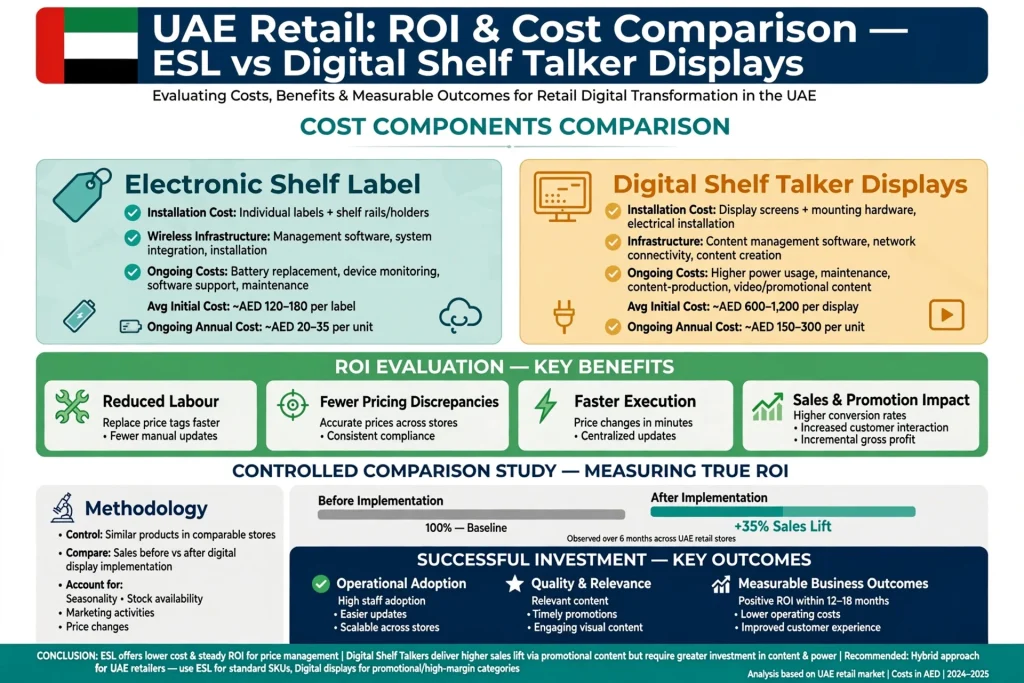
An ESL installation typically involves the cost of individual labels, shelf rails or holders, wireless infrastructure, management software, system integration, installation, and ongoing maintenance. Depending on the solution, retailers may also need to plan for battery replacement, device monitoring, and software support.
Digital shelf talker displays require a different investment. Costs can include the screens, mounting hardware, electrical installation, content management software, network connectivity, content creation, and maintenance. Displays used for video or continuously changing promotional content may have higher power and content-production requirements than simple electronic labels.
Return on investment should be evaluated against the problem each technology is intended to solve. For ESLs, useful measures include reduced labour spent replacing price tags, fewer pricing discrepancies, and faster execution of price changes. For digital shelf talkers, retailers can assess product sales, promotion conversion rates, customer interaction, and incremental gross profit.
For example, a retailer could compare sales of a promoted product before and after installing a digital display while accounting for price changes, seasonality, stock availability, and other marketing activities. A controlled comparison with similar products or stores can provide stronger evidence than relying on sales increases alone.
Neither technology guarantees higher revenue. A successful investment depends on implementation quality, the relevance of the content, operational adoption, and measurable business outcomes.
Integration with POS, ERP, and Retail Media Systems
System integration is an important consideration when choosing either technology. Electronic shelf labels commonly connect with retail pricing systems to ensure that shelf information reflects approved product data. Integration may involve POS software, ERP platforms, product information management systems, inventory applications, and dedicated ESL management tools.
Digital shelf talker displays may connect to a content management system (CMS) that controls which messages appear on each screen and when they are displayed. More advanced implementations can support centrally managed campaigns, store-specific content, and retail media workflows.
For instance, a retail chain operating in Dubai, Abu Dhabi, and Sharjah may want to display different promotional campaigns according to product availability, store location, or local marketing priorities. A centralised content management platform can help coordinate these campaigns, provided the software supports the required controls and integrations.
Retail media is another important consideration. Digital shelf talkers may offer opportunities for brands to sponsor product promotions at the point of purchase. Retailers can potentially package screen placements into broader advertising campaigns and evaluate their performance using sales and campaign data.
Before purchasing either system, businesses should confirm compatibility with their existing infrastructure, available APIs, supported content formats, network requirements, and data security policies. They should also establish who is responsible for maintaining pricing data, approving promotional content, and troubleshooting technical issues.
Using Both Technologies Together in Smart Retail Environments
Electronic shelf labels and digital shelf talker displays are not competing solutions in every situation. In many stores, they complement one another by supporting different stages of the shopping decision.
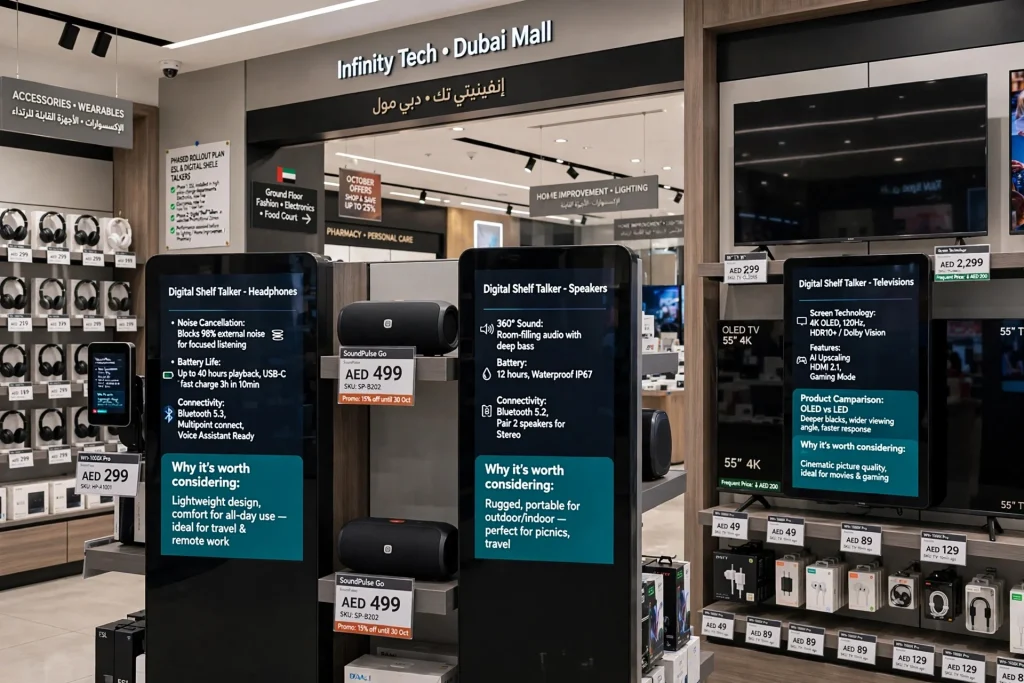
An electronic shelf label provides essential information such as the current price and product identifier. A nearby digital shelf talker can explain the product’s benefits, show a demonstration, or highlight an eligible promotion. Together, the displays can help shoppers understand both what a product costs and why it may be worth considering.
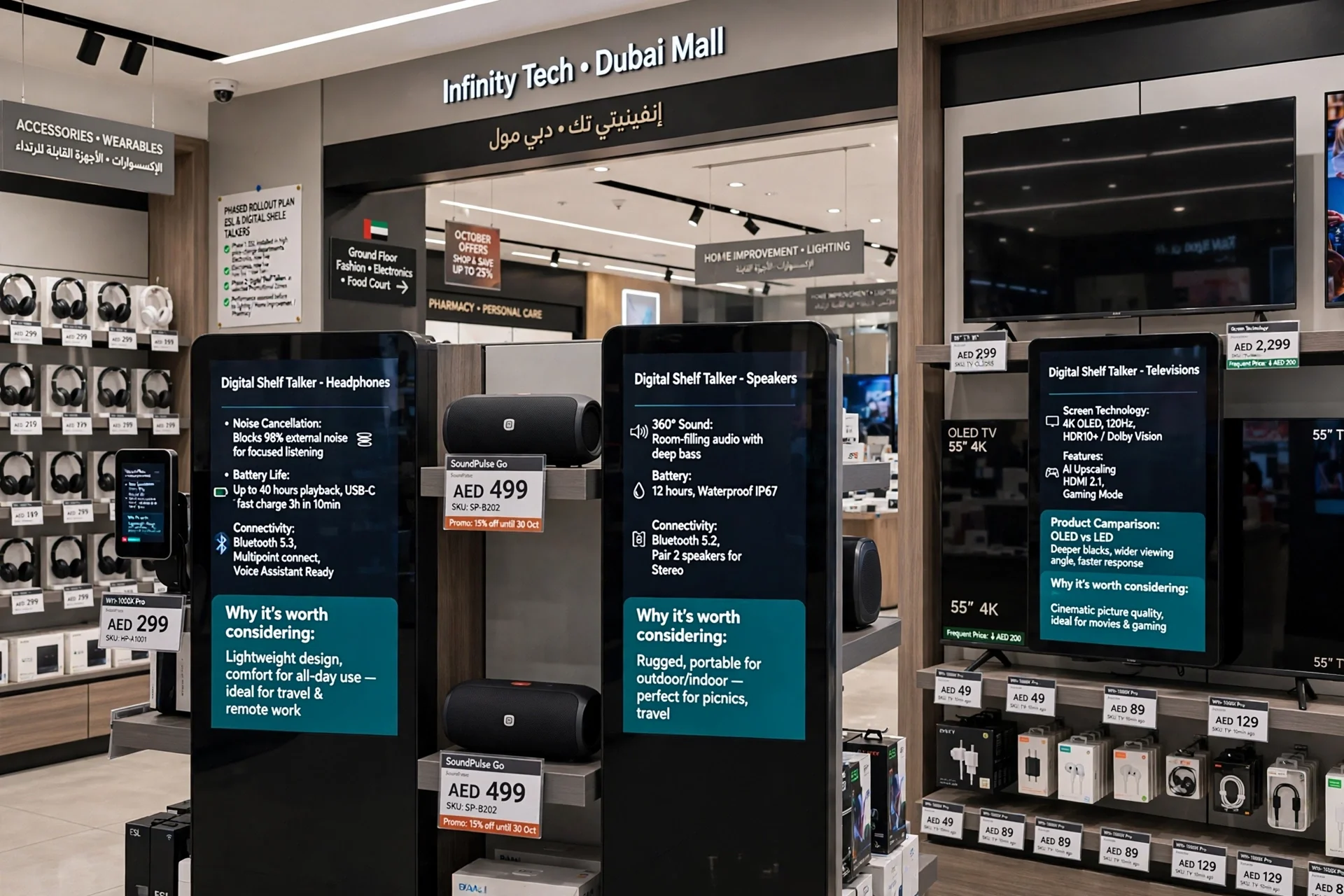
Consider a consumer electronics store in a Dubai shopping mall. Electronic labels can display prices for headphones, speakers, televisions, and accessories. Digital shelf talkers can highlight noise cancellation, battery life, connectivity, screen technology, or product comparisons. This creates a more informative shopping environment without requiring every detail to fit on a conventional shelf tag.
A similar approach can be applied to lighting showrooms, pharmacies, home improvement stores, and specialist retailers. ESLs handle routine pricing communication, while digital displays focus on selected products where additional explanation or promotional visibility is useful.
A phased rollout is often practical. Retailers can begin with electronic labels in departments that experience frequent price changes and introduce digital shelf talkers in selected promotional zones. Performance can then be assessed before expanding the installation.
Electronic Shelf Labels and Digital Shelf Talkers in the UAE Retail Market
The UAE offers a relevant environment for digital shelf communication because its retail sector includes large supermarkets, neighbourhood grocery stores, shopping malls, electronics showrooms, pharmacies, and specialist lighting outlets. Retail businesses in Dubai, Abu Dhabi, Sharjah, Ajman, and Ras Al Khaimah may have different operational requirements depending on store size, customer traffic, product range, and promotional activity.
In high-traffic locations such as Dubai Mall, Mall of the Emirates, and City Centre Mirdif, digital shelf talkers may be considered for selected product categories where visual merchandising can support product discovery. These examples represent potential applications rather than confirmation that any specific retailer currently uses this technology.
Supermarkets and grocery operators may prioritise electronic shelf labels to manage pricing across extensive product ranges. Electronics stores, cosmetics retailers, and lighting showrooms may find digital shelf talkers useful for communicating product specifications and promotional messages.
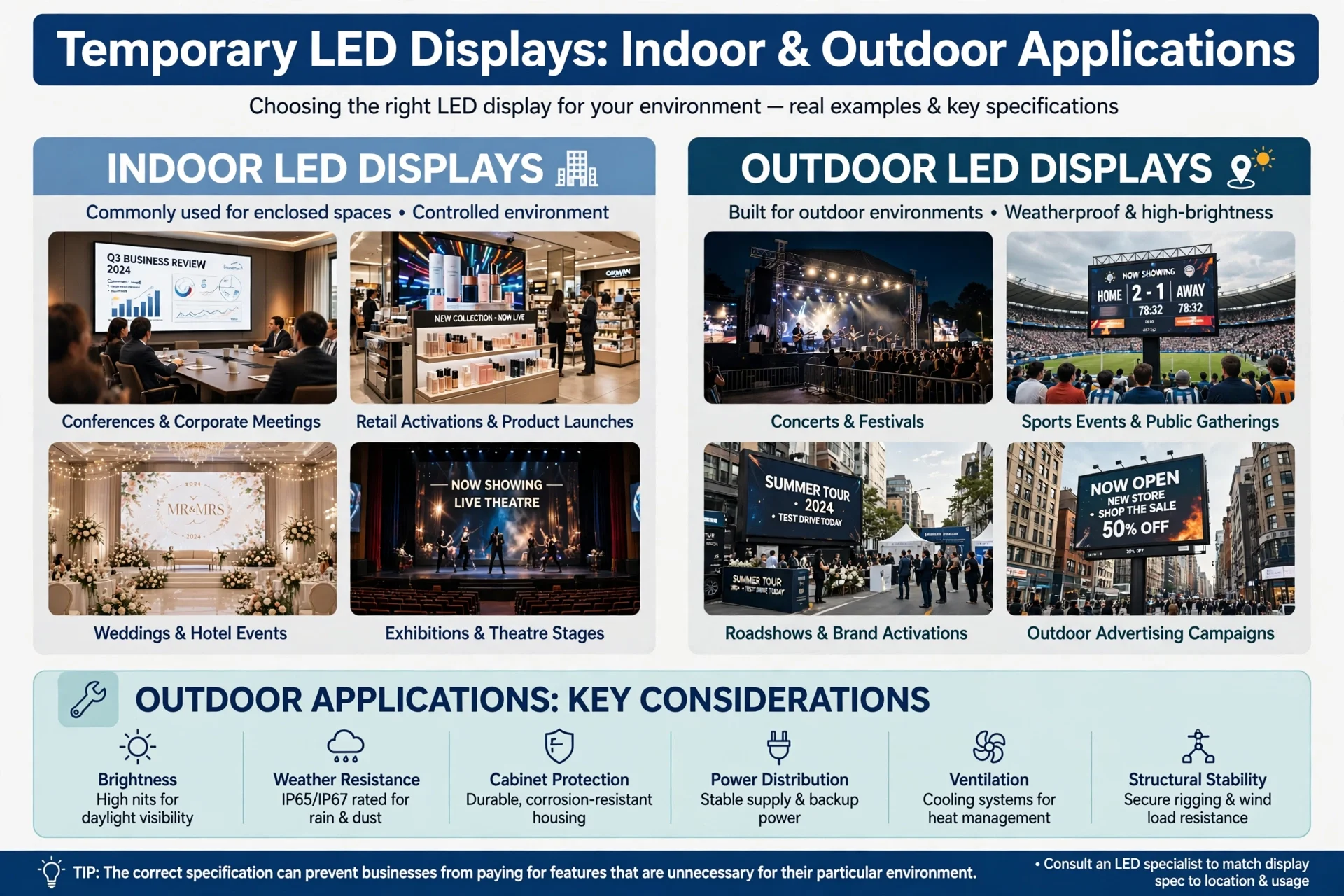
UAE retailers should also consider the local operating environment when specifying hardware. Screen brightness, viewing angles, ventilation, mounting stability, electrical safety, network reliability, and ease of maintenance can influence performance. Where displays are installed near entrances, windows, or areas exposed to strong lighting, visibility should be assessed under actual store conditions.
Retailers should check product warranties, installation support, spare-part availability, and software compatibility before selecting a supplier. Businesses operating multiple branches should also consider whether the system can support centralised content management and consistent deployment across locations.
How to Choose the Right Digital Shelf Display Solution
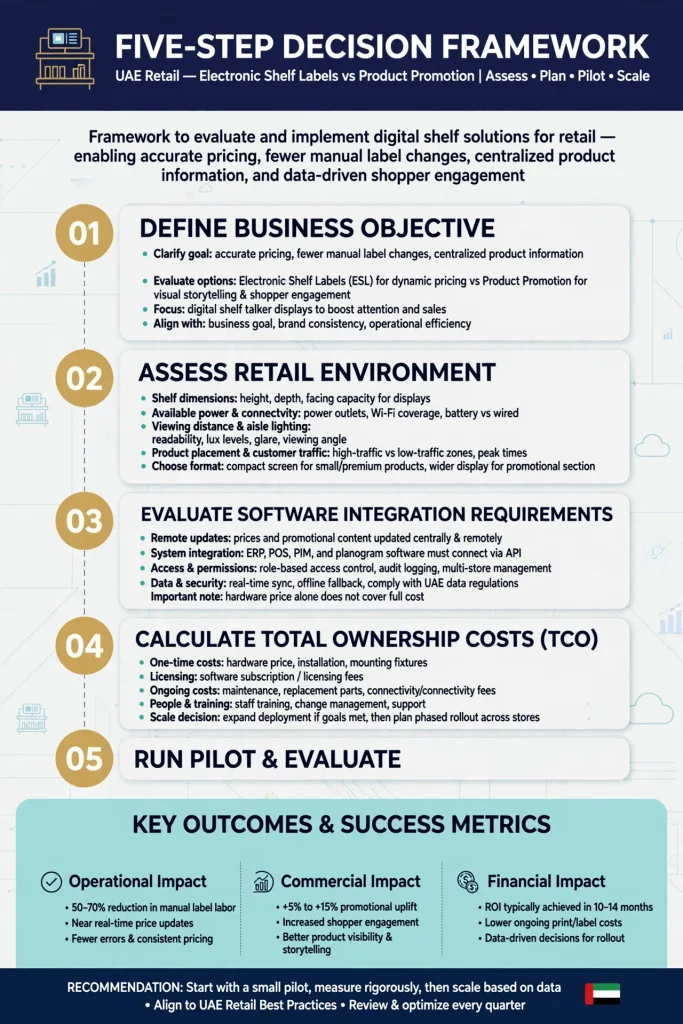
The first step is to define the main business objective. If the priority is accurate pricing, fewer manual label changes, and centralised product information, electronic shelf labels are usually the more appropriate starting point. If the priority is product promotion, visual storytelling, and shopper engagement, digital shelf talker displays may offer greater value.
The second step is to assess the retail environment. Shelf dimensions, available power, viewing distance, aisle lighting, product placement, and customer traffic all influence the suitable display format. A compact screen may work well beside a small premium product, while a wider display may be more appropriate for a promotional section.
The third step is to evaluate software and integration requirements. Retailers should confirm how prices or promotional content will be updated, whether updates can be scheduled remotely, which systems can be integrated, and how access permissions will be managed.
The fourth step is to calculate total ownership costs rather than comparing hardware prices alone. Installation, licensing, content production, maintenance, replacement parts, and staff training should be included.
Finally, retailers should run a pilot in a selected department. Establish baseline measurements, define success criteria, monitor technical reliability, and compare results with a similar area where the technology has not been introduced. This provides practical evidence for deciding whether to expand the deployment.
Common Mistakes to Avoid When Selecting Shelf Display Technology
One common mistake is choosing a digital display solely because it looks modern. A screen does not automatically improve customer engagement or increase sales. Its message must be relevant, readable, and connected to a genuine customer need.
Another mistake is expecting electronic shelf labels to replace every promotional sign. ESLs are primarily designed for concise product and pricing information. While some models support colour and promotional graphics, they may not deliver the same visual impact as a dedicated digital screen.
Retailers should also avoid overlooking software compatibility. A display system that cannot integrate effectively with existing pricing or content workflows may create additional manual work rather than reducing it.
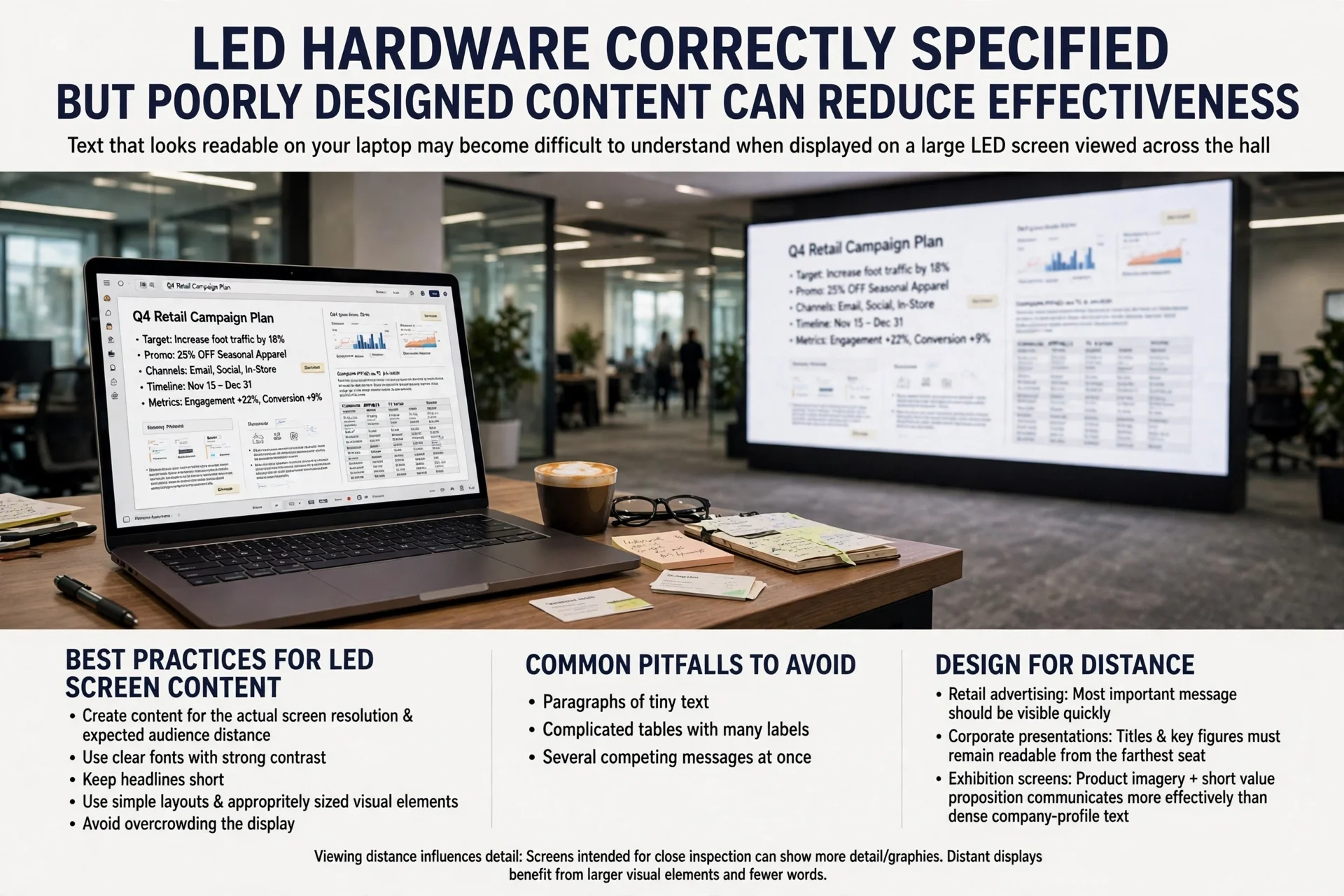
Poor screen placement can further limit performance. Displays that are too small, positioned at awkward angles, or crowded by product packaging may go unnoticed. Content that changes too frequently, contains excessive text, or uses unclear promotional claims can also reduce usefulness.
Finally, retailers should not evaluate performance using impressions alone. More meaningful measurements include pricing accuracy, employee time saved, product conversion rates, incremental gross profit, system uptime, and the cost of maintaining the installation.
Frequently Asked Questions
Are electronic shelf labels the same as digital shelf talkers?
No. Electronic shelf labels primarily display product prices and essential product information. Digital shelf talkers use digital screens to communicate promotional messages, product benefits, demonstrations, and advertising content. Some advanced models may overlap in functionality, but their primary purposes differ.
Can digital shelf talker displays show prices?
Yes. A digital shelf talker can display prices, discounts, promotional offers, and product details if its software and configuration support these features. However, retailers should ensure that displayed prices remain consistent with the checkout system and applicable pricing requirements.
Do electronic shelf labels require Wi-Fi?
Not necessarily. Many electronic shelf label systems use dedicated wireless communication infrastructure rather than standard store Wi-Fi. The exact requirements depend on the manufacturer, communication protocol, and system architecture.
Are electronic shelf labels better for supermarkets?
They are often a strong choice for supermarkets that need to manage prices across large product inventories. Digital shelf talkers can complement ESLs by highlighting promotions, new products, and selected high-margin items. The most appropriate combination depends on the supermarket’s objectives and budget.
Are digital shelf talker displays suitable for small retail stores?
Yes. Small retailers can install a limited number of digital shelf talkers near featured products, promotional displays, or high-value merchandise. A targeted installation can be more practical than deploying screens throughout the entire store.
Can digital shelf talker content be updated remotely?
Many network-connected digital shelf talker systems support remote content management. However, scheduling, real-time updates, analytics, and multi-store controls depend on the display hardware and software platform selected.
Which technology offers a better return on investment?
Neither technology is universally better. Electronic shelf labels may provide value through reduced manual pricing work and improved price consistency. Digital shelf talkers may provide value through improved product communication and measurable promotional performance. Retailers should compare each system against its specific business objectives.
Can both systems be installed in the same store?
Yes. Electronic shelf labels can manage routine pricing information, while digital shelf talkers can support product promotion and customer education. Using both technologies allows retailers to address operational efficiency and merchandising needs separately.
Conclusion: Choosing Between Electronic Shelf Labels and Digital Shelf Talker Displays
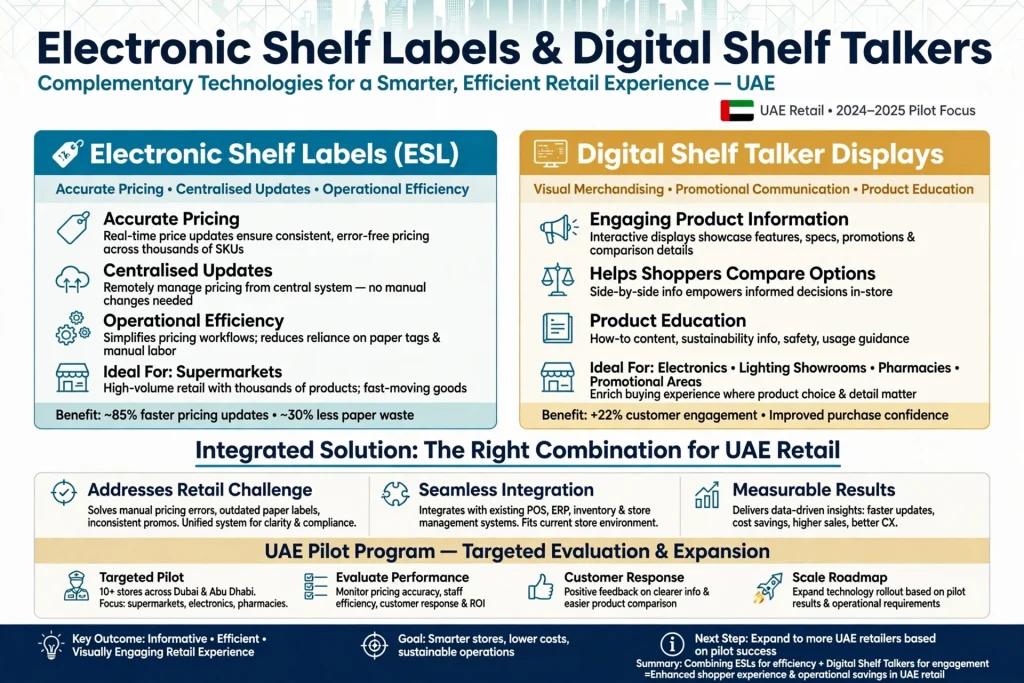
Electronic shelf labels and digital shelf talker displays serve different but complementary purposes in modern retail. ESLs focus on accurate pricing, centralised updates, and operational efficiency, while digital shelf talkers focus on visual merchandising, promotional communication, and product education.
For supermarkets and retailers managing thousands of products, electronic shelf labels can simplify pricing workflows and reduce reliance on paper tags. For electronics stores, lighting showrooms, pharmacies, and promotional retail areas, digital shelf talker displays can make product information more engaging and help shoppers compare available options.
The most effective solution is the one that addresses a clearly defined retail challenge, integrates with existing systems, fits the store environment, and delivers measurable results. UAE retailers can begin with a targeted pilot, evaluate performance, and expand the technology according to customer response and operational requirements. By selecting the right combination of shelf display technologies, businesses can build a more informative, efficient, and visually engaging retail experience.