Trade shows remain one of the most effective marketing channels for companies that want to generate qualified leads, launch new products, strengthen brand recognition, and build long-term business relationships. Unlike online advertising, exhibitions provide face-to-face interaction where potential customers can experience products, speak directly with industry experts, and compare multiple suppliers within a single venue.
Across the UAE, exhibitions hosted at Dubai World Trade Centre (DWTC), Dubai Exhibition Centre (Expo City Dubai), Abu Dhabi National Exhibition Centre (ADNEC), Festival Arena Dubai, Madinat Jumeirah Conference Centre, and other leading venues attract thousands of business visitors every year. International events such as GITEX Global, The Big 5 Global, Arab Health, Gulfood, INDEX Dubai, Cityscape Global, Beautyworld Middle East, Dubai Airshow, Seamless Middle East, and Middle East Energy demonstrate how competitive exhibition marketing has become.
With hundreds of exhibitors competing for attention inside the same exhibition hall, attracting visitors is no longer achieved through printed banners alone. Companies now invest in immersive digital experiences that immediately capture attention, communicate brand value, and encourage visitors to stop at their booths.
Among all exhibition technologies available today, commercial LED screens have become one of the most influential tools for increasing booth traffic. Their ability to display dynamic content, high-resolution visuals, live demonstrations, interactive presentations, and engaging brand stories makes them an essential component of modern exhibition stand design.
However, successful exhibition marketing is not simply about installing the largest LED screen available. Professional exhibitors understand that visitor psychology, content strategy, booth architecture, lighting, traffic flow, and digital communication must work together to create an unforgettable experience.

Understanding Why Visitors Choose One Booth Over Another
One of the biggest misconceptions in exhibition marketing is believing that visitors stop because of company size.
In reality, exhibition attendees rarely know which companies are market leaders before entering an exhibition hall.
Instead, people respond to visual stimulation.
Within only a few seconds, visitors subconsciously evaluate dozens of exhibition booths based on movement, lighting, colours, openness, digital content, staff interaction, and overall presentation.
Static printed graphics quickly become part of the background because the human brain naturally filters repetitive visual information.
Movement immediately interrupts this filtering process.
LED displays introduce motion, changing colours, product demonstrations, customer testimonials, animations, and live presentations that instinctively attract attention from people walking nearby.
This psychological response explains why professionally designed exhibition booths consistently receive higher visitor engagement than neighbouring booths relying entirely on traditional printed displays.
Successful exhibitors understand that attracting attention is the first stage of the customer journey—not the final objective.
The First Five Seconds Determine Visitor Decisions
Experienced exhibition designers often discuss the “five-second rule.”
Most visitors decide whether to approach a booth within approximately five seconds.
During this brief period they evaluate several questions without consciously thinking:
- Is this company relevant to me?
- What products are being offered?
- Does this booth appear professional?
- Is there something worth seeing?
- Should I stop or continue walking?
LED displays answer these questions almost instantly.
Instead of expecting visitors to read lengthy printed brochures, digital screens communicate products through motion graphics, short promotional videos, animated product features, before-and-after comparisons, manufacturing processes, customer success stories, and real-world project footage.
A visitor walking twenty metres away can immediately understand the company’s industry before reaching the stand.
That immediate clarity significantly increases booth visitation.

Motion Naturally Captures Human Attention
Human vision evolved to detect movement long before written communication existed.
This biological characteristic continues influencing buying behaviour today.
Moving digital content consistently attracts greater visual attention than static printed materials.
Professional exhibition marketers use this principle carefully.
Rather than displaying continuously changing advertisements, successful exhibitors develop structured content designed specifically for exhibition environments.
This often includes:
Product demonstrations.
Installation videos.
Manufacturing processes.
Case studies.
Customer testimonials.
Animated technical drawings.
Project timelines.
Corporate introductions.
Live event coverage.
Industry statistics.
Each piece of content communicates expertise while encouraging visitors to remain engaged for longer periods.
Longer viewing times frequently translate into more conversations with sales representatives.
LED Displays Transform Booth Architecture
Modern exhibition stands increasingly treat LED displays as architectural elements rather than simply presentation tools.
Large video walls become feature walls.
Curved LED screens wrap around product displays.
Transparent LED displays maintain openness while delivering digital content.
Suspended LED cubes remain visible across exhibition halls.
Fine pixel pitch LED panels create premium corporate environments suitable for luxury brands, technology companies, manufacturers, healthcare organizations, financial institutions, and government exhibitions.
Rather than decorating booths after construction, designers integrate digital displays into the entire architectural concept.
This creates cleaner, more contemporary exhibition environments that encourage visitors to explore further.

Dynamic Content Keeps Visitors Engaged
Attracting visitors represents only the beginning of successful exhibition marketing.
The next objective is maintaining visitor attention long enough for meaningful conversations to begin.
Digital displays continuously refresh the visitor experience.
Instead of repeating one static image throughout the exhibition, LED screens present scheduled content throughout the day.
Morning visitors may see corporate introductions.
Afternoon sessions can feature technical product demonstrations.
Live presentations may interrupt scheduled content.
Customer interviews.
Factory tours.
Installation projects.
3D animations.
Safety demonstrations.
Behind-the-scenes manufacturing footage.
Interactive product visualizations.
This constantly evolving content encourages repeat visits while preventing visual fatigue among attendees.
Live Product Demonstrations Create Stronger Trust
Visitors rarely purchase complex products after seeing a printed brochure.
They prefer understanding how products perform in real-world environments.
LED displays allow companies to demonstrate products operating inside factories, commercial buildings, hospitals, airports, shopping malls, hotels, warehouses, manufacturing plants, educational institutions, sports arenas, transportation hubs, and industrial facilities.
Rather than describing capabilities verbally, companies visually prove their expertise.
Construction companies display completed projects.
Interior designers showcase before-and-after transformations.
Lighting suppliers demonstrate illumination performance.
Engineering companies present installation procedures.
Manufacturers explain production quality.
These visual demonstrations build credibility far more effectively than static product catalogues.

Interactive Experiences Increase Booth Engagement
Modern exhibitions increasingly emphasize visitor participation rather than passive observation.
Touch-enabled displays, interactive LED walls, digital product configurators, QR code integration, augmented reality presentations, and virtual walkthroughs encourage visitors to actively engage with brands.
Instead of watching a presentation, visitors become participants.
They explore product specifications.
Browse project portfolios.
View completed installations.
Request quotations.
Register for demonstrations.
Download technical brochures.
Schedule meetings.
This active engagement significantly increases information retention while generating higher-quality sales leads.
Professional Booth Design Reflects Brand Quality
Visitors frequently associate exhibition stand quality with overall company standards.
A professionally designed booth communicates reliability, attention to detail, and technical competence.
High-resolution LED displays contribute significantly to this perception.
Fine pixel pitch technology delivers sharp text, detailed graphics, vivid colours, and exceptional image clarity even when viewed from short distances.
Combined with premium flooring, architectural lighting, custom joinery, elegant furniture, integrated audio systems, and well-trained exhibition staff, LED displays become part of a complete customer experience rather than standalone technology.
Companies participating in exhibitions at Dubai World Trade Centre, Dubai Exhibition Centre, Business Bay, Downtown Dubai, DIFC, Abu Dhabi, and Sharjah increasingly recognize that digital presentation quality directly influences visitor confidence.

Strategic LED Screen Placement Maximizes Visitor Flow
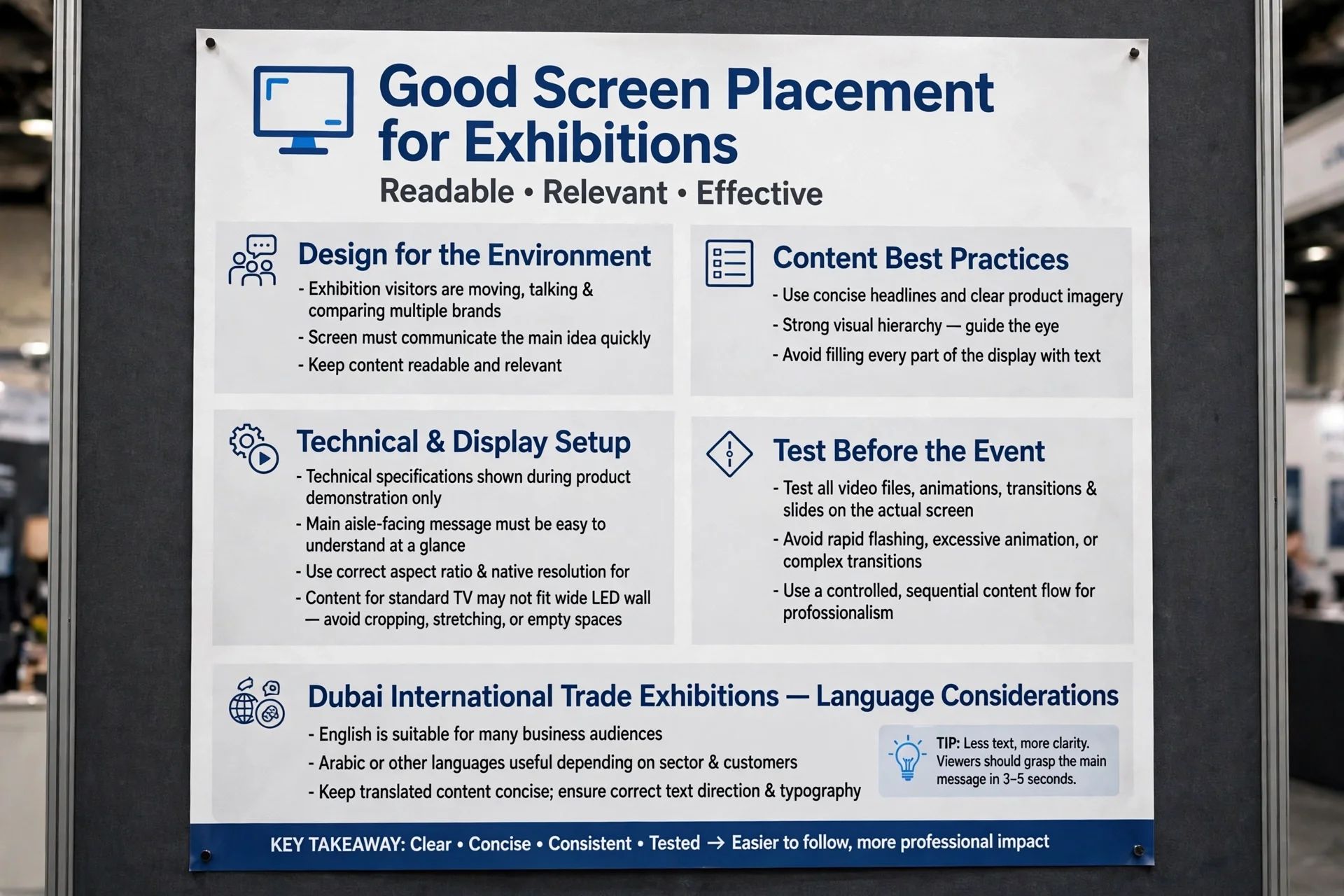
One of the most overlooked factors in exhibition success is the placement of LED screens. Many exhibitors invest in premium displays but position them where they cannot effectively attract passing visitors. Professional exhibition designers understand that the location, viewing angle, screen height, and content direction all influence booth traffic.
Large LED screens positioned at booth corners or elevated above the exhibition stand increase visibility from multiple aisles simultaneously. Visitors approaching from different directions can immediately identify the company’s products and services before reaching the booth.
For island stands, suspended LED cubes or overhead digital displays provide 360-degree visibility across the exhibition hall. Inline booths benefit from vertical LED walls that create strong visual landmarks, making the stand easier to locate in crowded environments.
Screen placement should never block product displays or staff interaction. Instead, digital displays should guide visitors naturally into the booth, creating a welcoming environment where conversations can begin.
Storytelling Through Digital Content Creates Emotional Connections
Many exhibitors focus only on displaying product specifications, yet buying decisions are often influenced by emotion before logic.
Professional exhibition content tells a story rather than presenting isolated facts.
Instead of showing random promotional videos, companies can guide visitors through a complete customer journey.
The presentation may begin by introducing an industry challenge, followed by the company’s innovative solution, real-world implementation, measurable results, customer testimonials, and future developments.
This storytelling approach keeps visitors engaged because it mirrors how people naturally process information.
For example, an LED display manufacturer may begin with the challenges businesses face using traditional signage, demonstrate the installation of high-resolution LED displays, showcase completed projects in shopping malls, airports, hotels, retail stores, corporate offices, and exhibition centres, and conclude with customer success stories.
This sequence builds credibility while encouraging visitors to continue watching until the presentation ends.

Real-Time Content Keeps Exhibition Booths Relevant
Unlike printed graphics, LED displays allow exhibitors to adapt content throughout the event.
Morning sessions may focus on introducing the company.
Afternoon presentations can highlight technical capabilities.
Product launches can be displayed instantly.
Award announcements, keynote presentations, media interviews, social media updates, and visitor testimonials can all become part of the exhibition experience.
If a product demonstration attracts a large audience, nearby LED displays can immediately direct additional visitors toward the presentation area.
Cloud-based Content Management Systems (CMS) enable marketing teams to update digital content remotely without interrupting exhibition activities.
This flexibility allows exhibitors to respond quickly to changing visitor behaviour and event schedules.
Interactive Technology Encourages Visitor Participation
Trade show visitors increasingly expect experiences rather than passive presentations.
Interactive LED displays encourage visitors to become actively involved with the brand.
Touch-enabled product catalogues allow users to explore technical specifications independently.
Interactive maps help visitors navigate large product portfolios.
Digital comparison tools enable customers to evaluate different models side by side.
QR codes displayed on LED screens provide instant access to brochures, product manuals, technical documentation, installation guides, case studies, and contact information.
Visitors can scan information directly onto their smartphones instead of carrying printed materials throughout the exhibition.
This convenience improves customer satisfaction while increasing the likelihood of future engagement.

Live Streaming Demonstrates Transparency
Companies exhibiting at international trade shows often have manufacturing facilities, research centres, or headquarters located elsewhere.
LED displays provide opportunities to connect exhibition visitors with these locations through live streaming.
Manufacturing lines can be shown operating in real time.
Quality inspection procedures become visible.
Research laboratories demonstrate innovation.
Warehouse operations highlight logistics capabilities.
Executive teams can deliver live presentations from different countries.
This transparency builds confidence because visitors see authentic business operations rather than carefully edited promotional videos.
Companies participating in exhibitions at Dubai World Trade Centre (DWTC), Expo City Dubai, and Abu Dhabi National Exhibition Centre (ADNEC) increasingly use live streaming to connect international operations with regional customers.
Product Demonstrations Become More Effective with LED Displays
Complex products are often difficult to explain using brochures alone.
Engineering systems, industrial machinery, architectural materials, commercial lighting, HVAC equipment, digital signage, automation systems, healthcare technology, and manufacturing solutions all benefit from visual demonstrations.
High-resolution LED displays can present exploded technical drawings, animated installation procedures, 3D product models, operational workflows, maintenance processes, and performance comparisons.
Instead of relying entirely on verbal explanations, exhibitors allow visitors to understand products visually.
This reduces confusion while increasing visitor confidence.
Sales representatives also benefit because digital presentations support technical discussions without requiring lengthy explanations.
Social Media Integration Extends Booth Visibility
Exhibition marketing no longer ends inside the exhibition hall.
Visitors frequently photograph impressive booths and share their experiences across LinkedIn, Instagram, Facebook, TikTok, and X.
Dynamic LED displays naturally become popular backgrounds for photographs and short videos because they create visually engaging environments.
Companies can encourage online engagement by displaying event hashtags, live social media feeds, customer testimonials, countdown timers, product launch announcements, and interactive campaigns.
User-generated content extends exhibition visibility beyond physical attendees while increasing online brand awareness.
This combination of physical and digital marketing creates significantly greater reach than traditional exhibition strategies.

Measuring Visitor Engagement Through Digital Technology
One advantage of digital exhibition technology is the ability to evaluate campaign performance.
Marketing teams can analyze content scheduling, visitor interaction patterns, QR code scans, lead generation activities, presentation attendance, and booth engagement throughout the event.
When combined with visitor counting technology, customer relationship management (CRM) systems, lead capture applications, and event analytics platforms, exhibitors gain valuable insights into visitor behaviour.
These insights help optimize future exhibition strategies, improve content quality, and allocate marketing budgets more effectively.
Rather than relying on assumptions, businesses can make decisions supported by measurable performance data.
Creating a Memorable Brand Experience
The most successful exhibition booths are remembered long after the event concludes.
This happens when every design element works together to deliver a consistent brand experience.
LED displays contribute by combining visual storytelling, product education, live demonstrations, customer interaction, and immersive presentation into one seamless environment.
Businesses seeking to maximize exhibition impact often partner with an experienced LED Screens Supplier in Dubai downtown to integrate high-resolution LED displays into custom exhibition stands that attract visitors while supporting meaningful business conversations.
Unlike static signage, professionally integrated LED technology transforms the exhibition booth into a dynamic communication platform that continuously engages audiences throughout the event.

Common Mistakes That Reduce Trade Show Booth Traffic
Many businesses invest heavily in exhibition space, premium booth construction, and marketing campaigns but still struggle to attract visitors because they make fundamental mistakes with their LED display strategy.
One of the most common problems is displaying content that is too long. Exhibition visitors rarely stop to watch a five-minute promotional video while walking through a busy exhibition hall. Successful exhibitors use short, engaging visual sequences that communicate key messages within the first few seconds.
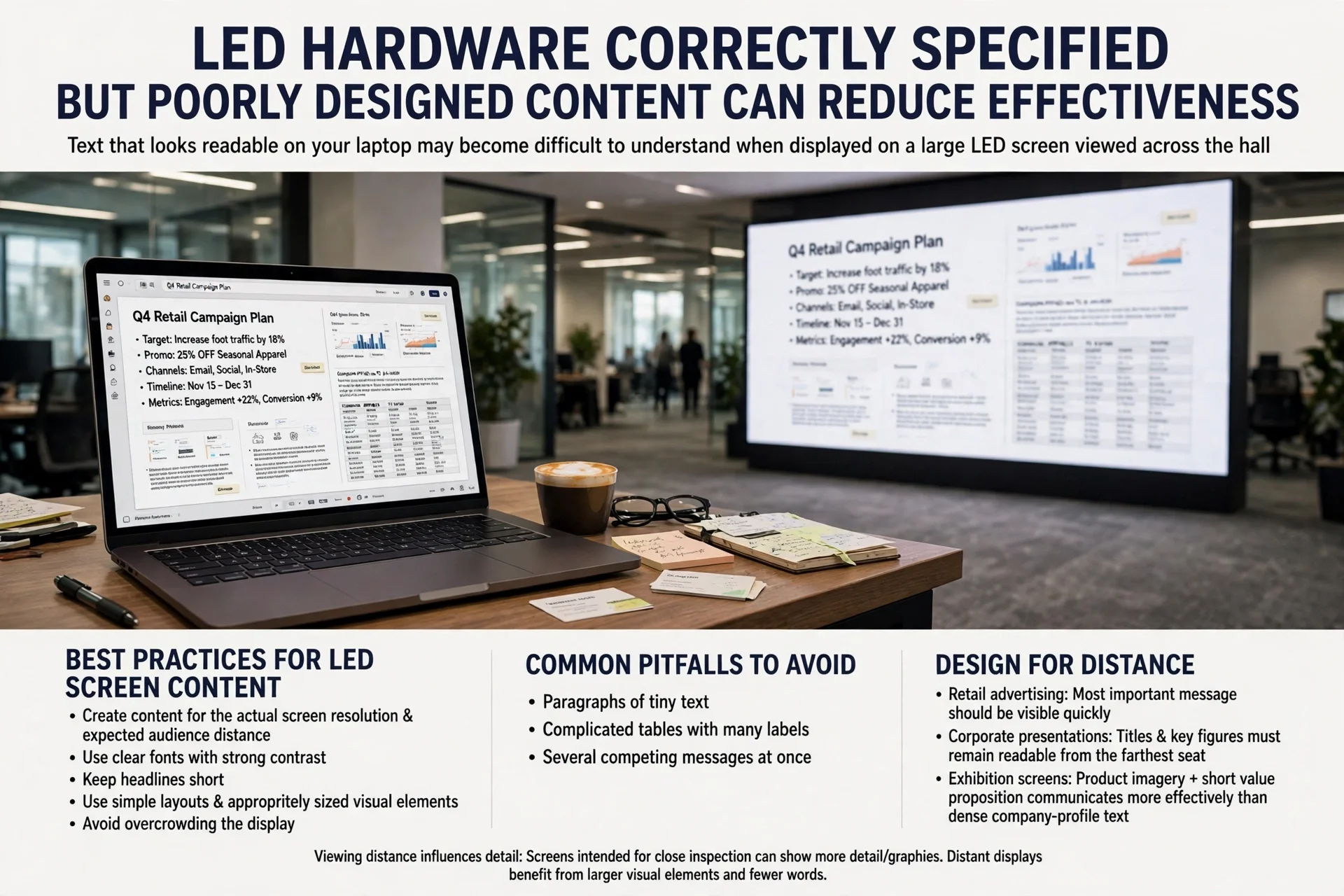
Another frequent mistake is designing content with excessive text. Visitors are moving continuously, often viewing displays from several metres away. Long paragraphs become difficult to read, causing people to continue walking rather than stopping.
Screen brightness also plays an important role. Displays that appear too dim inside brightly illuminated exhibition halls lose their visual impact. Conversely, excessive brightness can become uncomfortable for nearby visitors. Professional calibration ensures excellent visibility while maintaining comfortable viewing conditions.
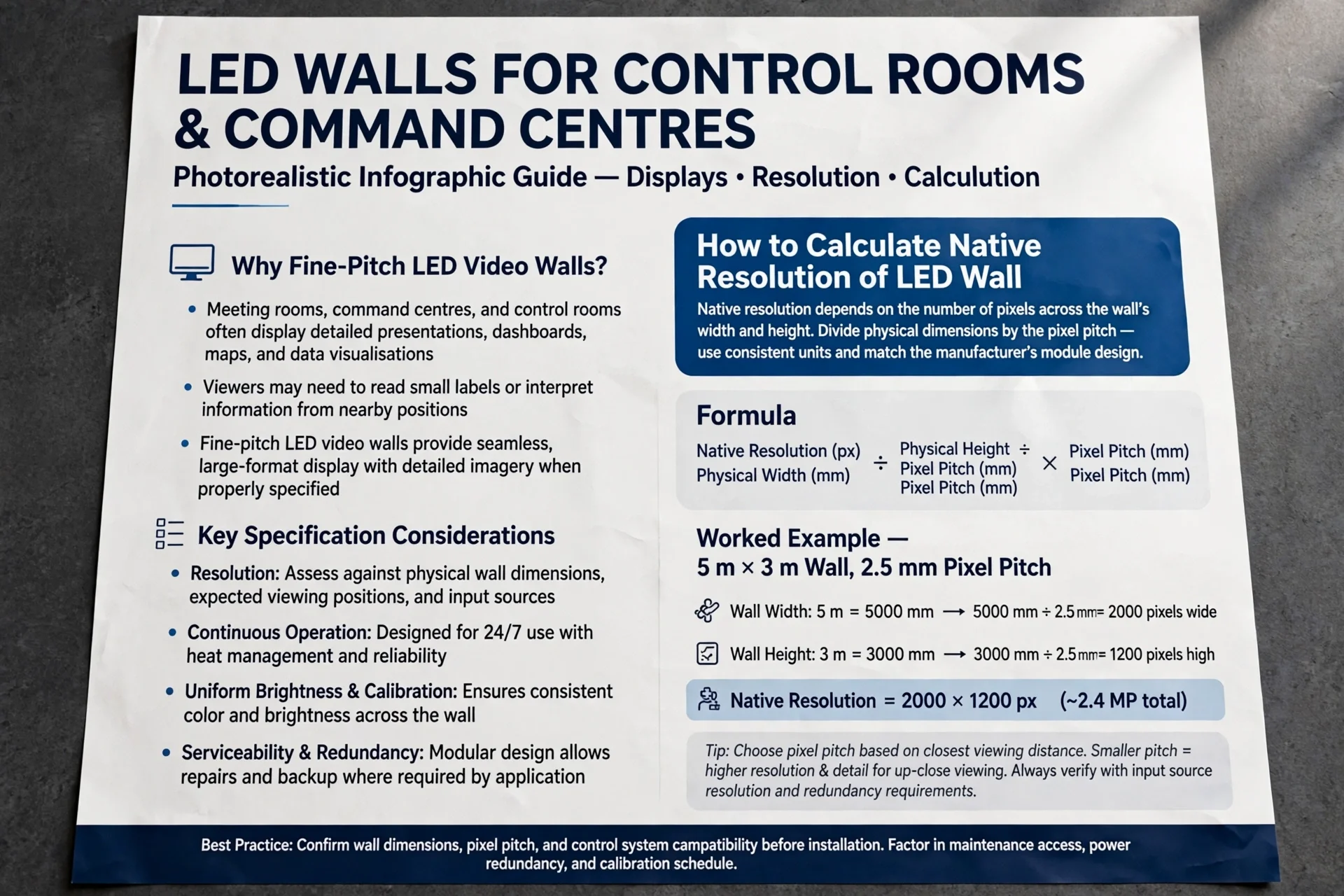
Poor resolution is another issue. Fine Pixel Pitch LED displays provide exceptional image clarity for close viewing distances, whereas displays with larger pixel pitches may appear less sharp when visitors stand near the booth.
Many exhibitors also underestimate the importance of synchronized content. When multiple LED screens display unrelated videos simultaneously, the booth appears visually chaotic. Coordinated content schedules create a more professional and memorable visitor experience.
Artificial Intelligence Is Transforming Exhibition Displays
Artificial Intelligence is beginning to reshape the future of exhibition marketing.
Modern LED display systems can integrate with AI-powered content management platforms that automatically adjust displayed content according to visitor behaviour, event schedules, audience demographics, and time of day.
For example, if large numbers of architects approach the booth, the display may prioritize completed architectural projects. If facility managers become the dominant audience, technical maintenance solutions can automatically receive greater emphasis.
AI-powered analytics can also evaluate visitor dwell time, engagement levels, presentation popularity, and content performance without identifying individual visitors.
These insights help exhibitors continuously improve digital communication throughout multi-day exhibitions.
As AI technology matures, exhibition displays will become increasingly responsive, personalized, and data-driven.

Sustainability Supports Modern Exhibition Design
Sustainability has become a major consideration for companies exhibiting at international trade shows.
Traditional exhibition graphics often require large quantities of printed vinyl, PVC banners, foam boards, acrylic panels, and disposable promotional materials that are discarded after each event.
LED displays significantly reduce this waste.
The same modular LED panels can be reused across multiple exhibitions, product launches, conferences, roadshows, shopping mall activations, retail promotions, and corporate events.
Digital content can be updated instantly without replacing physical graphics.
Modular cabinet systems simplify transportation, installation, maintenance, and future expansion while reducing long-term operational costs.
Energy-efficient LED technology also consumes considerably less electricity than older display technologies, supporting corporate sustainability initiatives.
Many international exhibitors participating at Dubai World Trade Centre, Expo City Dubai, ADNEC, and other UAE venues now prioritize reusable exhibition systems as part of their environmental responsibility strategies.
LED Displays Improve Lead Generation Quality
Attracting visitors alone does not guarantee exhibition success.
The real objective is generating qualified business opportunities.
Professionally planned LED content helps pre-qualify visitors before conversations begin.
By presenting industry-specific applications, completed projects, technical capabilities, certifications, manufacturing standards, and customer case studies, exhibitors naturally attract visitors who have genuine interest in their solutions.
Sales representatives therefore spend more time speaking with qualified prospects rather than answering basic introductory questions.
Interactive registration forms, QR code downloads, appointment scheduling, digital catalogues, and product demonstrations further support lead generation while simplifying visitor follow-up after the exhibition.
Higher-quality conversations frequently result in stronger business relationships and improved return on investment.

Integrating LED Technology with Complete Exhibition Experiences
The most successful exhibition booths combine multiple technologies into one unified visitor experience.
LED video walls work alongside interactive touchscreens, transparent OLED displays, holographic presentations, directional audio systems, smart lighting, digital kiosks, product demonstration areas, augmented reality experiences, and virtual reality applications.
Rather than competing for attention, each technology supports a common communication strategy.
Architectural lighting highlights products.
Digital displays explain technical features.
Interactive stations encourage exploration.
Meeting areas facilitate business discussions.
Storage remains concealed within custom-built structures.
This integrated approach creates exhibition environments that feel organized, engaging, and professionally executed.
Experienced exhibitors understand that outstanding hardware alone cannot guarantee success.
Preparing Content Before the Exhibition Opens
Preparation begins weeks before the exhibition.
Content should be specifically created for trade show environments rather than reusing website videos or social media advertisements.
Successful exhibition content usually includes:
Corporate introduction videos.
Manufacturing capabilities.
Completed projects.
Client testimonials.
Industry certifications.
Product comparison animations.
Installation processes.
Maintenance demonstrations.
Innovation highlights.
Future product roadmaps.
Emergency backup content should also be prepared to accommodate schedule changes, keynote presentations, or unexpected technical issues.
Professional testing ensures videos display correctly across every LED screen before the exhibition officially opens.

The Future of Exhibition Marketing
Trade shows continue evolving alongside digital technology.
Future exhibition booths will increasingly combine artificial intelligence, cloud computing, Internet of Things (IoT) devices, digital twins, real-time analytics, gesture recognition, voice interaction, mixed reality, and immersive LED environments.
Flexible MicroLED technology, transparent displays, curved video walls, ultra-fine pixel pitch panels, and AI-generated personalized presentations will transform how visitors interact with exhibitors.
Exhibitions will become increasingly experience-driven rather than product-driven.
Companies that invest early in advanced digital communication technologies will be better positioned to capture visitor attention in highly competitive exhibition environments.
Conclusion
Trade show success is no longer determined solely by booth size or marketing budget. It depends on how effectively a company communicates its expertise, products, and value proposition during the few seconds available to capture visitor attention. Commercial LED displays have become one of the most powerful tools for achieving this objective because they combine dynamic storytelling, live product demonstrations, interactive experiences, real-time communication, and immersive visual presentation within a single platform.
Across major exhibition venues including Dubai World Trade Centre, Dubai Exhibition Centre at Expo City Dubai, Abu Dhabi National Exhibition Centre, Festival Arena, Madinat Jumeirah Conference Centre, Business Bay, Downtown Dubai, DIFC, Dubai Marina, Sheikh Zayed Road, Al Quoz, Dubai South, Sharjah, and Abu Dhabi, businesses increasingly rely on advanced LED display technology to differentiate themselves from hundreds of competing exhibitors.
When integrated into a carefully planned exhibition strategy, LED screens do far more than display promotional videos. They guide visitor movement, strengthen brand credibility, improve product understanding, support lead generation, encourage meaningful conversations, and create memorable experiences that continue long after the exhibition closes.
Organizations that combine professional booth architecture, strategic content planning, high-resolution LED technology, interactive engagement, and experienced exhibition staff consistently achieve stronger visitor traffic, higher-quality business leads, and greater return on their exhibition investment. This comprehensive approach establishes lasting brand authority while positioning companies for continued success at regional and international trade events.