Pixel pitch is one of the most important specifications to understand when selecting an LED rental screen for an event, exhibition, conference, concert, corporate presentation, product launch, or temporary outdoor installation. It directly influences viewing distance, image sharpness, screen resolution, visual detail, LED display cost, and the overall audience experience.
For event organizers in Dubai and across the UAE, choosing the correct pixel pitch is particularly important because rental LED screens are used in very different environments. A large outdoor festival may require a different LED display configuration from a corporate conference in Downtown Dubai, an exhibition at Dubai World Trade Centre, or a wedding in a hotel ballroom.
Understanding pixel pitch helps businesses select an LED video wall that provides appropriate image quality without unnecessarily paying for a specification that the audience will never notice.
What Is Pixel Pitch in an LED Screen?
Pixel pitch is the distance between the centres of two adjacent LED pixels, usually measured in millimetres.
For example, a P2.5 LED display has a pixel pitch of approximately 2.5 mm, while a P4 LED display has a pitch of approximately 4 mm.
The smaller the number, the closer the LED pixels are positioned to one another.
This generally means:
Smaller pixel pitch = higher pixel density and finer image detail at the same screen size.
Larger pixel pitch means the pixels are farther apart and the display generally requires a greater viewing distance for the image to appear smooth.
Pixel pitch is therefore not simply a measure of screen size. It is a specification that connects screen resolution with viewing distance and application requirements.

Why Pixel Pitch Matters for Rental LED Screens
Rental LED displays are designed for temporary installations where the screen may be assembled, transported, installed and dismantled repeatedly.
The correct pixel pitch affects how the audience perceives:
Text, graphics, faces, product details, video footage, animations and live camera feeds.
If a screen has a pixel pitch that is too large for a close viewing environment, individual pixels may become noticeable.
If an extremely fine pixel pitch is selected for a large outdoor event where viewers are far away, the additional cost may not provide a meaningful visual improvement.
The goal is therefore to match the LED screen specification to the actual event environment.
Pixel Pitch and Viewing Distance
Viewing distance is one of the most important factors when selecting pixel pitch.
A simple principle is:
The closer the audience is to the screen, the smaller the pixel pitch generally needs to be.
A conference room where viewers may sit only a few metres away could benefit from a fine-pitch LED display.
An outdoor concert audience may be tens of metres away, meaning a larger pixel pitch can often provide an appropriate viewing experience.
There is no single pixel pitch that is best for every event.
Minimum Viewing Distance
The minimum comfortable viewing distance refers to the approximate distance at which individual pixels become difficult to distinguish.
A commonly used practical approximation is to relate pixel pitch to viewing distance, but the actual result depends on:
Content, display quality, viewer eyesight, screen resolution, camera distance, brightness, ambient lighting and viewing angle.
For this reason, professional LED display providers should evaluate the venue instead of relying solely on a theoretical formula.

Pixel Pitch and Image Sharpness
Pixel pitch affects pixel density.
A smaller pitch places more pixels into the same physical area.
This allows the display to reproduce:
Fine text, detailed graphics, facial features, product images and high-resolution video
with greater clarity when viewed at close distances.
For example, a P2.5 LED screen can generally provide finer detail at close range than a P5 screen of the same physical dimensions.
However, screen quality also depends on processing, LED package quality, refresh rate, calibration and source content.
Pixel pitch is important, but it is not the only factor determining image quality.
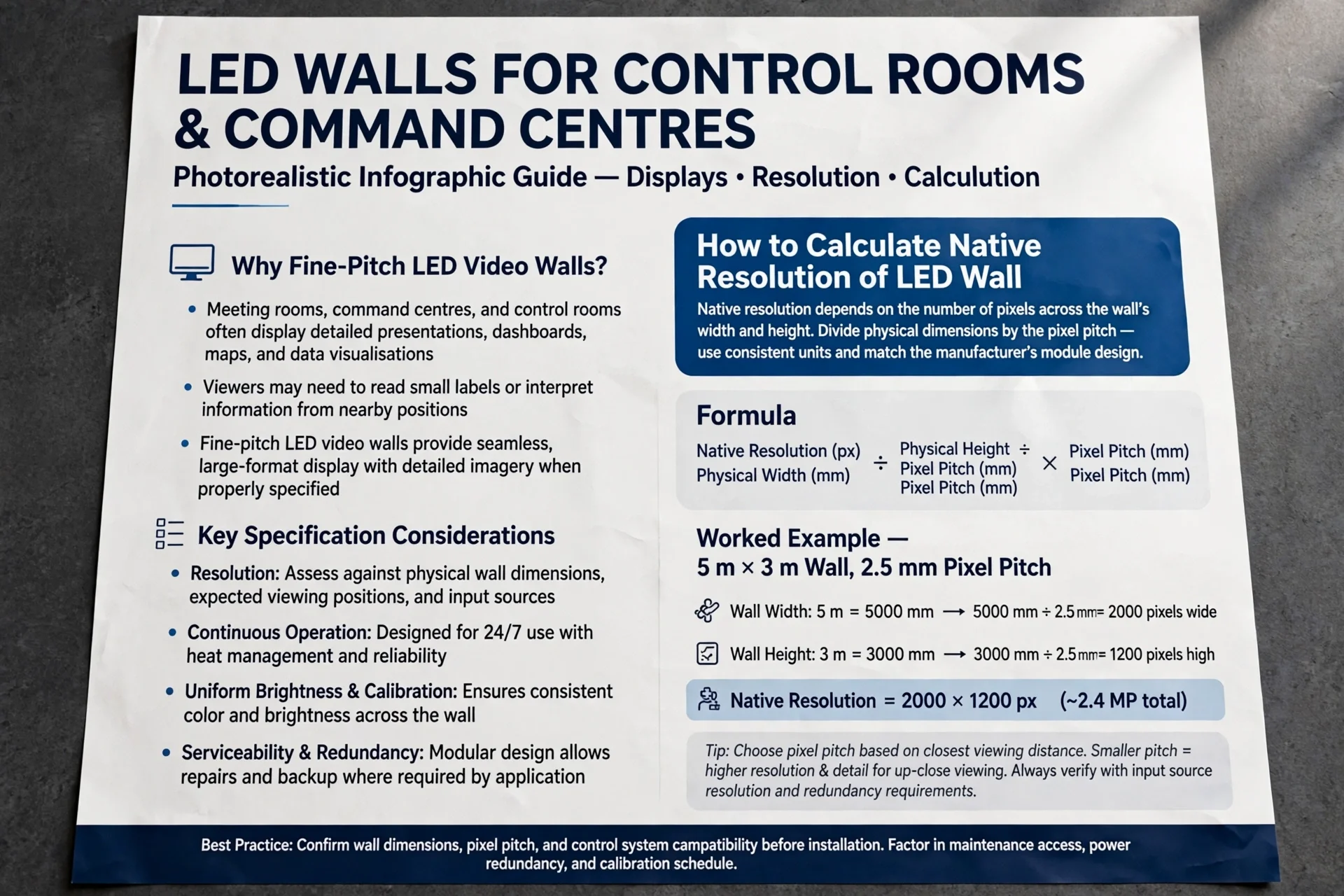
Pixel Pitch and Screen Resolution
Physical screen resolution depends on both pixel pitch and screen dimensions.
A large LED screen with a fine pixel pitch can contain a very high number of pixels.
For example, reducing the pixel pitch while keeping screen dimensions constant increases the number of pixels available to reproduce an image.
This can be particularly useful for:
Corporate presentations, detailed product demonstrations, close-up camera footage and exhibition displays.
For large outdoor screens, however, the audience may be too far away to benefit from extremely high pixel density.
Pixel Pitch for Indoor Events
Indoor venues generally have shorter viewing distances.
Examples include:
Conference halls, hotel ballrooms, shopping-centre atriums, exhibition stands, theatres, boardrooms and corporate event spaces.
Because viewers can stand or sit relatively close to the screen, fine-pitch LED displays are often preferred.
Common indoor rental specifications can include:
P1.9, P2.5, P2.6, P2.9 and P3.9, depending on the required viewing distance and application.
The exact specification should be selected according to the venue.

Pixel Pitch for Outdoor Events
Outdoor LED screens normally need to be viewed from greater distances.
Applications include:
Concerts, festivals, sporting events, outdoor conferences, public celebrations, brand activations and large-scale corporate events.
Larger pixel pitches can be appropriate because viewers are typically farther away.
Outdoor LED displays also need to address factors beyond pixel pitch, including:
Brightness, weather protection, viewing angle, cabinet durability, refresh rate and structural installation requirements.
Pixel Pitch for Corporate Conferences
Corporate events often display presentations containing text, charts, financial data, logos and detailed graphics.
This makes image clarity particularly important.
A fine-pitch LED display can be useful when the audience is relatively close.
For example, a conference in Dubai World Trade Centre may require a different screen configuration from a large outdoor corporate gathering.
The event layout should be considered before choosing the rental screen.
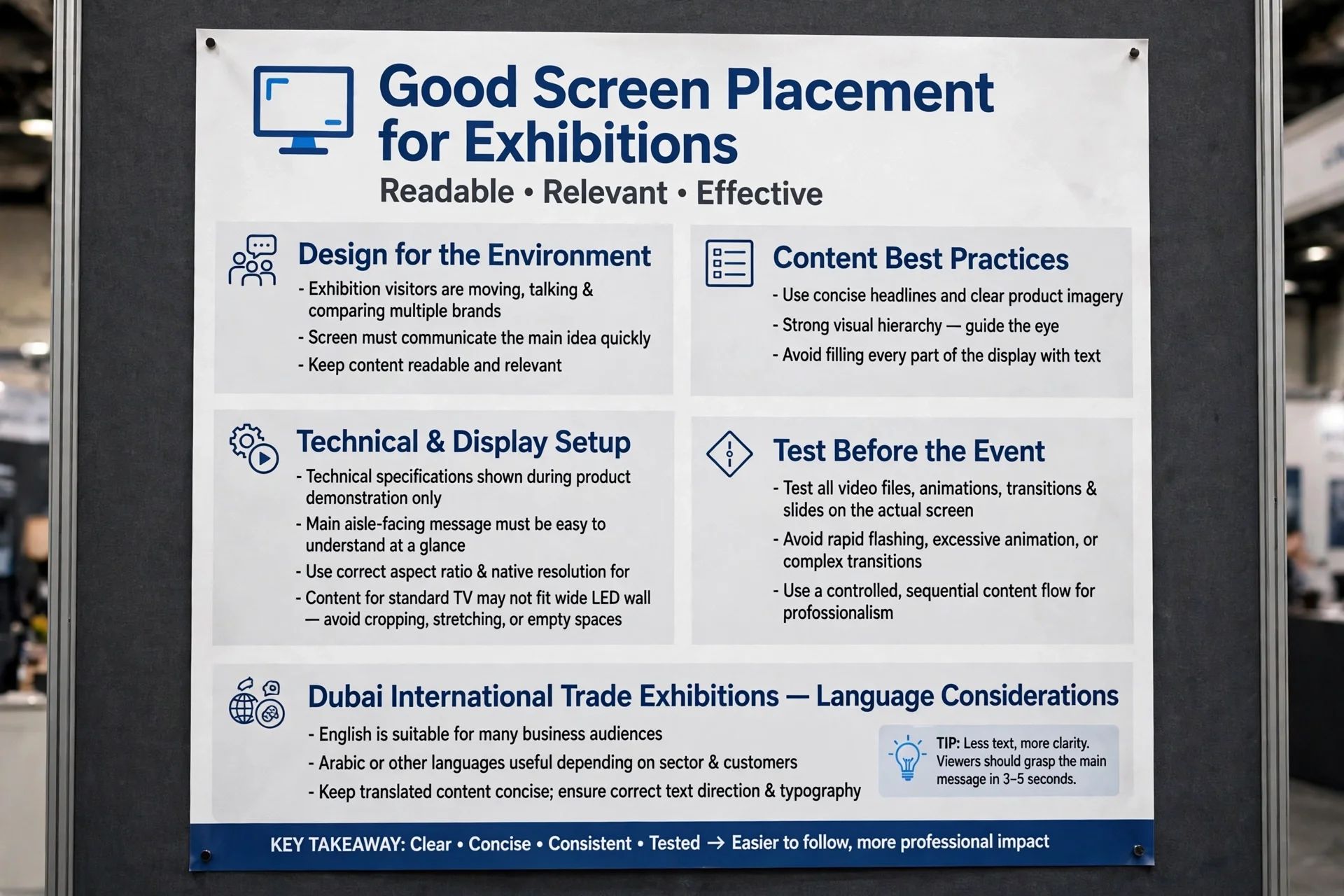
Pixel Pitch for Exhibitions
Exhibitions are another application where viewing distance can vary considerably.
An LED screen positioned inside an exhibition stand may be viewed from only a few metres away.
A fine pixel pitch can make:
Product demonstrations, promotional videos, brand graphics and detailed visual content
appear more refined.
Exhibitors at Dubai World Trade Centre, Expo City Dubai and other UAE exhibition venues should consider booth size, visitor flow and screen position when selecting pixel pitch.
Pixel Pitch for Concerts
Concerts typically require very large screens.
The audience can extend from people close to the stage to spectators hundreds of metres away.
Instead of using one specification for every position, production teams may use different LED configurations.
Large main screens may use a pixel pitch suitable for long-distance viewing, while side screens or close-viewing surfaces may require finer specifications.

Pixel Pitch for Weddings and Private Events
Wedding venues generally have shorter viewing distances than outdoor concerts.
LED screens may be used for:
Live camera feeds, wedding videos, photo slideshows, stage backgrounds, names, animations and decorative visuals.
Hotel ballrooms in Dubai, Abu Dhabi and Sharjah can benefit from fine-pitch rental LED displays when guests are seated close to the stage.
The screen should complement the event design rather than dominate the visual environment.
Pixel Pitch and Camera-Facing Applications
LED screens used behind presenters or performers are often captured by professional cameras.
This creates another consideration.
Camera-facing LED displays can experience:
Moiré patterns, scan lines, flicker or visible pixel structures
when the screen interacts with the camera sensor.
Fine pixel pitch can help, but camera performance also depends heavily on:
Refresh rate, scan architecture, camera shutter settings, processor configuration and LED module design.
For broadcast or professional video production, the rental provider should confirm that the screen is suitable for camera use.
Refresh Rate and Pixel Pitch
Pixel pitch should not be considered independently of refresh rate.
Refresh rate refers to how frequently the display updates its image.
High-refresh-rate LED displays can provide smoother camera footage and reduce visible flicker in many filming situations.
This is especially important for:
Television production, live streaming, corporate events, concerts and camera-heavy stage productions.
A fine pixel pitch with a poor refresh specification may still produce unsatisfactory camera results.

Brightness and Pixel Pitch
Brightness is particularly important for outdoor LED screens.
An outdoor display must compete with:
Direct sunlight, ambient daylight and surrounding artificial lighting.
A smaller pixel pitch does not automatically mean a brighter display.
Brightness should be selected according to the installation environment.
For outdoor Dubai events, the screen may need high brightness during daylight while requiring appropriate control at night.
Pixel Pitch and Viewing Angle
The audience does not always sit directly in front of an LED screen.
At exhibitions, concerts and large venues, people may view the display from the side.
LED panels with appropriate viewing angles help maintain:
Colour consistency, brightness and image visibility
across a wider audience area.
Pixel pitch is therefore only one component of overall viewing performance.
Pixel Pitch and LED Cabinet Design
Rental LED screens are typically assembled from modular cabinets.
Cabinet size, weight, locking mechanisms and construction influence how quickly the screen can be installed and dismantled.
For touring events, rental companies often prioritize:
Lightweight cabinets, fast locks, robust connectors, protective flight cases and modular replacement components.
A good rental system should be practical as well as visually effective.
Pixel Pitch and Screen Size
Screen size and pixel pitch work together.
A large screen with a fine pitch can contain a very high pixel count.
For example, a large P2.5 screen may offer substantially more pixels than a similarly sized P5 display.
However, if the audience is far away, the difference may not be visually meaningful.
This is why selecting pixel pitch based solely on “higher resolution” can lead to unnecessary rental costs.

Choosing the Right Pixel Pitch
The right pixel pitch depends on several factors:
Viewing distance, screen dimensions, indoor or outdoor location, content type, camera usage, ambient lighting, audience position and rental budget.
A professional supplier can evaluate these factors and recommend an appropriate specification.
The question should not simply be:
“What is the smallest pixel pitch available?”
Instead, ask:
“What pixel pitch provides the required image quality for this audience and venue?”
Pixel Pitch for Dubai Events
Dubai hosts a wide range of events throughout the year.
LED rental screens are used for:
Business conferences, exhibitions, product launches, fashion shows, concerts, weddings, sporting events, government events and promotional activations.
Different Dubai locations present different technical conditions.
An LED display installed at Dubai World Trade Centre may have different requirements from one used at Dubai Marina, Downtown Dubai, Dubai Opera, Expo City Dubai, or a hotel ballroom.
Venue size, audience arrangement and lighting conditions should therefore be assessed before rental.
LED Rental Screens in Abu Dhabi
Abu Dhabi also has a wide range of venues suitable for LED display applications.
Locations and event environments can include:
Yas Island, Abu Dhabi National Exhibition Centre, Saadiyat Island, Al Maryah Island and major hotels and conference venues.
Outdoor events may require weather-resistant high-brightness LED systems, while indoor conferences may benefit from fine-pitch displays.
LED Rental Screens in Sharjah
Sharjah hosts cultural, educational, corporate and public events where LED displays can support communication and visual engagement.
Venues such as exhibition centres, theatres, universities, conference halls and public event spaces can have very different viewing distances.
Pixel pitch should therefore be selected according to the specific event layout.

Pixel Pitch for Digital Advertising
Temporary LED rental displays can also be used for:
Brand activations, advertising campaigns, retail promotions, product launches and experiential marketing.
When viewers are close to the display, fine-pitch technology can make advertising content easier to read.
Large text and high-contrast graphics can remain effective even on larger-pitch screens when viewed from an appropriate distance.
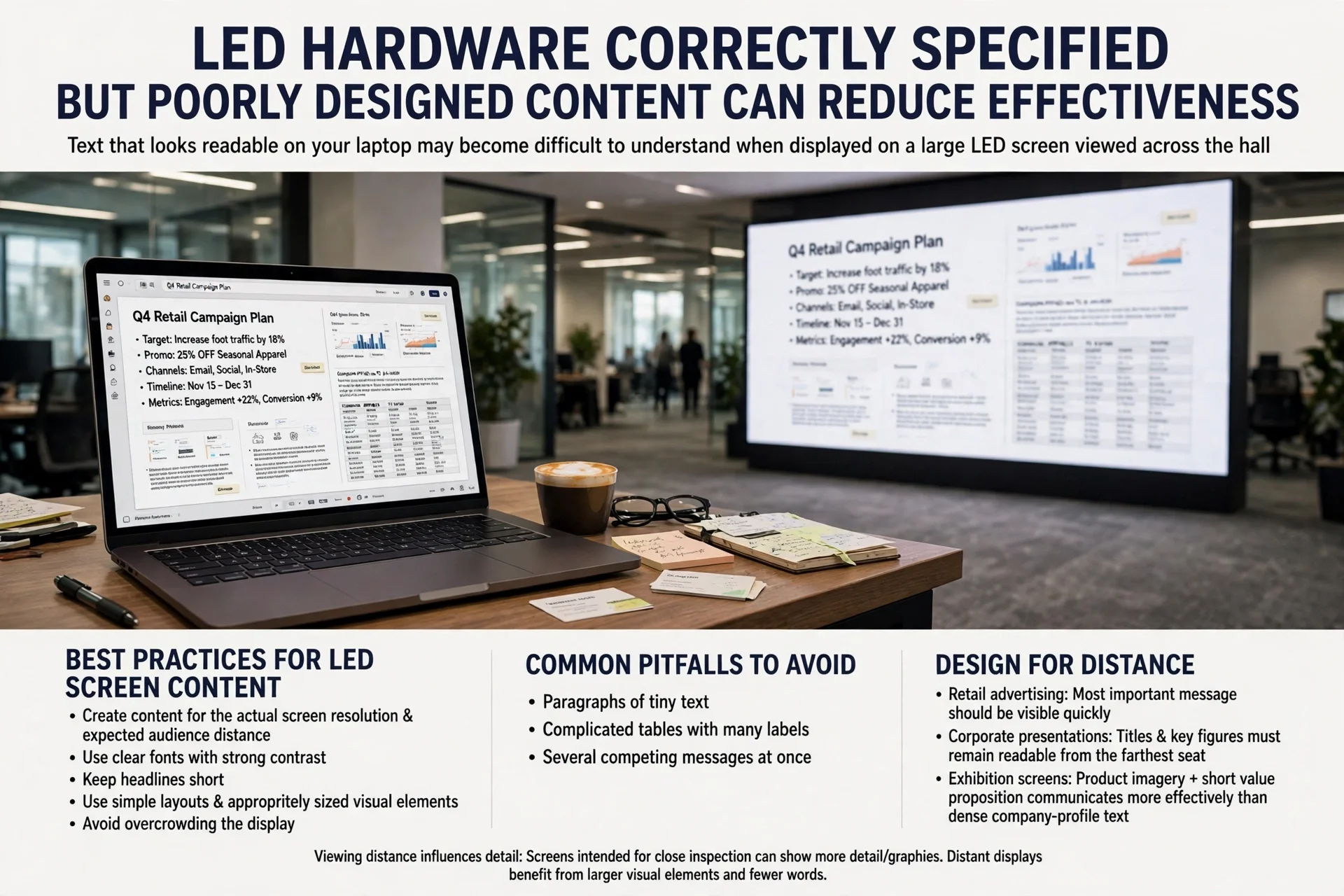
Pixel Pitch and Content Design
The screen specification and content should work together.
Fine-pitch screens can support detailed content, but content designers should still consider:
Font size, contrast, viewing distance, colour, motion, image composition and screen aspect ratio.
A very detailed presentation designed for a laptop may not work effectively on a large event screen.
Content should be designed specifically for the LED display.
Pixel Pitch Does Not Determine Everything
It is a common mistake to assume that smaller pixel pitch automatically means a better LED screen.
Other specifications include:
Brightness, contrast ratio, refresh rate, colour reproduction, grayscale performance, LED package, processing technology, calibration, cabinet construction and reliability.
Two LED screens with the same pixel pitch can deliver different visual results if their components and processing systems differ.
Maintenance and Reliability of Rental LED Screens
Rental LED displays are transported and assembled repeatedly.
This means mechanical reliability is important.
Professional rental providers should inspect:
LED modules, power supplies, receiving cards, data cables, cabinet connections, locking mechanisms and structural components.
Spare modules and power components can help reduce downtime during important events.

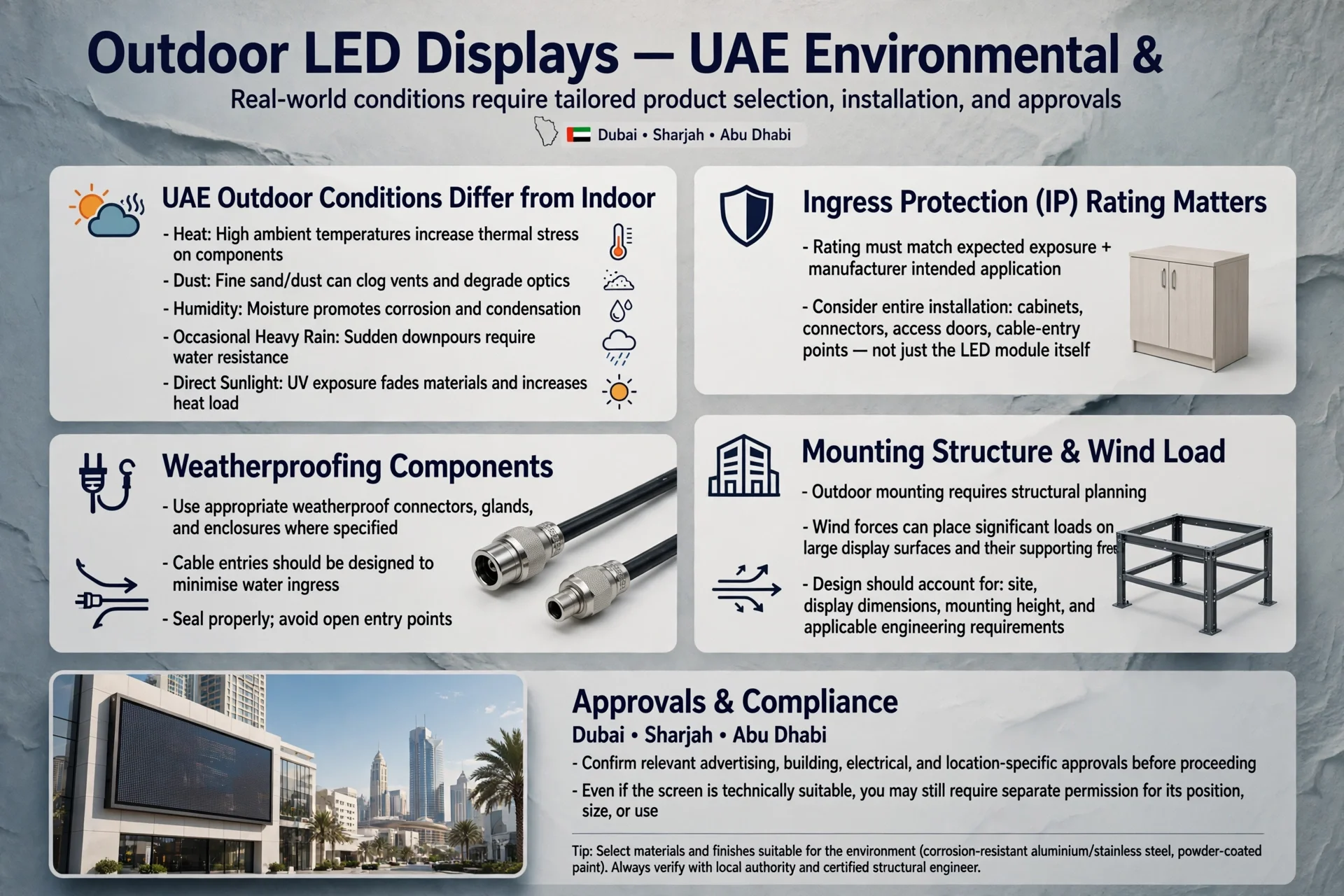
Weather Considerations for Outdoor LED Screens
Outdoor rental screens may be exposed to:
Heat, dust, humidity and unexpected rainfall.
Outdoor LED cabinets should have suitable environmental protection for the intended application.
The rental provider should also consider:
Structural stability, wind loading, electrical safety, cable management and safe installation.
Dubai’s high temperatures make thermal management particularly relevant for outdoor equipment.
Energy Consumption and Pixel Pitch
LED display power consumption depends on multiple variables.
These include:
Screen size, brightness, LED efficiency, content, operating mode and display technology.
A smaller pixel pitch can increase the number of LEDs and pixels within a given area, potentially affecting power requirements.
However, actual consumption varies considerably between products.
Rental providers should provide technical power information for the specific LED panel system.
Cost Considerations
Fine-pitch LED technology generally requires more LED components per square metre.
As a result, finer-pitch rental screens can have higher rental costs.
However, the most expensive screen is not necessarily the most suitable.
For a large outdoor event with long viewing distances, choosing a P2.5 screen instead of a suitable P4 or P5 system may add cost without creating a noticeable benefit for most viewers.
A properly specified display offers better value.
Pixel Pitch Comparison
| Pixel Pitch | Typical Application | Approximate Viewing Environment |
|---|---|---|
| P1.9 | Premium indoor events, presentations, close viewing | Very close |
| P2.5 | Conferences, exhibitions, premium indoor events | Close |
| P2.6 | Corporate events, stages, exhibitions | Close to medium |
| P2.9 | Indoor events and camera applications | Medium |
| P3.9 | Indoor/outdoor events, stages, conferences | Medium |
| P4 | Outdoor events and larger venues | Medium to long |
| P5 | Large outdoor events and stages | Long |
| P6+ | Large outdoor applications | Long distance |
These are general examples rather than strict rules. Actual suitability depends on the screen, content, venue and audience arrangement.

How to Calculate Pixel Density
Pixel density can be understood by considering how many pixels fit within a physical area.
As pixel pitch decreases, more pixels can fit into each metre.
This produces higher pixel density.
For example, a P2.5 display has pixels spaced approximately 2.5 mm apart, while a P5 display has pixels spaced approximately 5 mm apart.
Because the P2.5 spacing is half as large, significantly more pixels can fit into the same physical surface.
This is one reason fine-pitch displays can reproduce greater detail at close distances.
Pixel Pitch and Total Resolution
A rental LED screen’s total resolution depends on:
Physical screen dimensions ÷ pixel pitch.
A screen that is 5 metres wide will contain more pixels at P2.5 than at P5.
However, increasing physical resolution does not necessarily mean viewers will perceive a dramatic improvement if they are standing far away.
The viewing environment remains the key consideration.
Common Mistakes When Selecting Pixel Pitch
One common mistake is choosing the smallest pixel pitch simply because it sounds technically superior.
Another is selecting a large pitch for a close-viewing corporate presentation.
Other mistakes include ignoring:
Screen brightness, refresh rate, camera compatibility, viewing angle, content resolution, outdoor conditions and screen size.
A professional event production plan should consider all these factors together.
How to Choose an LED Rental Screen for Your Event
Start by identifying the venue and audience.
Determine:
Where the screen will be installed, how far viewers will be from it, whether cameras will record it, whether the event is indoors or outdoors, how large the screen needs to be, and what content will be displayed.
Then compare available LED panel specifications.
A professional rental provider can use this information to recommend an appropriate pixel pitch and cabinet configuration.

Frequently Asked Questions
Is a lower pixel pitch always better?
No. A lower pixel pitch generally provides higher pixel density and better close-range detail, but it may not provide meaningful additional value when viewers are far from the screen.
What pixel pitch is best for a conference?
Fine-pitch displays such as P1.9, P2.5 or P2.9 may be appropriate for close-viewing conference environments, depending on screen size and audience distance.
What pixel pitch is suitable for outdoor events?
P3.9, P4, P5 and larger pitches can be suitable for outdoor applications, depending on viewing distance, screen size and event conditions.
Does pixel pitch affect LED screen price?
Yes. Fine-pitch LED panels generally contain more pixels per square metre and can cost more to rent.
Does pixel pitch affect camera quality?
It can influence how the LED surface appears on camera, but refresh rate, scan technology, processor settings and camera configuration are also important.
Is P2.5 suitable for outdoor events?
Some P2.5 systems are designed for outdoor use, but suitability depends on the specific LED panel’s brightness, weather protection and operating specifications.
How far should viewers stand from an LED screen?
There is no universal distance. The appropriate viewing distance depends on pixel pitch, display quality, content and individual visual perception.
Conclusion
Pixel pitch has a direct relationship with the viewing experience of an LED rental screen. A smaller pixel pitch provides greater pixel density and can produce more detailed images at close distances, while larger pixel pitches can be highly effective for large screens viewed from farther away.
For events in Dubai, Abu Dhabi and Sharjah, selecting the right specification requires more than comparing P2.5, P3.9, P4 or P5 on a quotation. Event organizers should consider viewing distance, screen size, venue layout, brightness, refresh rate, camera requirements, weather conditions, content type and budget.
A corporate conference at Dubai World Trade Centre, an exhibition at Expo City Dubai, a wedding in a hotel ballroom and an outdoor concert each have different LED display requirements.
The most effective approach is to match the pixel pitch to the actual viewing environment rather than automatically choosing the smallest available number.
When the right pixel pitch is combined with a high-quality LED module, suitable brightness, reliable processing, appropriate refresh rate and professional installation, a rental LED display can deliver clear and engaging visuals throughout the event.
For businesses planning temporary displays, choosing the right LED Rental Screen specification can help achieve the right balance between image quality, viewing comfort, technical performance and rental value.