LED screens have become an important part of modern event production, from corporate conferences and exhibitions to concerts, weddings, sports events, product launches, retail activations, and outdoor festivals. However, choosing an LED display is not simply about selecting the largest screen or the highest resolution. One of the most important technical considerations is LED screen brightness.
Brightness determines how clearly content can be seen under different lighting conditions. An LED display that performs beautifully inside a dark conference hall may look too dim in direct sunlight. Similarly, an extremely bright outdoor display may be unnecessary for an indoor ballroom and could create an uncomfortable viewing experience.
For event organisers in Dubai and across the UAE, brightness deserves particular attention because indoor venues, outdoor spaces, exhibition halls, hotel ballrooms, and open-air event locations can have dramatically different lighting conditions.
Understanding measured brightness, ambient light, viewing distance, pixel pitch, screen orientation, content type, and installation environment can help event planners choose an LED display that delivers clear and engaging visuals.
What Does LED Screen Brightness Mean?
LED screen brightness refers to the amount of light produced by an LED display. It is commonly measured in nits, with one nit representing one candela per square metre (cd/m²).
The higher the nit rating, the brighter the screen can appear. However, a higher brightness rating does not automatically mean that a display is better for every event.
The ideal brightness depends on the environment in which the screen will operate.
An indoor conference room with controlled lighting may require considerably less brightness than an outdoor stage exposed to sunlight. An exhibition stand inside a brightly illuminated exhibition centre may need more brightness than a private meeting room, while a nighttime outdoor concert requires a different balance again.
This is why professional LED screen selection considers the complete viewing environment rather than relying on the brightness specification alone.

Why Brightness Matters for Event LED Screens
The primary purpose of an event LED screen is to make visual information easy to see. If brightness is too low, images can appear dull, colours may lose impact, and text can become difficult to read.
This can be particularly problematic when displaying presentations, sponsor logos, live camera feeds, product demonstrations, schedules, social media walls, or promotional videos.
On the other hand, excessive brightness can produce glare and make viewing uncomfortable, especially in indoor environments. It can also make colours appear less natural if the display is not correctly calibrated.
For this reason, professional event production focuses on achieving the right balance between brightness, contrast, colour accuracy, resolution, and viewing conditions.
A properly selected LED screen should allow audiences to see important content clearly without creating unnecessary visual discomfort.
Indoor LED Screen Brightness
Indoor venues typically provide controlled or partially controlled lighting. Conference halls, hotel ballrooms, exhibition centres, shopping malls, theatres, restaurants, and corporate event spaces generally do not receive the same intensity of direct sunlight as outdoor locations.
Indoor LED displays therefore usually require lower brightness levels than outdoor screens.
The appropriate specification depends on the venue. A dark theatre may require relatively modest brightness, while a brightly illuminated exhibition hall can require a higher output to maintain visual clarity.
The position of the LED screen is also important. A display positioned opposite strong artificial lighting may need different brightness characteristics from one installed in a darker stage environment.
For indoor events, brightness should be considered alongside colour accuracy and viewing comfort. A screen that is excessively bright can dominate the room rather than complementing the event environment.

Outdoor LED Screen Brightness
Outdoor LED displays face a much more demanding lighting environment.
Sunlight can be extremely intense, particularly during daytime events. If an LED screen does not produce sufficient luminance, its content may appear washed out or difficult to see.
Outdoor screens therefore require higher brightness capabilities than most indoor displays.
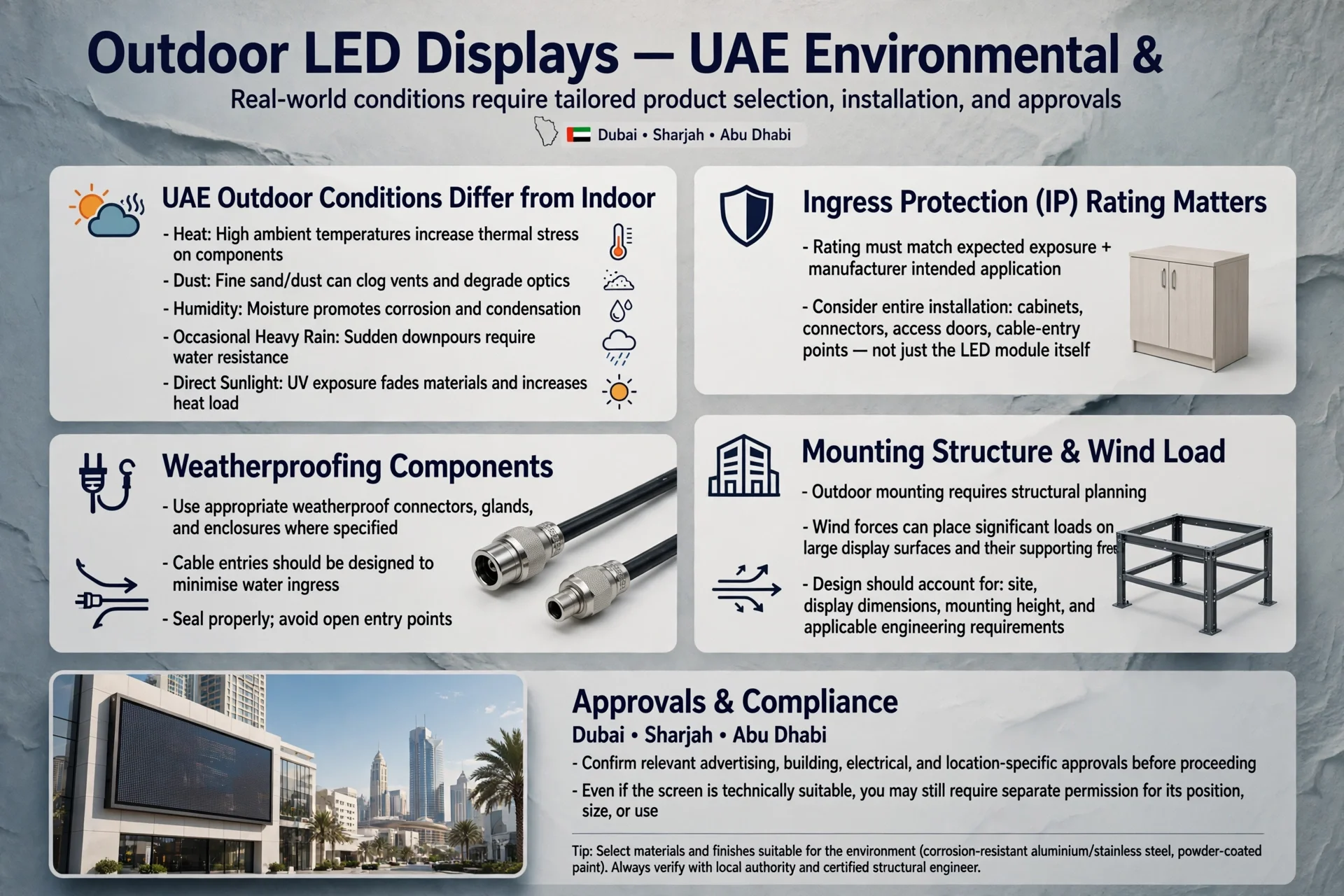
However, outdoor LED screen selection involves more than brightness. The display may also need suitable weather protection, structural support, appropriate ingress protection, durable cabinets, reliable power distribution, and proper thermal management.
For outdoor events in Dubai, environmental conditions should be considered carefully. High temperatures, dust, strong sunlight, and occasional weather changes can affect equipment performance and installation requirements.
A professional event display provider should therefore assess the site and expected operating conditions before recommending a screen.
Understanding Nits and LED Display Specifications
Nits are useful for comparing LED screen brightness, but the number should not be considered in isolation.
A display specification may state a maximum brightness level, but the screen may not operate continuously at that maximum level during normal use. Brightness can also be adjusted according to the venue, time of day, content, and lighting conditions.
Other technical specifications can influence perceived image quality, including:
- Pixel pitch
- Refresh rate
- Contrast ratio
- Colour reproduction
- LED package type
- Cabinet design
- Viewing angle
- Processing system
- Calibration
- Screen resolution
For example, a very bright screen with poor colour calibration may produce a less attractive image than a moderately bright display with accurate colour reproduction.
Event planners should therefore evaluate the complete LED display specification rather than selecting equipment based only on its advertised brightness.

Pixel Pitch and Brightness Work Together
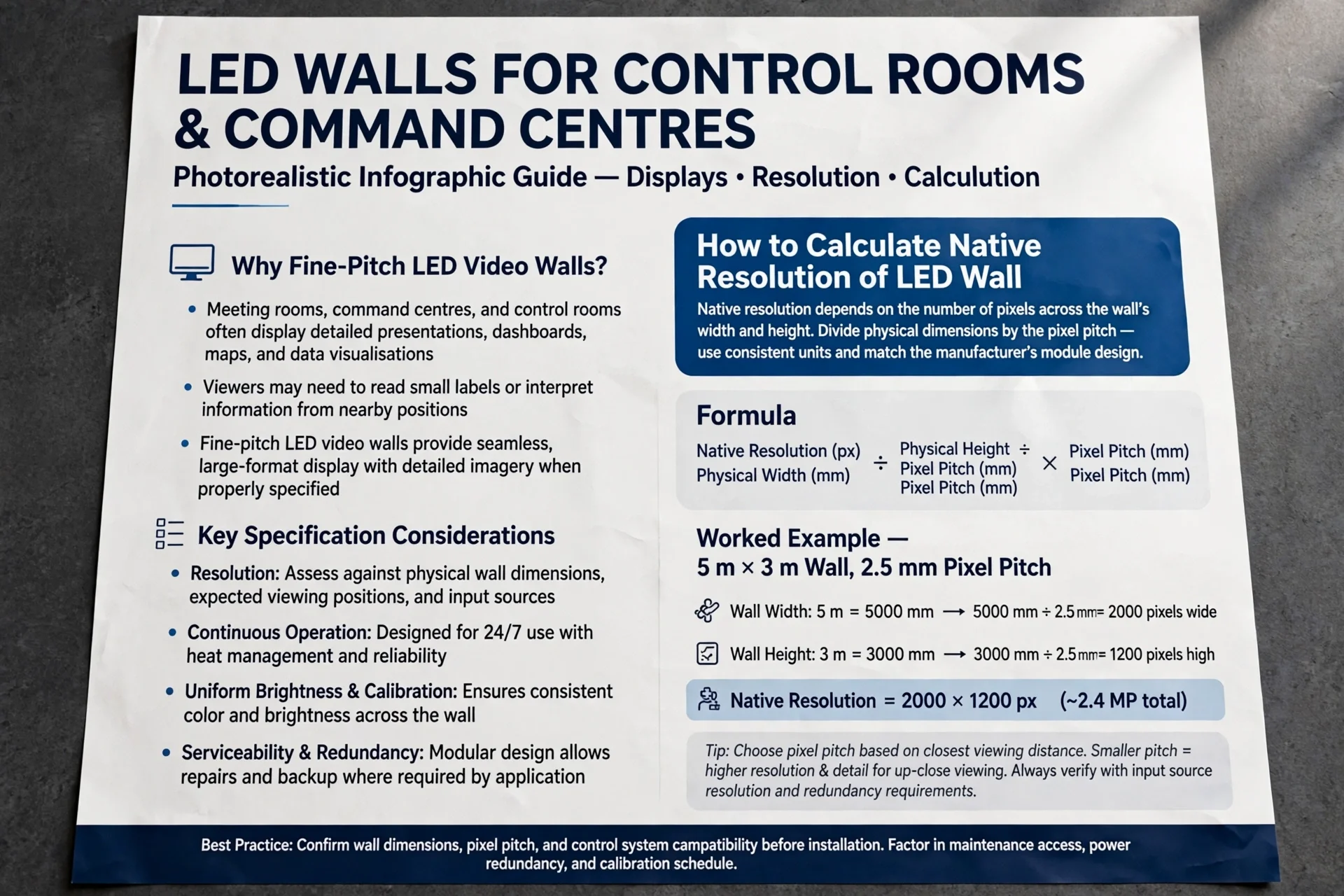
Pixel pitch refers to the distance between individual LED pixels, usually measured in millimetres. Smaller pixel pitch generally allows viewers to stand closer to the screen while still seeing a detailed image.
Brightness and pixel pitch address different technical requirements, but both contribute to the overall viewing experience.
For a corporate conference where attendees sit relatively close to the stage, a fine-pitch indoor LED display may provide excellent detail. For a large outdoor concert where the audience is located much farther away, a larger pixel pitch may be appropriate.
The correct choice depends on viewing distance, screen size, content type, venue layout, and budget.
A professional LED screen supplier can calculate the relationship between screen dimensions, pixel pitch, and audience distance to help determine a suitable configuration.
Viewing Distance Affects the Required Brightness
Viewing distance is another important factor when planning an LED screen installation.
Audiences standing close to an extremely bright display may find it uncomfortable, particularly indoors. Conversely, viewers positioned hundreds of metres away at an outdoor event need sufficient brightness and contrast to distinguish the content.
Screen size also affects perception.
A large outdoor LED video wall may be clearly visible from a significant distance, while a smaller indoor display may be designed for a more intimate viewing environment.
The audience’s position should therefore be considered during event planning. Event production teams can evaluate seating layouts, audience movement, sightlines, screen elevation, and viewing angles before determining the appropriate display configuration.

Daytime Events Require Different LED Screen Considerations
A daytime event presents one of the most challenging environments for LED screens.
When natural sunlight falls directly onto a display, ambient illumination can significantly reduce perceived contrast. Text and darker image areas may become difficult to distinguish if the display is not sufficiently bright.
This is why outdoor daytime events generally require high-brightness LED technology.
Screen orientation can also influence performance. A display facing direct sunlight may require different planning from one positioned under shade or facing away from the strongest source of natural light.
For Dubai events, this consideration can be particularly important for outdoor exhibitions, sports activities, brand activations, festivals, construction launches, and corporate events.
A site assessment before installation can help determine whether additional shading, positioning adjustments, brightness control, or a different LED specification is required.
Nighttime Events Need Brightness Control
It may seem logical to use maximum brightness at all times, but nighttime events demonstrate why brightness control matters.
An outdoor LED screen that is appropriate during daylight can appear excessively bright after sunset. This can affect audience comfort, stage aesthetics, photography, video production, and the overall atmosphere of the event.
Modern LED display systems can generally be adjusted to suit changing environmental conditions.
Brightness can be reduced as ambient light decreases, creating a more balanced appearance. Professional operators can also calibrate displays to maintain appropriate contrast and colour reproduction throughout the event.
For events that continue from afternoon into evening, automatic or manual brightness adjustment can help maintain consistent visibility without excessive luminance.

LED Screen Brightness for Exhibitions and Trade Shows
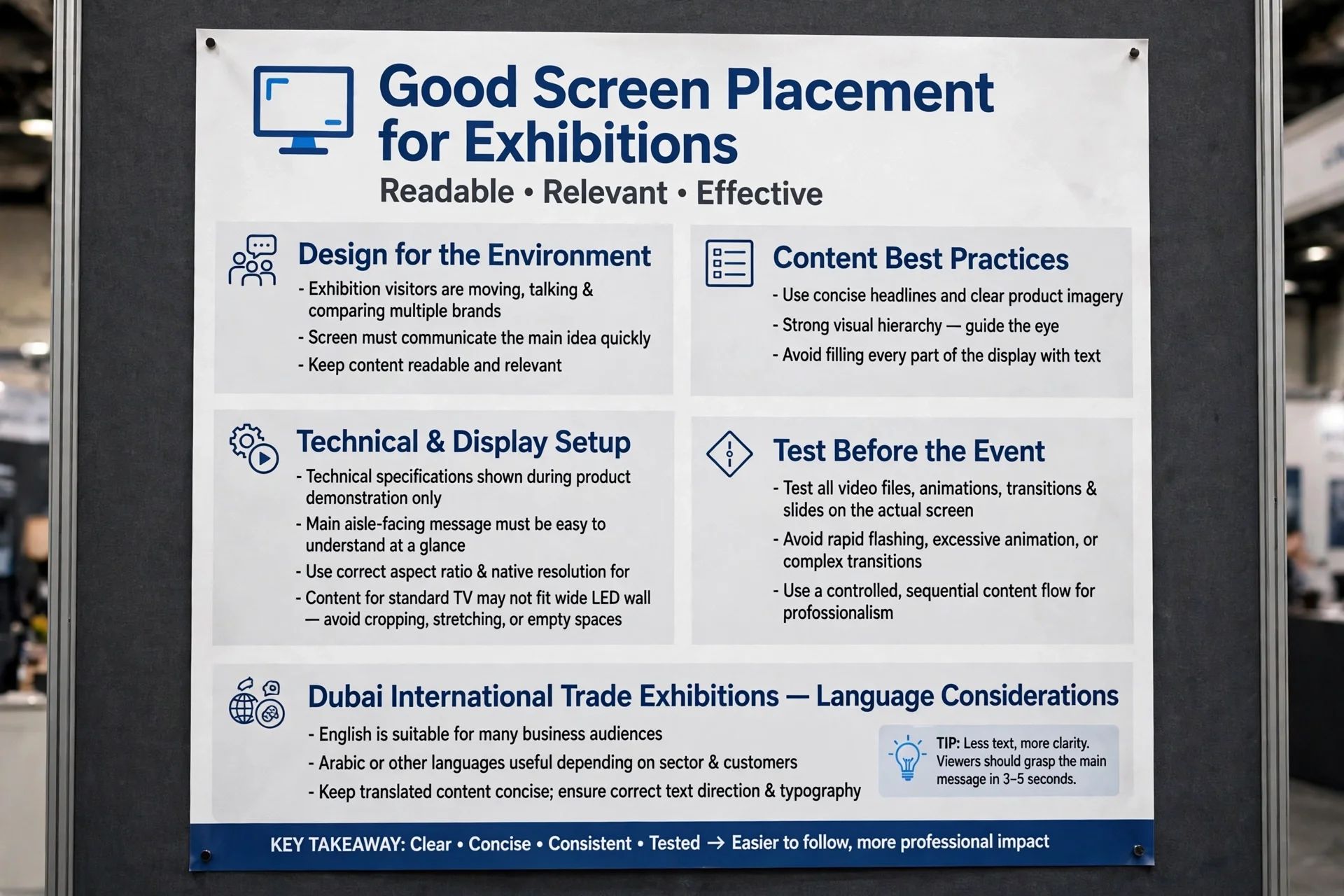
Exhibitions create a unique visual environment because multiple brands compete for visitor attention.
Exhibition halls often have strong overhead lighting, illuminated displays, spotlights, signage, and numerous digital screens operating simultaneously.
An LED screen must therefore be bright enough to remain visually prominent without appearing excessively intense.
For exhibition stands at major Dubai venues such as Dubai World Trade Centre, screen positioning and brightness should be coordinated with the overall booth design. A display may be used for brand videos, product demonstrations, presentations, visitor engagement, or large-format advertising.
Brightness should also be considered alongside viewing distance. Visitors may walk directly past a screen, stand several metres away, or view it from across an exhibition aisle.
A properly selected display can help attract attention while maintaining comfortable viewing conditions.
LED Screens for Corporate Conferences
Corporate conferences often involve presentations, speaker visuals, videos, charts, branding, sponsor content, and live camera feeds.
In this environment, image clarity and colour accuracy are especially important.
A screen that is too dim may make presentation text difficult to read, while excessive brightness can distract the audience from the speaker.
Conference organisers should consider the room’s lighting design, stage arrangement, screen dimensions, audience seating, and camera requirements.
Fine-pitch LED screens are increasingly used for premium conferences because they can provide detailed visuals at relatively close viewing distances.
Brightness should be calibrated to work with the room’s lighting rather than simply set to maximum output.

LED Screens for Weddings and Social Events
LED displays are also widely used for weddings, private celebrations, gala dinners, award ceremonies, and social events.
These events often take place in hotels, ballrooms, banquet halls, outdoor venues, and luxury event spaces.
For indoor weddings, brightness should complement decorative lighting and photography. Excessive brightness can overpower stage decoration and affect the atmosphere.
For outdoor evening celebrations, the screen may need higher brightness during twilight before being adjusted downward as the environment becomes darker.
LED screens can display wedding videos, photographs, names, animations, live camera feeds, decorative visuals, and personalised content.
The screen should therefore be selected not only for technical performance but also for how it integrates visually with the event design.
LED Screens for Concerts and Live Performances
Concerts and live entertainment events typically require large-format LED displays capable of producing dynamic visuals from significant viewing distances.
Brightness becomes particularly important for outdoor daytime performances. During nighttime concerts, however, brightness control and colour calibration become equally important.
Live event LED systems may display performers, camera feeds, animations, graphics, sponsor content, and visual effects.
High refresh rate can also be important when professional cameras are being used to capture the screen. A suitable LED system can help reduce visible scanning or flicker on camera.
The complete display system may include LED cabinets, video processors, sending cards, receiving cards, media servers, control systems, power distribution, structural support, and signal management.

Weather and Environmental Conditions in Dubai
Dubai’s climate creates specific requirements for outdoor event technology.
High temperatures and direct solar exposure can place additional demands on electronic equipment. Dust and environmental exposure can also affect equipment if the display is not appropriately designed and maintained.
Outdoor LED cabinets should therefore be suitable for their intended operating environment.
Ingress protection ratings can help indicate resistance to dust and water, while thermal management can help equipment operate within appropriate temperature limits.
Installation also requires proper structural planning. Large LED walls can create significant wind loads, particularly when installed outdoors.
For this reason, outdoor LED screen deployment should be handled by experienced technicians who understand event structures, electrical distribution, rigging requirements, and local venue procedures.
Brightness and Energy Consumption
Brightness can also influence power requirements.
Operating an LED display at a higher brightness level generally requires more energy than operating it at a lower level. This makes intelligent brightness management useful for longer events.
For large LED walls, power consumption can become a significant consideration. Event organisers may need to plan electrical distribution, generator capacity, cable routing, and backup power according to the equipment configuration.
Efficient LED technology combined with appropriate brightness control can help reduce unnecessary power consumption while maintaining visual quality.
Rather than running every display at maximum brightness throughout an event, professional operators can adjust output according to actual environmental conditions.

How to Select the Right Brightness for Your Event
Choosing the correct brightness starts with understanding the event environment.
Consider whether the event is indoors or outdoors, whether it occurs during daytime or nighttime, how much natural and artificial light is present, how far the audience will be from the screen, and what type of content will be displayed.
The screen’s location should also be evaluated. A display positioned behind a stage may experience different lighting conditions from one facing an entrance or exhibition aisle.
Other considerations include screen size, pixel pitch, viewing angle, camera usage, event duration, weather exposure, power availability, and venue restrictions.
Working with a professional LED display provider can simplify this process because technical specifications can be matched to the actual site rather than selected from a generic product catalogue.
Why Professional Brightness Calibration Matters
Installing the right LED screen is only part of achieving good image quality. Calibration and configuration are equally important.
Brightness, contrast, colour temperature, gamma, and other display parameters can influence how content appears to the audience.
Professional technicians can configure the screen according to venue conditions and content requirements. This can be particularly valuable for events involving professional photography and video production.
For businesses planning conferences, exhibitions, product launches, concerts, or outdoor activations, specialist LED Screen Brightness Services can help ensure that the display is configured for the intended environment.
Professional support can also help identify whether the screen requires brightness adjustments during different phases of the event.
Common Mistakes When Choosing LED Screen Brightness
One common mistake is choosing the brightest screen available without considering where it will be installed.
Another is focusing entirely on brightness while ignoring pixel pitch, viewing distance, refresh rate, colour accuracy, and processing quality.
Some event organisers also fail to account for changing light conditions. A screen that works well at 5 PM may need different settings after sunset.
Ignoring power requirements and environmental conditions can create additional technical problems, particularly for large outdoor LED walls.
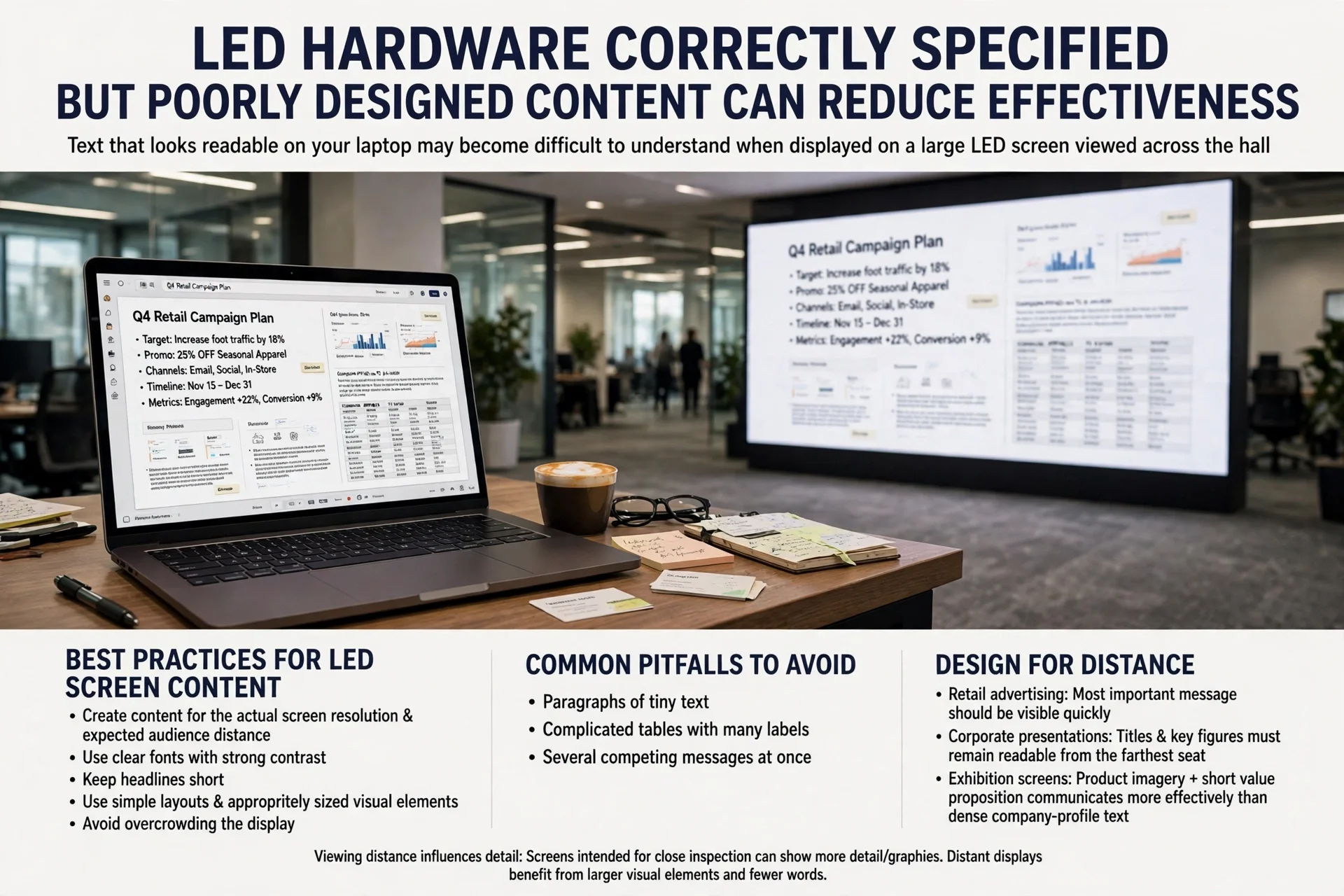
Finally, using unsuitable content can reduce the effectiveness of even a high-quality LED display. Small text, low-contrast graphics, or poorly designed visuals may remain difficult to read regardless of screen brightness.
Good event display performance therefore requires coordination between hardware, content, installation, and operation.

LED Screen Brightness: Quick Guide
The ideal brightness depends on the application rather than a single universal specification.
| Event Environment | Main Brightness Consideration |
|---|---|
| Dark indoor venue | Moderate brightness with comfortable viewing |
| Hotel ballroom | Balance brightness with decorative lighting |
| Conference room | Clear text and accurate colours |
| Exhibition hall | Compensate for strong artificial lighting |
| Indoor retail activation | Bright enough to attract attention without glare |
| Outdoor daytime event | High brightness for sunlight visibility |
| Outdoor evening event | Adjustable brightness for changing conditions |
| Concert stage | Brightness, contrast, refresh rate, and camera compatibility |
| Sports event | Long-distance visibility and outdoor performance |
| Wedding or gala | Visual comfort, colour quality, and atmosphere |
This table should be treated as a planning guide rather than a substitute for a site assessment. Actual requirements can vary considerably depending on screen position, sunlight, venue lighting, viewing distance, and content.
The Importance of a Professional LED Screen Supplier
Choosing an LED screen should involve more than comparing screen size and rental price.
A professional supplier or event technology company should be able to discuss brightness, pixel pitch, screen resolution, refresh rate, cabinet construction, power requirements, weather protection, processing equipment, installation, operation, and technical support.
For Dubai events, the supplier should also understand local venues, access requirements, installation schedules, event regulations, and environmental conditions.
A detailed site assessment can help identify potential problems before equipment arrives. This can include checking mounting locations, power availability, audience sightlines, ambient lighting, signal routes, structural requirements, and access for installation.
The result is a more reliable event display with fewer last-minute surprises.

Final Thoughts
LED screen brightness is one of the most important technical factors when planning a digital display for an event, but the highest brightness is not always the best choice.
Indoor and outdoor environments have very different requirements. Daytime events may require high luminance to overcome sunlight, while indoor conferences need a balanced output that provides clear visuals without uncomfortable glare. Evening events require brightness adjustment as ambient light changes.
Other factors such as pixel pitch, viewing distance, refresh rate, colour accuracy, contrast, screen size, content design, weather protection, and power consumption should also be considered.
For events in Dubai, professional planning is particularly valuable because the combination of strong sunlight, high temperatures, major exhibition venues, hotel event spaces, and outdoor entertainment locations creates a wide range of display requirements.
Whether you are organising a corporate conference in Business Bay, an exhibition at Dubai World Trade Centre, a wedding in Palm Jumeirah, a product launch in Downtown Dubai, or an outdoor activation elsewhere in the UAE, selecting and calibrating the correct LED display can significantly improve audience visibility and the overall event experience.
The goal is simple: choose the right brightness for the environment, configure the display correctly, and make sure the technology supports the event rather than distracting from it.