Pixel pitch is one of the most important technical specifications to consider when selecting an LED display for an event, exhibition, conference, concert, product launch, or corporate production. It directly affects image sharpness, viewing distance, screen resolution, visual detail, and the overall appearance of content on an LED display.
For event organizers in Dubai and across the UAE, understanding pixel pitch is especially important because rental LED screens are used across a wide range of environments, from intimate corporate meeting rooms to large outdoor festivals and exhibition halls at Dubai World Trade Centre (DWTC). Choosing the wrong pixel pitch can result in unnecessary costs, poor image quality at close viewing distances, or paying for a higher specification than the event actually requires.
An appropriately selected LED Rental Screen can provide high brightness, excellent contrast, smooth video playback, and strong visual impact. However, the screen’s performance depends heavily on selecting the right pixel pitch for the venue, audience distance, content type, screen dimensions, and lighting conditions.
What Is Pixel Pitch in an LED Display?
Pixel pitch refers to the physical distance between the centers of two adjacent LED pixels, normally measured in millimeters. It is commonly written as P1.2, P1.5, P1.8, P2.6, P2.9, P3.9, P4.8, or P6. Pixel pitch is one of the fundamental specifications used to describe the density of an LED display.
A smaller pixel pitch means the individual LED pixels are positioned closer together. This creates a higher pixel density and allows the display to reproduce finer visual details at close viewing distances.
A larger pixel pitch means the LEDs are spaced farther apart. These displays are generally more suitable for situations where viewers are positioned farther away from the screen.
For example, a P1.5 LED screen has a 1.5 mm distance between pixel centers, while a P3.9 screen has a 3.9 mm distance. The P1.5 display therefore provides significantly higher pixel density.
However, a smaller pixel pitch is not automatically the best choice for every rental event. The correct specification depends on how and where the screen will be viewed.

Why Pixel Pitch Matters for LED Rental Screens
Pixel pitch affects several aspects of LED rental screen performance, including image clarity, viewing distance, resolution, perceived sharpness, and content reproduction.
Consider an exhibition stand where visitors may stand only two or three meters away from the display. A very large pixel pitch can make individual pixels more noticeable, particularly when the content contains text, graphics, product details, or high-resolution photography.
By comparison, a large outdoor stage may be viewed from 20, 30, or even 50 meters away. In that situation, a larger pixel pitch can provide an effective visual experience without requiring the additional cost of an ultra-fine-pitch display.
Pixel pitch should therefore be selected based on the relationship between screen size and viewing distance, rather than treated as an isolated specification.
Pixel Pitch and Viewing Distance
Viewing distance is one of the most useful factors when selecting an LED rental screen.
The closer the audience is to the display, the more important a fine pixel pitch becomes. When viewers are farther away, the individual pixels become less distinguishable and a larger pitch can be perfectly suitable.
A simplified rule sometimes used in the LED display industry is to estimate minimum comfortable viewing distance from pixel pitch. A P3.9 screen, for example, can be suitable for medium-distance viewing, while P1.5 or P1.8 may be more appropriate for close-up applications.
These calculations are only guidelines. Actual performance also depends on LED package technology, display processing, content, screen size, viewing angle, camera distance, and ambient lighting.
For rental applications, professional suppliers should assess the venue before recommending a specific pixel pitch.
Fine Pixel Pitch LED Screens for Close Viewing
Fine-pitch LED displays are particularly useful when audiences will be relatively close to the screen.
Applications can include:
- Corporate presentations
- Indoor conferences
- Exhibition booths
- Product launches
- Retail displays
- Broadcast environments
- Control rooms
- Luxury events
- Hospitality venues
- Stage backdrops viewed from short distances
A P1.2, P1.5, or P1.8 display can reproduce small text, detailed graphics, product photography, and presentation slides with excellent clarity.
Fine-pitch technology is also valuable when an LED wall is being used as a camera background. Smaller pixel spacing can reduce the visibility of the LED structure on camera, although camera performance also depends on refresh rate, shutter speed, scan technology, processing, and other technical factors.

Medium Pixel Pitch for Events and Exhibitions
Medium pixel pitch is widely used for rental applications because it provides a balance between image quality, viewing distance, cost, and versatility.
P2.6, P2.9, and P3.9 displays are common choices for conferences, exhibitions, weddings, corporate events, stage productions, and indoor or semi-outdoor installations.
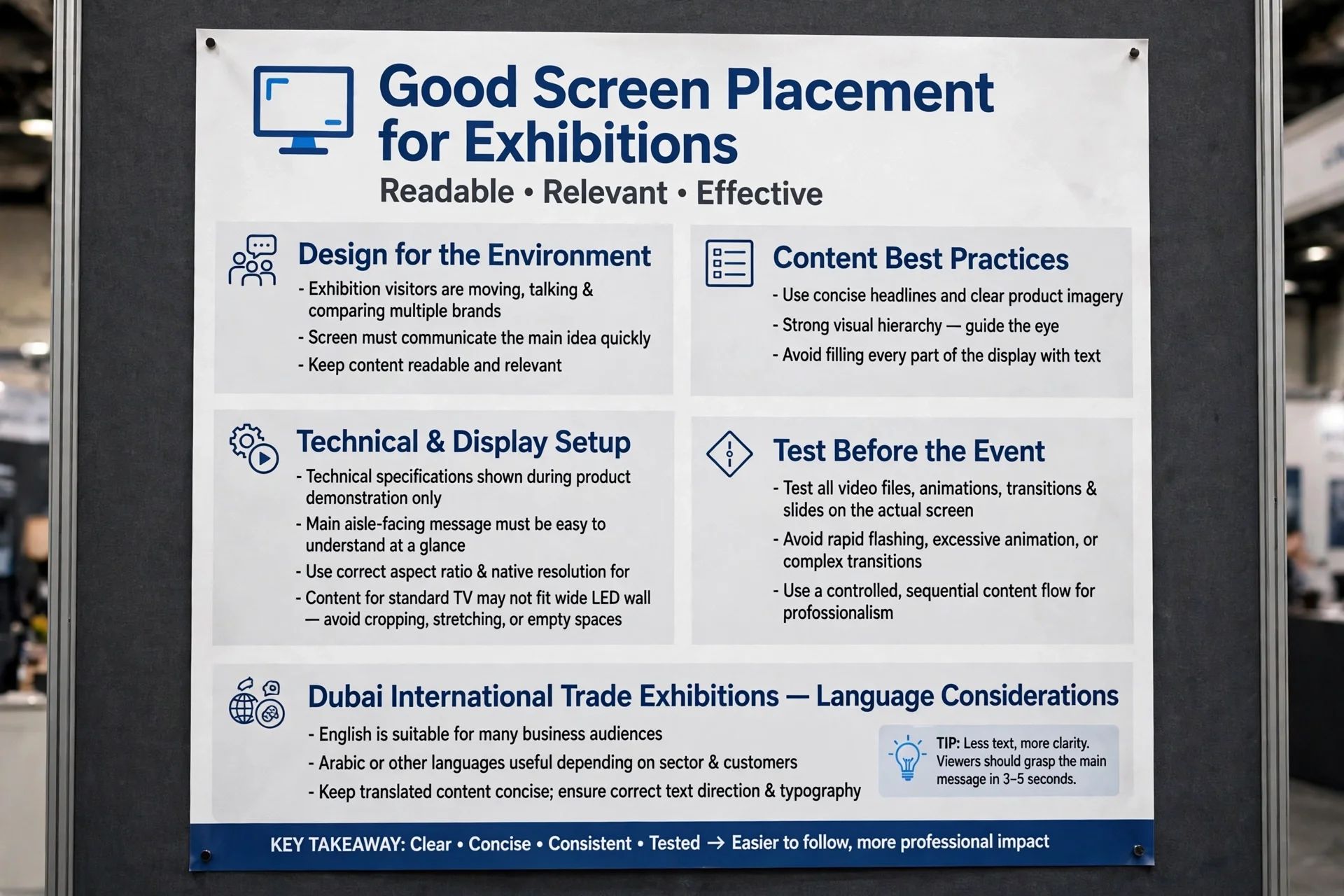
At an exhibition, visitors may approach the screen closely while also viewing it from across an aisle. The selected pixel pitch therefore needs to provide acceptable image quality across multiple viewing distances.
A P2.9 or P3.9 LED display can often provide an effective balance for these situations, particularly when the content is designed appropriately.
Larger Pixel Pitch for Outdoor LED Screens
Outdoor events frequently require larger LED screens because audiences are positioned farther away.
P4.8, P5, P6, or larger pixel-pitch displays can be suitable for outdoor stages, sporting events, concerts, festivals, public gatherings, and large corporate events.
The key advantage is that viewers generally do not need to resolve individual pixels from a long distance.
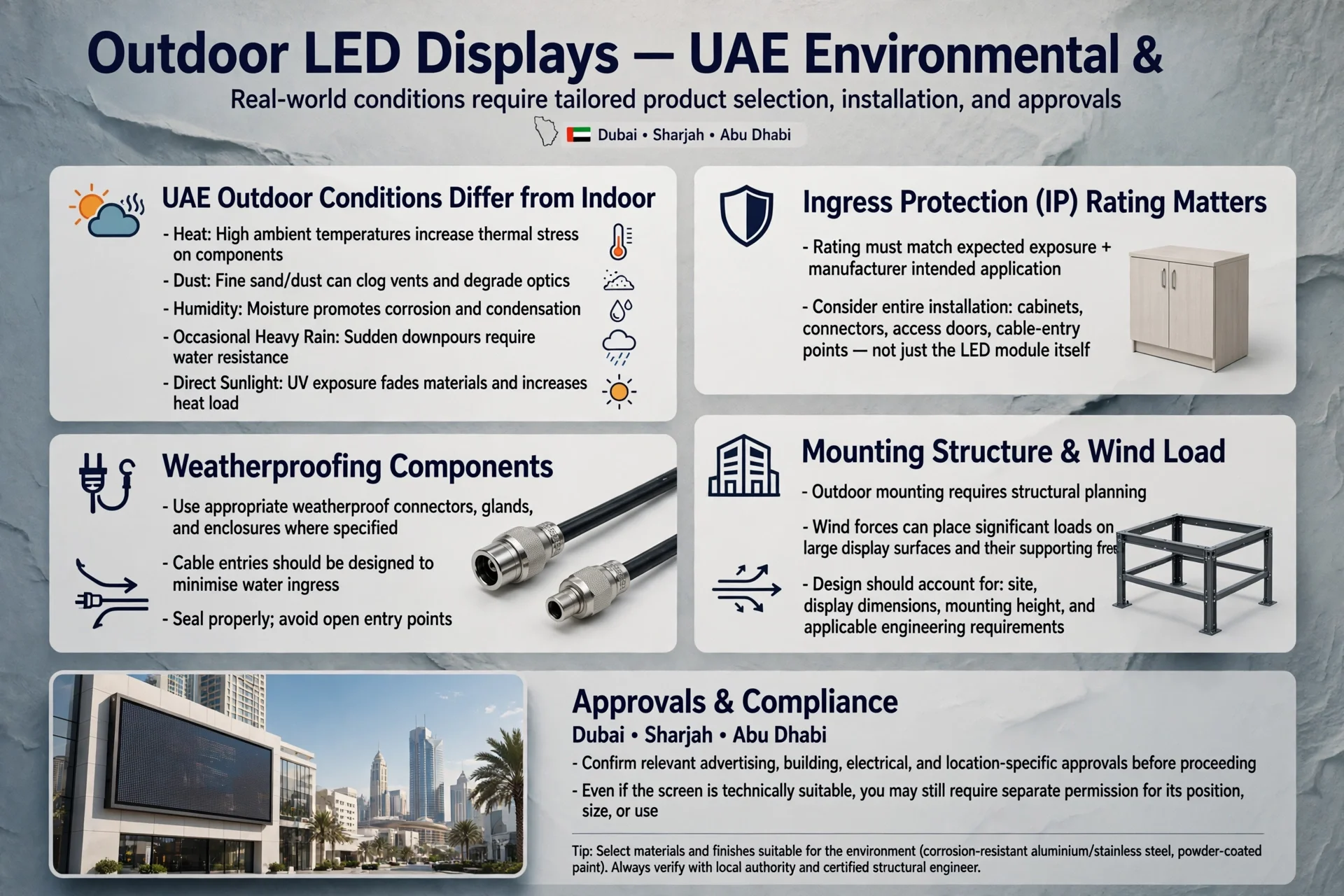
Outdoor LED displays also need to address other technical requirements, including:
- High brightness
- Weather resistance
- IP-rated cabinets
- High refresh rate
- Robust cabinet construction
- Appropriate viewing angles
- Thermal management
- Reliable power distribution
Pixel pitch is therefore only one part of outdoor LED screen performance.
Pixel Pitch and Screen Resolution
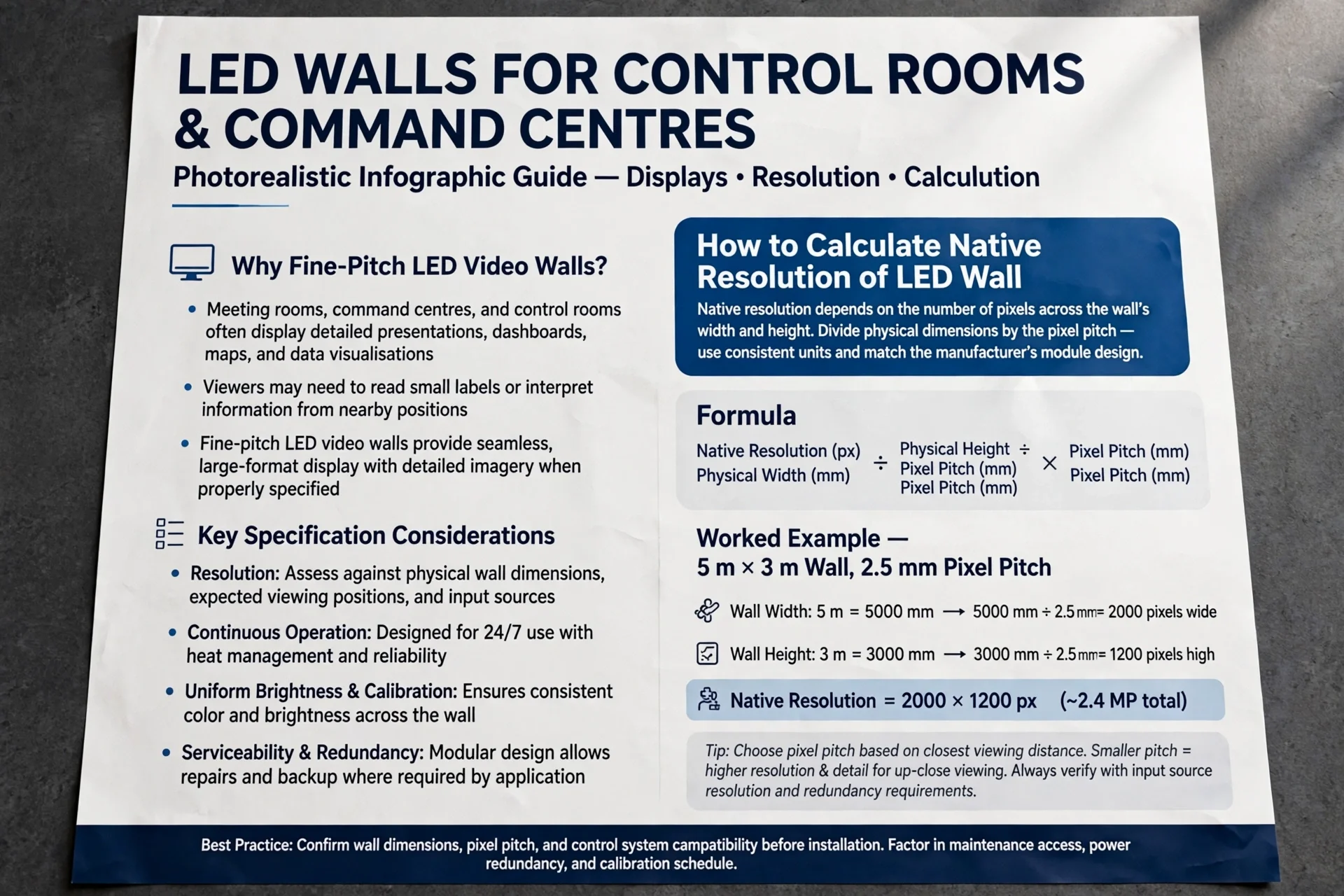
Pixel pitch has a direct relationship with the number of pixels that can fit into a specific physical screen area.
For the same screen dimensions, a smaller pixel pitch provides more pixels.
For example, consider two LED walls with identical physical dimensions. A P2.6 display will contain substantially more pixels than a P3.9 display.
This higher pixel density can improve the reproduction of:
- Fine typography
- Detailed graphics
- Facial features
- Product photography
- Architectural images
- High-resolution video
- Data visualization
However, the source content also needs sufficient resolution. Installing a very fine-pitch display does not automatically make low-resolution video look high-resolution.

Pixel Pitch and Image Sharpness
Image sharpness is influenced by several factors, but pixel density is fundamental.
When individual pixels are smaller and closer together, the eye can perceive a more continuous image at shorter distances. This is particularly noticeable with text and detailed graphics.
For example, an LED screen displaying a corporate presentation may need to reproduce small fonts and detailed charts. If the viewing audience is relatively close, a fine pixel pitch can make these elements easier to read.
For a concert where the primary content consists of large animated graphics and performers, the audience may be much farther away, making a larger pixel pitch entirely appropriate.
Pixel Pitch and LED Screen Size
Screen dimensions should always be considered alongside pixel pitch.
A large LED wall with a relatively fine pixel pitch can deliver extremely high resolution. However, this can increase equipment requirements, processing capacity, transportation considerations, power consumption, and rental cost.
Conversely, a large screen with a larger pixel pitch can provide sufficient resolution for long-distance viewing while reducing the total number of LED pixels.
For rental events, the objective is not necessarily to choose the smallest possible pixel pitch. The objective is to choose the most appropriate pixel density for the intended audience and application.
Pixel Pitch for Corporate Events in Dubai
Dubai hosts a large number of corporate conferences, business forums, product launches, seminars, award ceremonies, and networking events.
Venues such as Dubai World Trade Centre, Dubai Exhibition Centre, Dubai International Convention and Exhibition Centre, and major hotels in Downtown Dubai and Business Bay may require different LED display configurations.
For a conference where delegates are seated relatively close to the stage, a fine or medium pixel pitch can help presentation slides remain readable.
If the LED wall is used as a stage backdrop, the production team may also prioritize camera-friendly specifications such as high refresh rate and suitable processing.
Pixel Pitch for Exhibition Stands


7
Exhibitions create unique LED display requirements because visitors can approach the screen from very short distances.
At trade shows such as GITEX Global, Arab Health, Gulfood, Dubai International Boat Show, and The Big 5, exhibitors often use LED walls to attract attention and communicate product information.
When visitors stand close to the display, a coarse pixel pitch can make individual pixels more noticeable.
Fine-pitch or medium-fine-pitch LED technology can be particularly useful for exhibition environments where branding, product imagery, video demonstrations, and text need to remain visually sharp.
Pixel Pitch for Concerts and Stage Productions
Concerts and entertainment productions often use large LED walls as stage backdrops, IMAG displays, side screens, and scenic elements.
The appropriate pixel pitch depends largely on audience distance and screen position.
Main-stage LED walls viewed from the back of an arena can use a larger pixel pitch than smaller side screens positioned closer to the audience.
Production teams must also consider refresh rate because LED displays used on camera can exhibit scanning lines, flickering, or banding if their specifications are unsuitable for the camera system.
For professional stage productions, pixel pitch should therefore be selected alongside refresh rate, receiving cards, processors, brightness, and camera requirements.

Pixel Pitch and Camera Performance
Camera compatibility is increasingly important for conferences, livestreams, concerts, corporate productions, and hybrid events.
An LED screen may look excellent to the human eye but behave differently when captured by a professional camera.
Important specifications can include:
Refresh rate: Higher refresh rates can help reduce visible flicker and scanning artifacts.
Scan technology: The LED module’s scan architecture can influence camera performance.
Processing: Video processors and receiving cards affect image timing and signal management.
Brightness: Excessive brightness can affect exposure and image balance.
Pixel pitch: Fine pitch can provide a denser visual structure that is often beneficial for close camera shots.
For events with live production, the LED rental provider should coordinate with the camera and production teams before selecting the final display.
Pixel Pitch and Brightness Are Different
A common misconception is that smaller pixel pitch automatically means a brighter screen. Pixel pitch and brightness describe different characteristics.
Pixel pitch concerns the physical spacing of LED pixels.
Brightness refers to the amount of light produced by the display, typically expressed in nits or candelas per square meter.
An outdoor LED screen may require significantly higher brightness than an indoor display because direct sunlight can wash out the image.
For indoor exhibitions or conference rooms, excessive brightness can be uncomfortable and may reduce visual quality.
The appropriate LED display therefore requires a balance between pixel pitch and brightness based on the venue.

Pixel Pitch and Contrast
Contrast ratio describes the difference between the darkest and brightest portions of an image.
High contrast can make colors appear more vivid and improve the visual separation between dark backgrounds and bright objects.
Pixel pitch contributes to perceived image quality, but contrast is influenced by other factors such as LED package design, cabinet construction, black level, processing, ambient light, and calibration.
In an event environment, a display with an appropriate pixel pitch but poor contrast may still produce an underwhelming image.
Pixel Pitch and Viewing Angle
LED rental screens are frequently viewed from different positions.
At exhibitions, people may approach from the side. At conferences, audiences may sit across a wide seating area. At concerts, viewers may be distributed across an entire venue.
A quality LED display should provide suitable horizontal and vertical viewing angles so that colors and brightness remain consistent across the audience.
Pixel pitch does not determine viewing angle by itself. LED package technology, module design, optical characteristics, and cabinet configuration also influence the result.
Pixel Pitch for Indoor and Outdoor Applications
Indoor and outdoor LED rental screens have different priorities.
Indoor displays generally focus on fine pixel pitch, close viewing distances, lower brightness requirements, lightweight cabinets, and high visual detail.
Outdoor displays need greater brightness, weather protection, structural stability, thermal management, and resistance to environmental conditions.
For example, a P1.5 LED wall may be ideal for a corporate ballroom but inappropriate for a large outdoor festival if the display lacks the required brightness and weather protection.
Likewise, using a very high-brightness outdoor display in a dark conference room can produce an uncomfortable viewing experience.

Rental Cabinet Design and Pixel Pitch
LED rental screens are generally built using modular cabinets that can be assembled into different configurations.
Cabinet dimensions, weight, locking mechanisms, module accessibility, and curve capability influence how quickly the display can be installed and adapted to different venues.
For rental companies, the cabinet must also be durable enough to withstand repeated transportation and installation.
A high-quality rental LED cabinet should maintain accurate alignment between modules. Misaligned cabinets can create visible seams or irregularities even when the pixel pitch is appropriate.
Pixel Pitch and Content Design
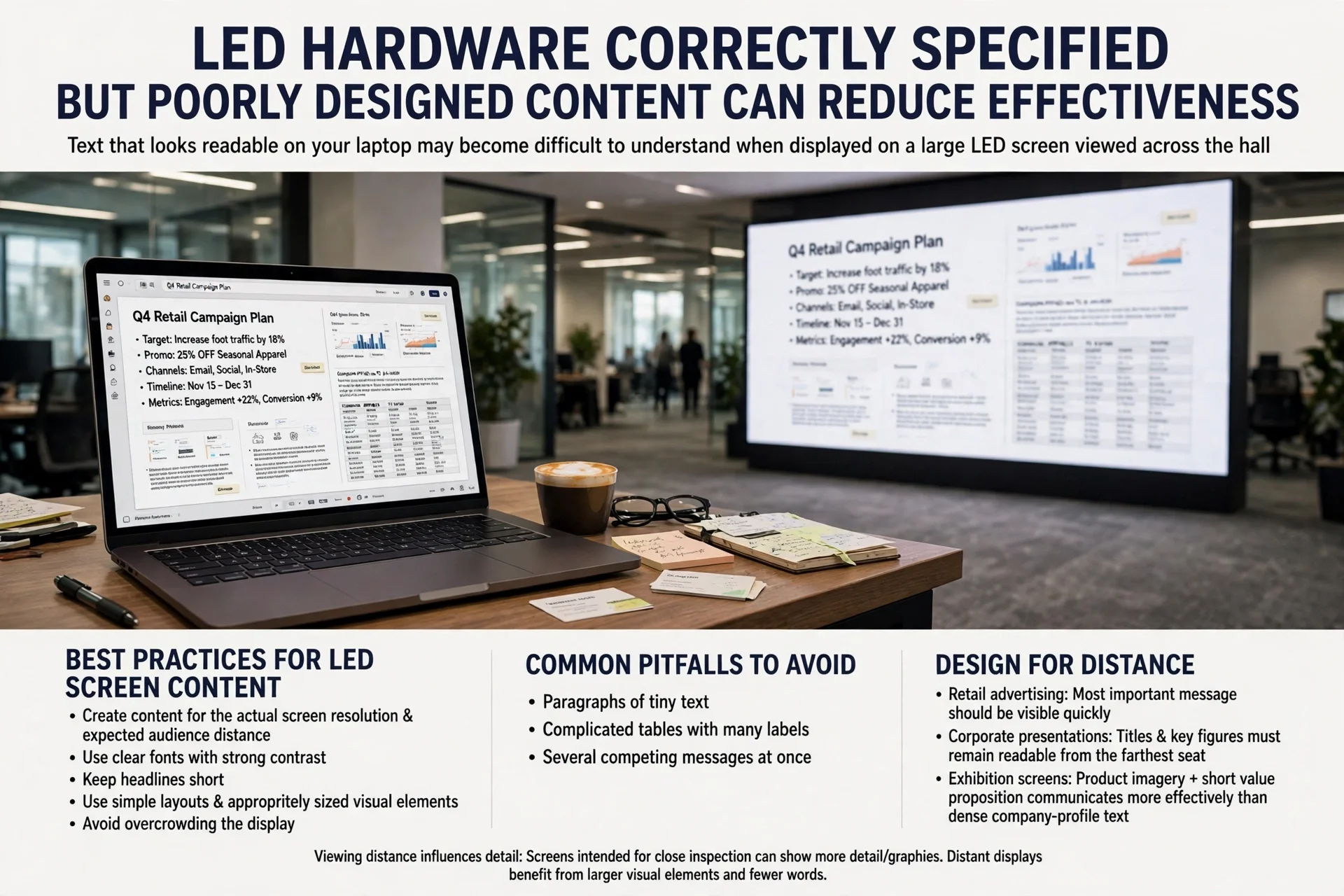
Content should be created according to the characteristics of the LED screen.
A screen with a fine pixel pitch can reproduce detailed content effectively, but designers should still consider viewing distance.
For large stage screens, text should generally be large enough to be read from the intended audience area. Important information should not be placed too close to cabinet boundaries or screen edges.
Animations should also be optimized for the screen’s aspect ratio and resolution.
Professional LED production teams commonly use video processors and media servers to scale and distribute content correctly across large LED walls.
Selecting the Right Pixel Pitch for a Dubai Event
There is no single pixel pitch that is ideal for every event in Dubai.
A professional assessment should consider:
Audience distance: How close will viewers stand or sit?
Screen size: How large will the LED wall be?
Venue: Is it an exhibition hall, ballroom, outdoor stage, stadium, retail environment, or conference room?
Content: Will the display show text-heavy presentations, video, branding, photography, or live camera feeds?
Lighting: Is the display indoors, outdoors, or exposed to daylight?
Camera use: Will the event be livestreamed or professionally filmed?
Budget: Does the event require fine-pitch technology or would a medium-pitch solution provide sufficient quality?
These factors provide a much more reliable basis for selecting an LED display than simply choosing the smallest pixel pitch available.

Common Pixel Pitch Mistakes
One of the most common mistakes is selecting a display solely because it has the smallest pixel pitch.
A P1.2 screen may provide exceptional detail, but using it for a giant outdoor stage viewed from 40 meters away may provide little practical benefit compared with a properly selected larger-pitch display.
Another mistake is ignoring brightness. A fine-pitch indoor screen may not perform well outdoors in direct sunlight.
A third mistake is failing to consider camera requirements. An event that will be livestreamed needs an LED system capable of delivering camera-friendly performance.
The best rental solution considers the complete event environment.
Pixel Pitch Comparison
| Pixel Pitch | Typical Application | Viewing Distance | Key Advantage |
|---|---|---|---|
| P1.2 | Corporate, broadcast, premium indoor events | Very close | Extremely high detail |
| P1.5 | Conferences, exhibitions, premium displays | Close | Excellent text and image clarity |
| P1.8 | Indoor events and exhibitions | Close to medium | Fine image reproduction |
| P2.6 | Corporate events and exhibitions | Medium | Balance of clarity and cost |
| P2.9 | Conferences, exhibitions, stages | Medium | Versatile rental application |
| P3.9 | Events, stages, exhibitions | Medium to long | Popular all-purpose rental option |
| P4.8 | Large events and outdoor stages | Long | Cost-effective for distance |
| P5–P6+ | Outdoor events, festivals, large venues | Long | Effective long-distance viewing |
These are general application categories rather than strict industry rules. Actual selection should be based on the venue and technical requirements.
How Pixel Pitch Affects Rental Cost
Pixel pitch can have a significant impact on rental pricing because finer-pitch displays contain more LEDs and require greater pixel density.
However, rental cost is influenced by more than pixel pitch. Other factors include:
- Screen dimensions
- Rental duration
- Indoor or outdoor specification
- Brightness
- Cabinet type
- Installation complexity
- Rigging requirements
- Transportation
- LED processor
- Technician support
- Content management
- Event location
- Setup and dismantling requirements
A professional rental company can often recommend a cost-effective configuration that meets the event’s actual requirements without unnecessarily upgrading to an ultra-fine pitch.

LED Rental Screens in Dubai and the UAE
Dubai’s event industry includes international exhibitions, luxury weddings, corporate conferences, sporting events, concerts, government functions, product launches, and large-scale public events.
This diversity means LED rental suppliers need access to different pixel-pitch options.
A single event may even require multiple pixel pitches. For example, a large outdoor stage might use P4.8 or P3.9 for the main wall while a smaller VIP area uses a finer-pitch display for close viewing.
In Abu Dhabi, Sharjah, Ajman, and other UAE locations, venue dimensions and audience layouts can similarly influence the appropriate specification.
Professional LED Screen Planning
Successful LED screen rental begins before the equipment arrives at the venue.
The supplier should understand the stage dimensions, audience layout, rigging points, power availability, content resolution, camera setup, installation access, and event schedule.
A technical site survey can identify practical limitations before installation begins.
For major events, suppliers may also create a screen layout showing cabinet dimensions, pixel resolution, processing requirements, power distribution, and mounting or rigging arrangements.
This preparation reduces the risk of last-minute technical problems.

Frequently Asked Questions About LED Pixel Pitch
What is the best pixel pitch for an LED rental screen?
There is no universal best pixel pitch. The correct choice depends on viewing distance, screen size, venue, content, lighting, and whether cameras will be used.
Is a smaller pixel pitch always better?
No. Smaller pixel pitch provides higher pixel density and better close-range detail, but it can cost more. For long-distance viewing, a larger pitch may provide excellent results at a lower rental cost.
What pixel pitch is good for exhibitions?
P1.5, P1.8, P2.6, and P2.9 can be suitable depending on booth size, visitor distance, screen dimensions, and content. Close-viewing applications generally benefit from finer pitch.
What pixel pitch is suitable for outdoor events?
Outdoor applications commonly use larger pitches such as P3.9, P4.8, P5, or P6, depending on audience distance and screen size. Brightness and weather protection are also critical.
Does pixel pitch affect LED screen resolution?
Yes. Smaller pixel pitch means more pixels can fit into a given physical area, resulting in higher native resolution for the same screen dimensions.
Does pixel pitch affect LED screen price?
Generally, finer pixel-pitch displays can cost more because they contain more LED pixels and require higher component density. However, total rental pricing also depends on screen size, duration, installation, location, and technical support.
Final Thoughts on Choosing Pixel Pitch
Pixel pitch is a fundamental factor in LED rental screen performance, but it should never be considered alone. The ideal display is determined by the relationship between pixel density, viewing distance, screen size, content, brightness, viewing angle, refresh rate, camera requirements, and venue conditions.
For close-viewing environments such as exhibition stands, corporate conferences, hotel ballrooms, and product launches, fine-pitch LED displays can provide excellent detail and readability. For concerts, outdoor festivals, sporting events, and large stages, medium or larger pixel pitches can deliver strong visual impact at significantly longer viewing distances.
In Dubai and throughout the UAE, the best approach is to work with an experienced LED rental provider that can assess the venue and recommend a configuration based on the actual audience and production requirements.
Ultimately, the best pixel pitch is not the smallest one—it is the one that delivers the required image quality at the intended viewing distance while providing the right balance of performance, reliability, and rental cost.