Renting an LED screen in Dubai can be an effective way to make an event, exhibition, conference, product launch, wedding, concert, or corporate activation more visible and engaging. However, an LED screen rental involves much more than choosing a screen size and paying for equipment. Screen type, pixel pitch, viewing distance, venue conditions, installation, content, power requirements, operation, dismantling, and technical support all affect the final experience.
Dubai has a highly active events and exhibitions industry, with venues such as Dubai World Trade Centre, Dubai Exhibition Centre at Expo City Dubai, Dubai Marina event spaces, hotels in Downtown Dubai, and large outdoor locations hosting events throughout the year. This means LED display requirements can vary significantly from one project to another.
Understanding what happens before, during, and after an LED screen rental can help event organizers plan more accurately and avoid unexpected technical problems.
What Is an LED Screen Rental?
An LED screen rental is a temporary display solution supplied, installed, operated, and removed for a specific event or project. Instead of purchasing a permanent LED display, the event organizer rents the required equipment for a defined period.
Rental LED screens are generally modular. Individual LED panels can be assembled into different screen dimensions depending on the venue and application. A screen can be configured as a large stage backdrop, presentation display, advertising screen, outdoor billboard-style structure, exhibition wall, or creative event installation.
The rental package may include LED cabinets, receiving cards, sending equipment, video processors, control systems, signal cables, power distribution, mounting structures, installation, technical operators, dismantling, and transportation.
The exact package depends on the event requirements and the rental company.
The First Step Is Understanding Your Event
Before selecting an LED screen, the rental provider will normally need information about the event itself.
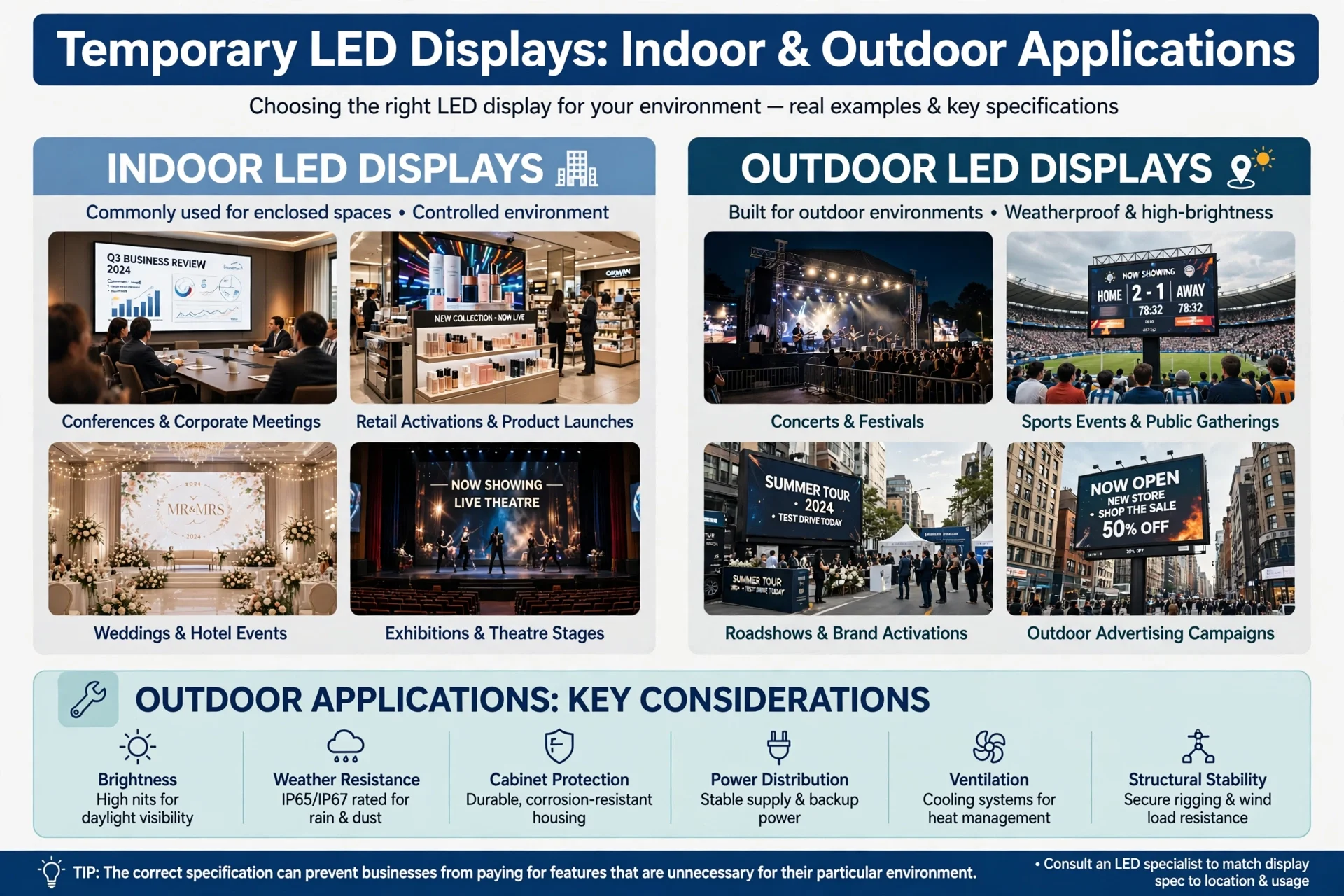
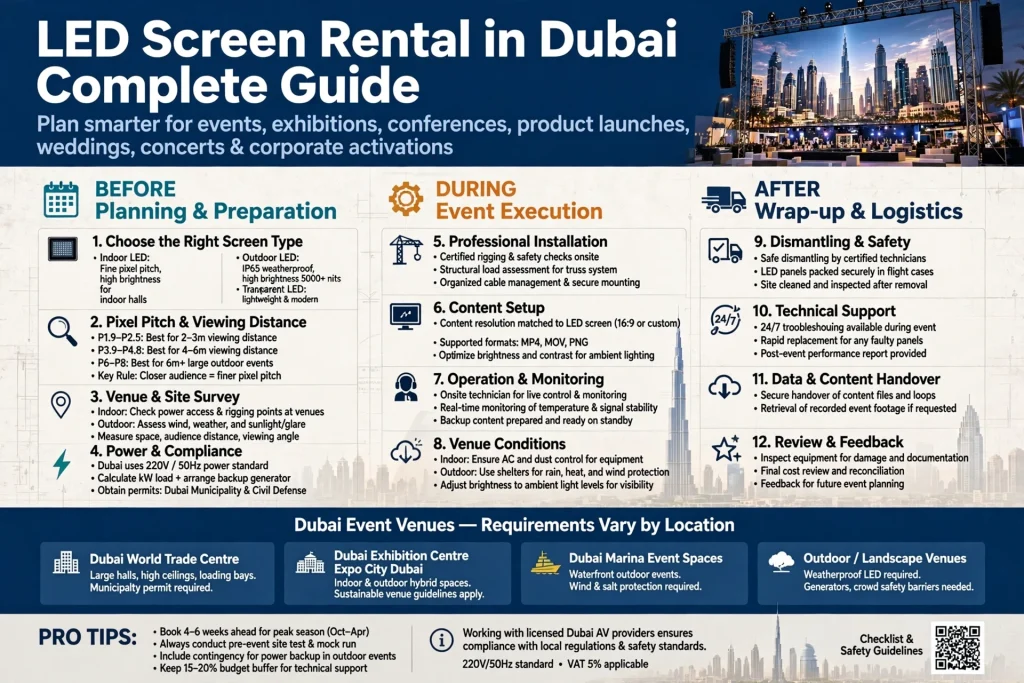
The type of event affects the recommended screen. A corporate conference at a Dubai hotel may require a fine-pitch indoor LED display suitable for presentations and speakers. A concert or outdoor festival may require a high-brightness outdoor LED screen capable of operating in changing weather and daylight conditions.
An exhibition stand at Dubai World Trade Centre may need a compact LED wall that fits within a specific booth structure, while a product launch could require a much larger stage backdrop.
The event schedule is also important. Installation may need to happen several hours or even a day before the event, depending on venue access and production complexity.
Choosing the Right LED Screen Size
Screen size should be based on the venue, audience size, viewing distance, content and available installation space.
A larger screen is not automatically better. If a screen is too large for a small meeting room, it can dominate the space and create an uncomfortable viewing experience. Conversely, a screen that is too small may be difficult for people at the back of a large auditorium to read.
For exhibitions, the available booth width and height are important. For stages, the screen should work visually with the stage design, lighting, speakers, performers and branding.
The rental provider may recommend dimensions after reviewing the venue layout and expected audience position.
Understanding Pixel Pitch
Pixel pitch is one of the most important technical terms to understand when renting an LED screen.
It refers to the distance between the centres of adjacent LED pixels. Smaller pixel pitches generally provide greater pixel density and are often preferred when viewers will be relatively close to the screen.
For example, a fine-pitch indoor LED display can be suitable for a conference where attendees sit relatively close to the screen. A larger-pitch display may be appropriate for an outdoor event where the audience is much farther away.
The correct pixel pitch depends on viewing distance rather than simply choosing the smallest available number.
Indoor LED Screens for Dubai Events
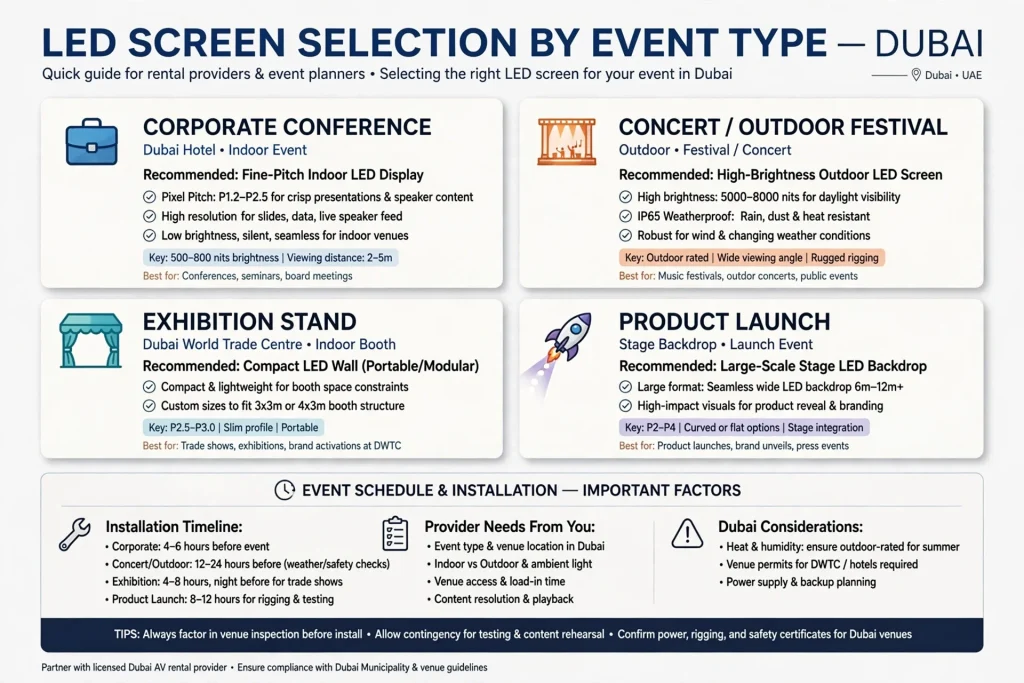
Indoor LED screens are commonly used for conferences, exhibitions, corporate events, hotel functions, seminars, award ceremonies and product launches.
Venues around Downtown Dubai, Business Bay, Dubai Marina and Sheikh Zayed Road frequently host corporate and commercial events where visual quality is important.
Indoor LED displays are generally designed around controlled lighting conditions. They can provide high image quality and are suitable for presentations, videos, animations, logos, speaker graphics and live camera feeds.
When choosing an indoor screen, organizers should consider pixel pitch, brightness, viewing distance, screen dimensions, refresh rate and content resolution.
Outdoor LED Screen Rentals in Dubai
Outdoor events create additional technical requirements. Daylight can make an LED display difficult to see if the screen does not provide sufficient brightness.
Outdoor LED screens are therefore typically designed for higher ambient-light conditions and may have weather-resistant construction. The screen specification should be appropriate for the expected environment.
Outdoor installations can also require additional structural considerations. Wind exposure, mounting height, ballast, truss systems, ground conditions and cable routing should be assessed before installation.
Events at outdoor venues, beach locations, open plazas, sports areas and large public spaces may require a site survey before the rental company confirms the final setup.
LED Screens for Dubai World Trade Centre Events
Dubai World Trade Centre is one of the most important exhibition and event destinations in Dubai. Events held there can range from large international exhibitions to conferences, product launches and corporate functions.
An LED screen installation at an exhibition venue needs to comply with the venue’s access, installation, safety and technical procedures.
For exhibition stands, organizers should provide the booth dimensions, stand design and location to the LED supplier in advance. The supplier can then determine where the LED structure can be installed and how cables, power and control equipment should be positioned.
Early coordination is particularly important when the LED display forms part of a custom exhibition stand.
LED Screens at Expo City Dubai
Expo City Dubai is another major destination for exhibitions, conferences, cultural activities and large-scale events.
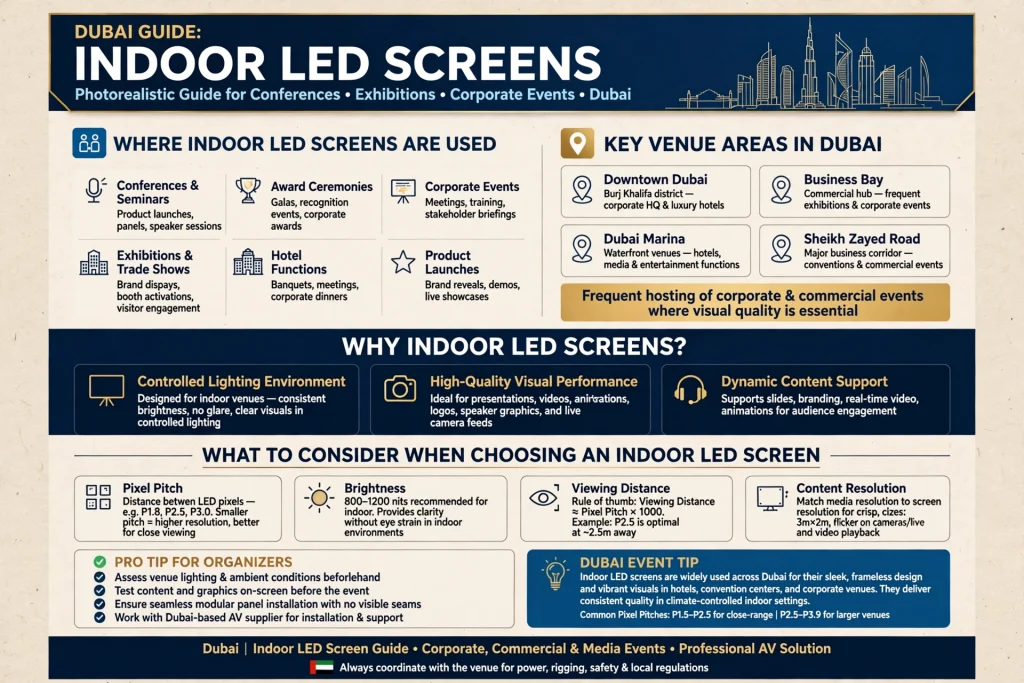
An LED screen installation at Expo City Dubai may have requirements that differ from those of a hotel ballroom or smaller exhibition space. Outdoor installations can also involve additional considerations related to sunlight, weather, structural support and audience viewing distance.
Event organizers should confirm technical access times, installation areas, loading arrangements and venue requirements before finalizing their rental schedule.
Hotel Events and Conference LED Screens
Dubai’s hotels regularly host conferences, seminars, corporate meetings, weddings, gala dinners and product launches.
For a hotel ballroom, the LED screen may serve as a presentation backdrop, stage display, branding wall or live-video surface.
The screen should be selected according to the room dimensions. Ceiling height, stage depth, seating arrangement and audience distance all influence the appropriate screen configuration.
Cable management is also important. Event spaces often need to remain visually clean, so power and signal cables should be routed safely without creating trip hazards or interfering with guest movement.
LED Screens for Exhibitions and Trade Shows
LED displays have become an important part of exhibition stand design because they allow brands to present videos, product demonstrations, animations and corporate messaging in a visually prominent format.
At an exhibition in Dubai, an LED wall can be used as a main backdrop, product presentation screen or dynamic branding element.
The content should be designed specifically for the LED screen’s aspect ratio. Simply displaying a standard presentation on a very wide LED wall can leave large unused areas or make important information difficult to read.
The exhibition stand designer and LED supplier should therefore coordinate screen dimensions before the final artwork is produced.
What Happens During a Site Survey?
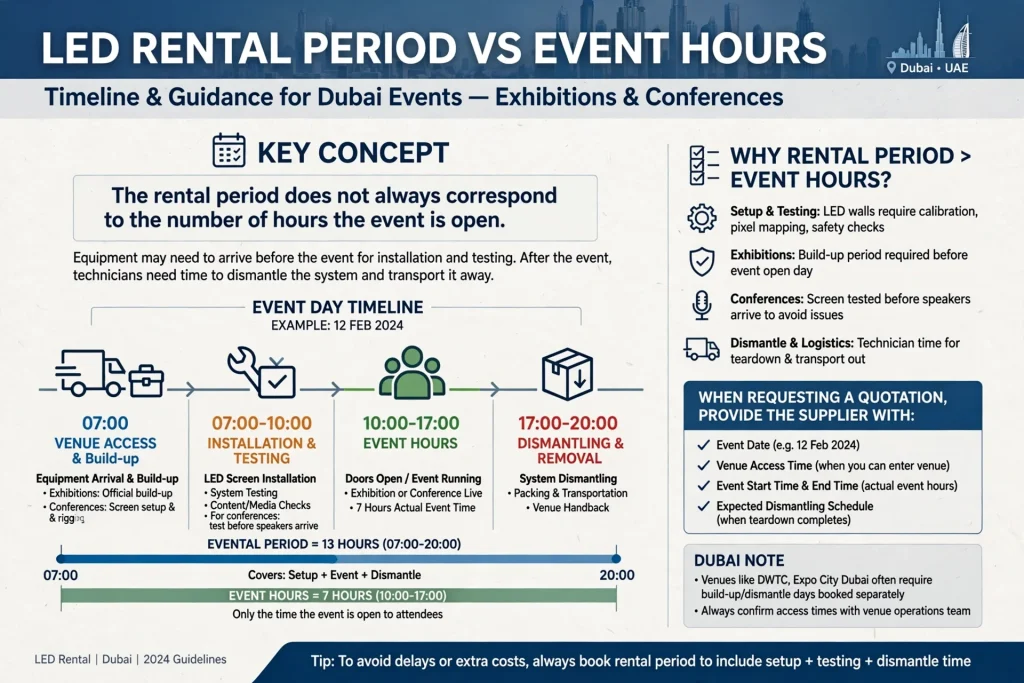
For larger or more complex installations, the rental company may conduct a site survey.
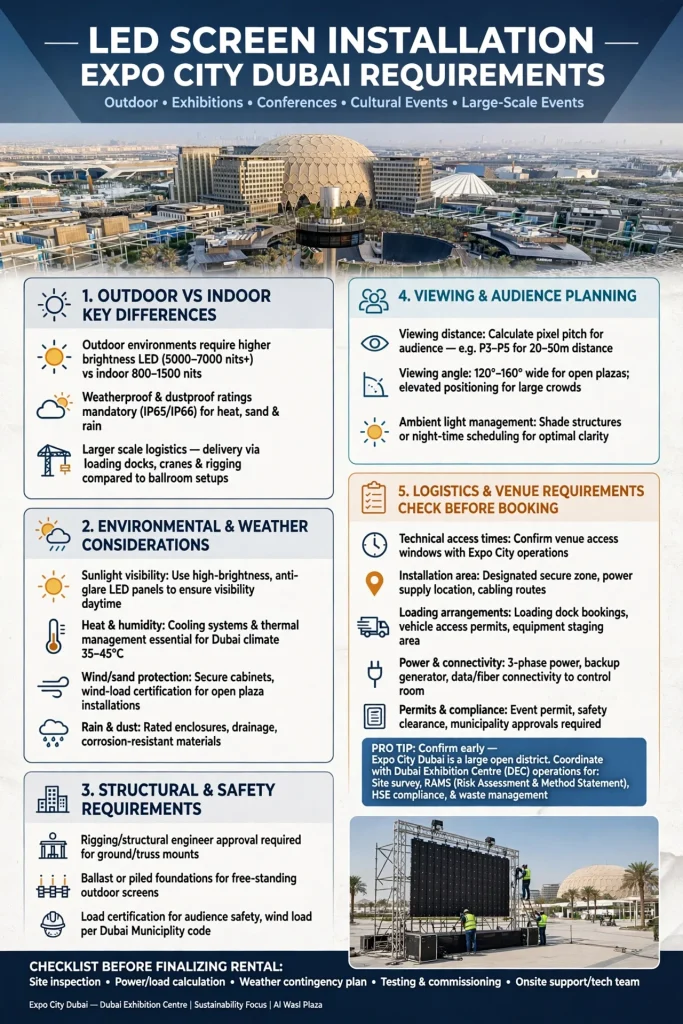
A site survey allows technicians to assess the physical environment before equipment arrives. They may review the proposed screen position, ceiling or structural support, stage dimensions, audience viewing distance, access routes, power availability, cable paths and control position.
For outdoor projects, the survey can also consider ground conditions, weather exposure and structural requirements.
A site survey can identify problems before installation rather than discovering them during event setup.
Installation and Rigging
LED screens are assembled from multiple cabinets or panels. These are connected mechanically and electrically to create the final display.
Depending on the event, the screen may be ground-supported, mounted on a stage structure, attached to a truss system, integrated into an exhibition stand, or suspended using an approved rigging arrangement.
Large suspended LED displays require particularly careful coordination because the structure, rigging points, load capacity and safety procedures must be considered.
The LED rental company should coordinate with the event production team and venue rather than treating the screen as an isolated piece of equipment.
Power Requirements
LED screens require electrical power, and larger displays can create significant power demand.
The required power depends on screen size, LED technology, brightness settings and operating conditions.
For an event, power distribution should be planned before installation. The production team needs to know where power will be available and whether additional distribution equipment is required.
Power cables should also be routed safely and protected from pedestrian traffic.
For large events in Dubai, the screen’s electrical requirements should be coordinated with the venue and wider event production system.
Video Processors and Signal Equipment
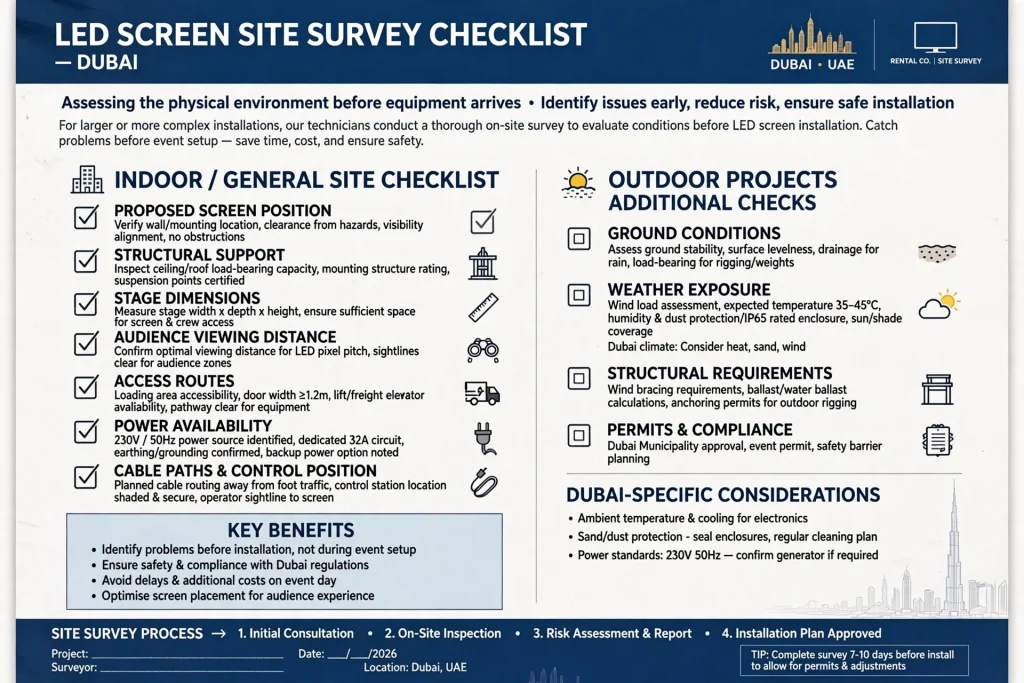
The LED panels themselves are only one part of the display system.
Video processors and sending/receiving equipment help convert and distribute the image signal across the LED display. Depending on the event, the system may also need laptops, cameras, switchers, media servers or other video sources.
For a conference, the screen might receive presentations from a laptop. For a concert, it could display live camera feeds, animations and pre-produced content.
The rental provider should confirm the required input formats and connections before the event.
Content Preparation Is Part of the Planning
A technically perfect LED screen can still deliver a poor result if the content is not designed correctly.
Content should match the screen’s aspect ratio and resolution. Text should be large enough to read from the expected viewing distance, and important information should not be placed too close to the screen edges.
Videos should be exported using appropriate resolutions and formats. Logos should ideally be supplied in high-quality formats to prevent visible pixelation.
For exhibitions and corporate events, content can include product videos, company presentations, animations, social media feeds, promotional messages and event schedules.
Refresh Rate and Camera-Friendly Displays
If an event will be photographed, livestreamed or recorded, refresh rate becomes an important consideration.
Some LED screens can produce visible scan lines or flickering when captured by professional cameras, depending on the display technology, camera settings and refresh characteristics.
For conferences, concerts, television production and livestreamed events, the rental company should know in advance that cameras will be used.
The production team can then select and configure an appropriate LED display system.
Brightness and Viewing Conditions
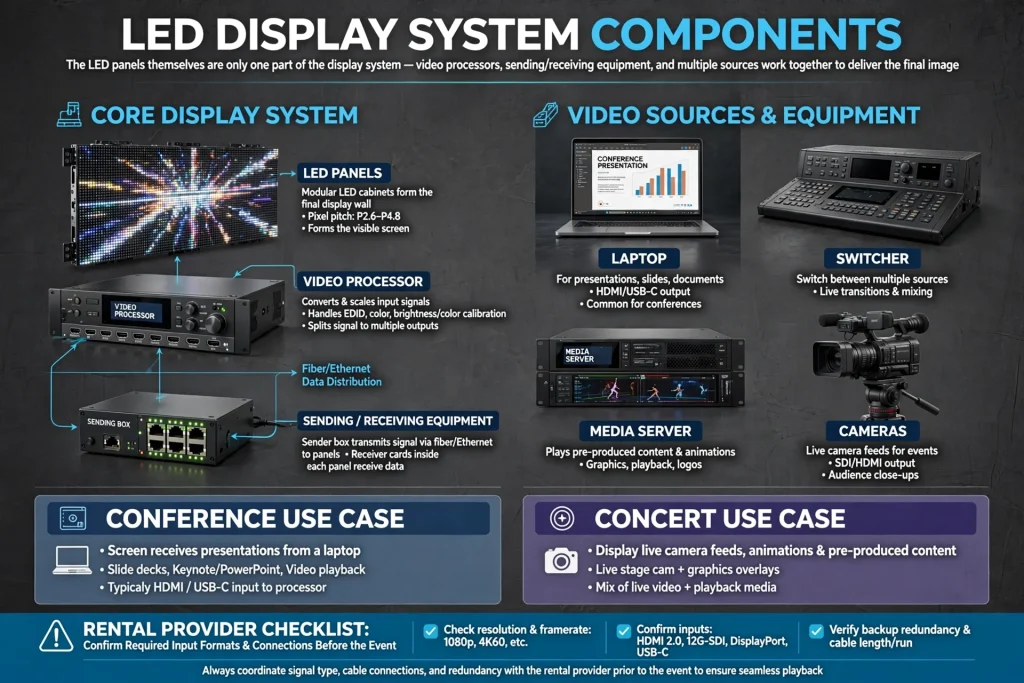
Brightness needs vary between indoor and outdoor environments.
A screen that works well inside a dark conference hall may not be suitable for direct sunlight. Similarly, an extremely bright screen inside a ballroom may be uncomfortable for attendees.
Brightness should therefore be configured according to ambient lighting and the application.
For outdoor Dubai events, daylight conditions should be considered during planning. The screen may need different brightness settings during daytime and evening operation.
Technical Support During the Event
For important events, technical support can be just as important as the hardware itself.
A professional LED rental package may include an operator or technician who remains available during setup and the event. This person can monitor the display, switch inputs, troubleshoot signal issues and coordinate with the production team.
Technical support becomes especially valuable for conferences involving multiple presenters, live cameras, presentations and video playback.
For a simple promotional display, on-site support may not be required throughout the event. The appropriate level of support depends on the complexity and importance of the production.
What Does LED Screen Rental Cost in Dubai?
LED screen rental prices in Dubai vary considerably, so there is no single price that applies to every event.
Cost can depend on screen size, pixel pitch, indoor or outdoor specification, rental duration, installation complexity, rigging, transportation, technician support, content requirements and venue conditions.
A small indoor display for a short corporate event will naturally have different requirements from a large outdoor LED wall for a multi-day festival.
When comparing quotations, event organizers should look beyond the daily rental price. Two suppliers may quote different amounts because one includes delivery, installation, dismantling, technical support and processing equipment while another charges for these separately.
Rental Duration and Setup Time
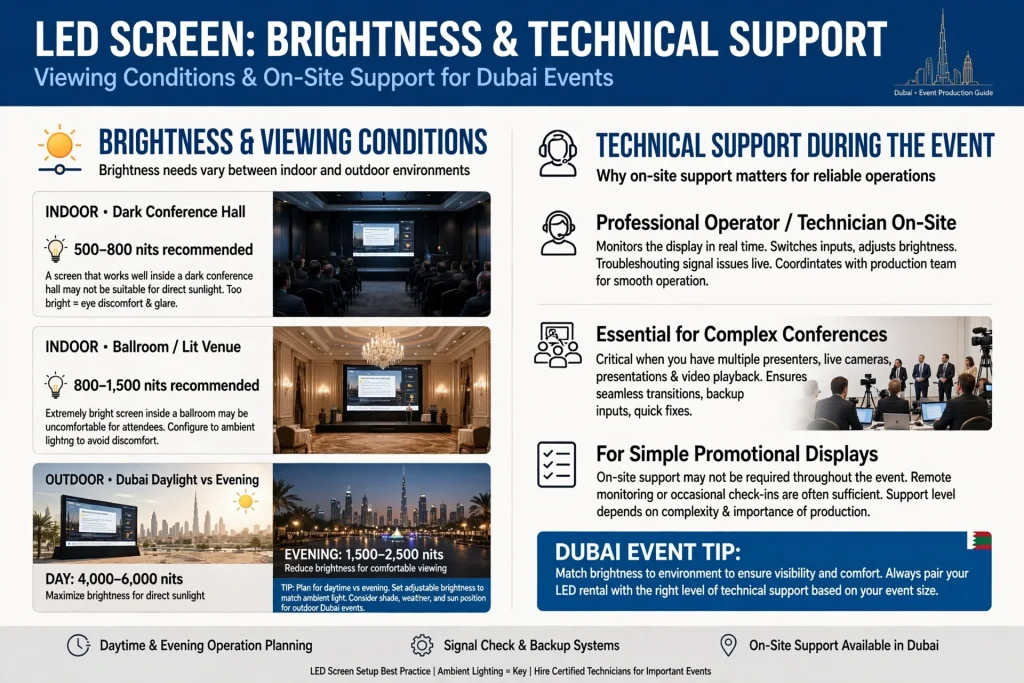
The rental period does not always correspond to the number of hours the event is open.
Equipment may need to arrive before the event for installation and testing. After the event, technicians need time to dismantle the system and transport it away.
For exhibitions, the setup may take place during an official build-up period. For conferences, the screen may need to be tested before speakers arrive.
When requesting a quotation, provide the supplier with the event date, venue access time, event start time and expected dismantling schedule.
Transportation and Logistics in Dubai
Dubai event venues can have strict loading and access procedures. Large LED displays may require multiple cases, transportation vehicles, lifting equipment and several technicians.
The supplier should understand where equipment can be unloaded and how it will reach the installation area.
For venues located in Downtown Dubai, Dubai Marina, Business Bay, Jumeirah or other busy areas, logistical planning can be especially important because traffic and restricted access may affect delivery timing.
The event organizer should provide the venue’s loading and access information as early as possible.
LED Screen Rental for Weddings and Private Events
LED screens are also widely used for weddings, celebrations and private events in Dubai.
They can display photographs, videos, wedding monograms, animations, live camera feeds and personalized content.
For weddings, visual quality and colour reproduction can be particularly important because the display may appear in professional photographs and videos.
The screen should also be coordinated with stage decoration, floral arrangements, lighting and the overall event design.
LED Screens for Product Launches
Product launches often depend heavily on visual presentation. An LED wall can create a large backdrop for product videos, countdown sequences, launch animations and presentations.
The display can also be synchronized with stage lighting and audio to create a coordinated production.
For premium product launches in Dubai, screen resolution, content quality and colour reproduction should be considered carefully because the LED display forms part of the brand experience.
Common Mistakes When Renting an LED Screen
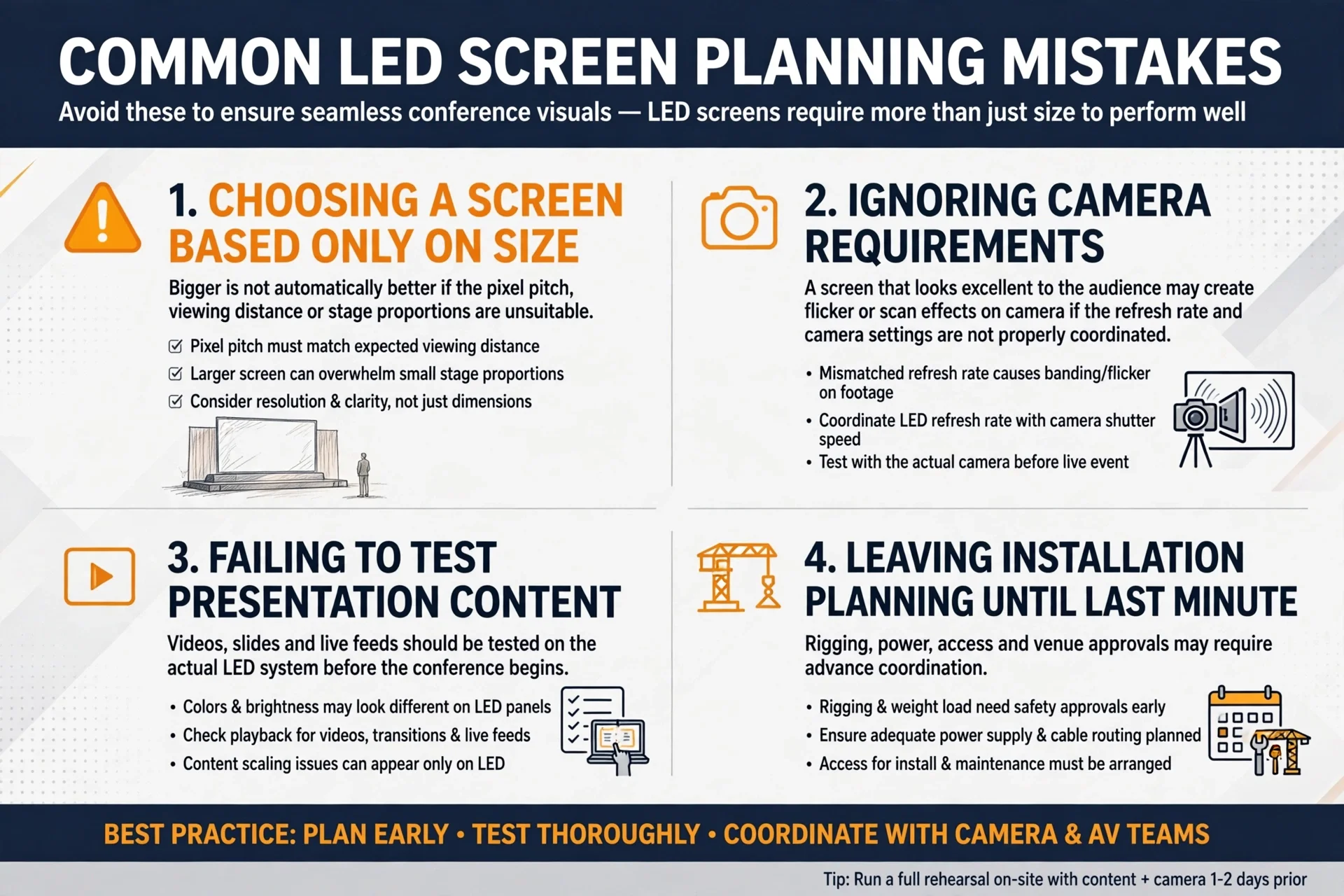
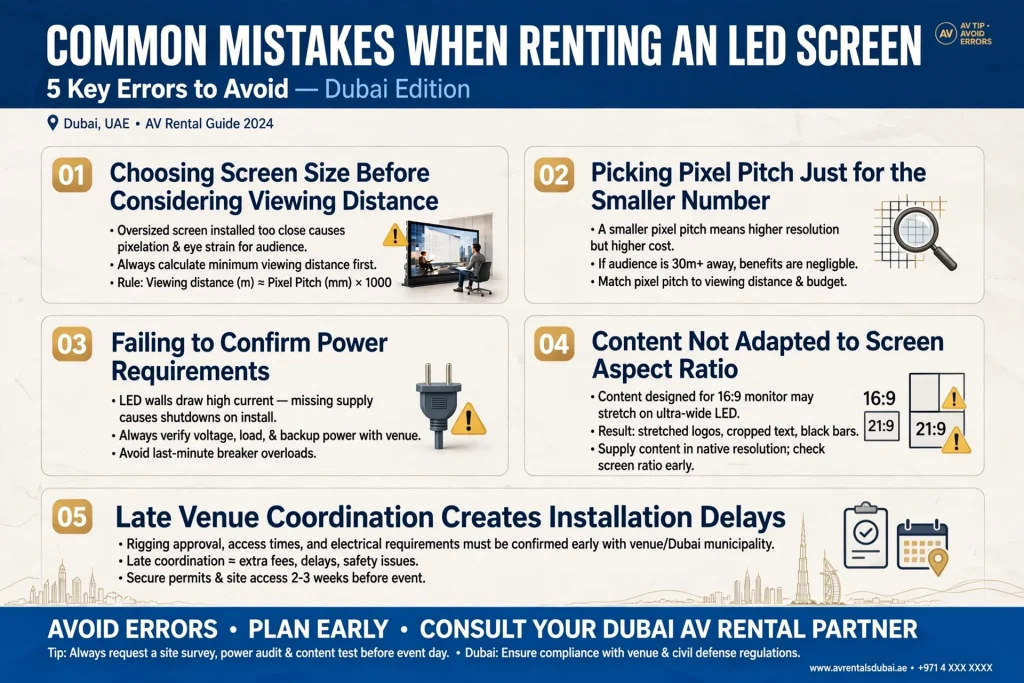
One common mistake is choosing a screen size before considering viewing distance. Another is selecting pixel pitch solely because it has a smaller number without understanding whether the audience will actually benefit from it.
Failing to confirm power requirements can also create problems during installation.
Content is another frequent issue. A presentation designed for a standard 16:9 monitor may not work properly on an unusually wide LED screen.
Late venue coordination can create additional complications, especially when rigging approval, access times or electrical requirements have not been confirmed.
Questions to Ask an LED Screen Rental Company
Before confirming a rental, ask the supplier what is included in the quotation.
Confirm the LED screen size, pixel pitch, indoor or outdoor specification, brightness, refresh rate, processor, installation, dismantling, transportation and technical support.
Also ask about setup and testing time, power requirements, content specifications and what happens if equipment develops a technical problem during the event.
For large productions, it is useful to confirm whether a backup plan or spare equipment is available.
How to Prepare for Your LED Screen Rental
A smooth rental usually starts with accurate event information.
Provide the supplier with the venue name, event date, screen location, desired dimensions, audience size, viewing distance, indoor or outdoor conditions and event schedule.
If you already have an exhibition stand design, stage drawing or venue floor plan, share it with the supplier.
Prepare the content before installation day and confirm its resolution and aspect ratio.
Finally, schedule enough time for testing. The screen should be checked with the actual content, video sources and camera system before guests arrive.
Final Thoughts
Renting an LED screen in Dubai involves a combination of technology, event production, venue coordination and logistics. The right display depends on the event rather than simply the largest available screen.
Dubai’s diverse event environment means a conference at a hotel, an exhibition at Dubai World Trade Centre, an outdoor activation at Expo City Dubai and a private celebration can all require completely different LED display solutions.
By considering screen size, pixel pitch, viewing distance, brightness, refresh rate, content, power, installation, rigging, technical support and venue access in advance, organizers can create a more reliable and professional visual experience.
The most useful approach is to discuss the event requirements with the rental provider before selecting equipment. A properly planned LED screen can become an important part of the stage, exhibition stand, product launch or event environment while helping audiences see presentations, branding and visual content clearly.