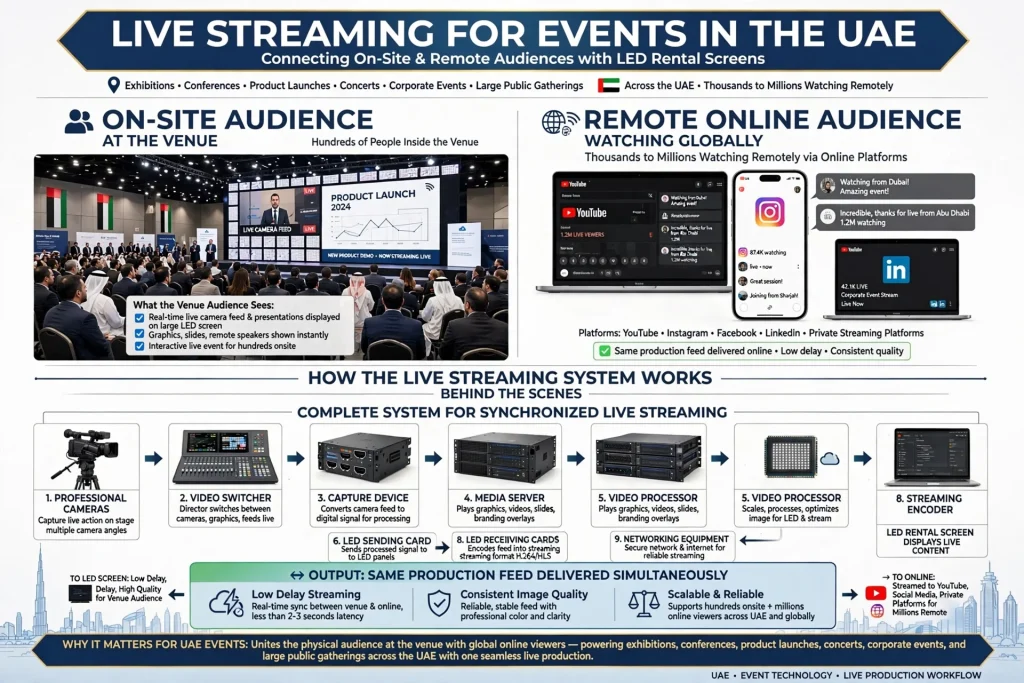
Live streaming has become an important part of exhibitions, conferences, product launches, concerts, corporate events, and large public gatherings across the UAE. An event may have hundreds of people inside the venue while thousands or even millions watch remotely through YouTube, social media, websites, or private streaming platforms. LED rental screens help connect these two audiences by displaying live camera feeds, presentations, graphics, remote speakers, and other real-time content to people at the venue.
Understanding how LED rental screens handle live streaming requires more than looking at the screen itself. The complete system can include professional cameras, video switchers, capture devices, media servers, LED sending cards, receiving cards, video processors, networking equipment, streaming encoders, and content management systems. When these components are properly configured, the LED display can show live content with low delay and consistent image quality while the same production feed is delivered to an online audience.
What Are LED Rental Screens?
LED rental screens are modular LED display systems designed for temporary installation at events and productions. Unlike permanent LED billboards or fixed indoor displays, rental LED panels are built around lightweight cabinets, quick-lock mechanisms, removable modules, and practical transportation systems.
They are commonly used for conferences, exhibitions, concerts, award ceremonies, product launches, weddings, festivals, sporting events, corporate presentations, and outdoor activations.
In Dubai and Abu Dhabi, rental LED displays can be configured for different event sizes. A compact screen may be used behind a speaker at a conference, while a much larger LED video wall can become the primary visual surface at a concert or product launch.
The modular structure also allows event production teams to create different screen shapes and configurations. Flat LED walls, curved configurations, stage backdrops, side screens, confidence monitors, and extended visual surfaces can all be created depending on the event design.
How Live Streaming Works With an LED Rental Screen
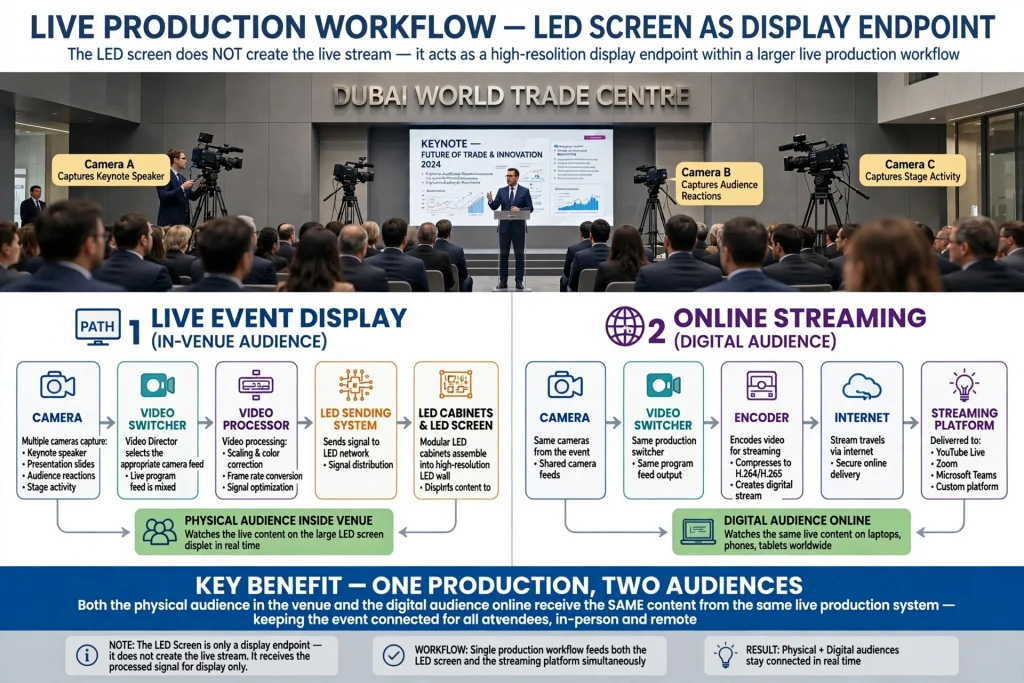
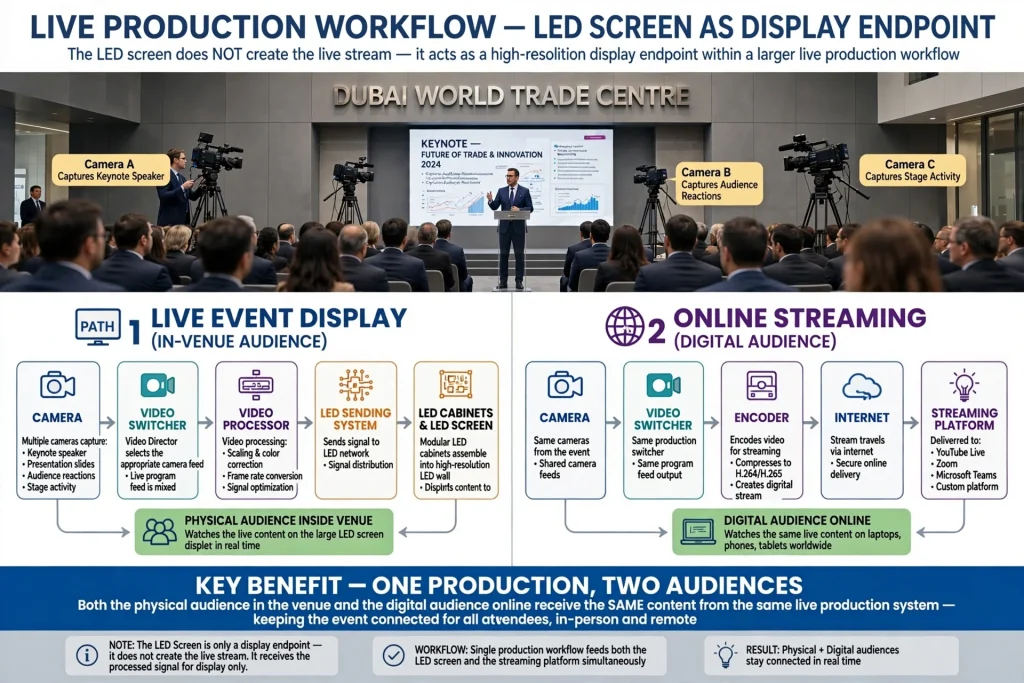
The LED screen itself does not normally create the live stream. Instead, it acts as a high-resolution display endpoint within a larger live production workflow.
A typical live event signal can follow this path:
Camera → Video Switcher → Video Processor → LED Sending System → LED Receiving Cards → LED Cabinets
At the same time, another output from the production system can follow:
Camera → Video Switcher → Encoder → Internet → Streaming Platform
This means the audience inside the venue and the online audience can receive content from the same live production system.
For example, imagine a business conference at Dubai World Trade Centre. Several cameras capture the keynote speaker, presentation slides, audience reactions, and stage activity. A video director selects the appropriate camera feed using a production switcher. The resulting program feed is sent to the LED screen through the video processing chain while a separate output is encoded and transmitted to the online streaming platform.
This workflow allows the physical event and digital audience to remain connected.
The Role of Cameras in Live LED Displays
Professional cameras are one of the most important sources in a live event production system. Multiple cameras may be positioned around the venue to capture different perspectives.
A conference might use one camera for the main speaker, another for the presentation screen, and another for audience reactions. A concert may require several cameras positioned at the stage, front of house, backstage, and elevated positions.
The camera signal is transmitted to the video production system, where the production team can select which image should appear on the LED rental screen.
Camera selection also affects image quality. Resolution, frame rate, shutter settings, exposure, colour balance, lens selection, and camera positioning all influence the final result.
For UAE events, production teams also need to consider lighting conditions. Outdoor events in Dubai, Abu Dhabi, or other areas can experience strong daylight, while indoor conference halls may have controlled stage lighting. Camera exposure and LED brightness should therefore be considered together.
Video Switchers and Live Production
A video switcher is responsible for selecting and combining different live sources. It allows the production operator to move between cameras, presentations, graphics, videos, and other inputs.
For example, during a corporate presentation, the LED screen might show the speaker’s camera feed. When the speaker begins a presentation, the production operator can switch to the presentation computer. When a question comes from the audience, the operator can return to the camera.
Advanced productions can use picture-in-picture layouts, split screens, lower-third graphics, countdown timers, logos, sponsor messages, and other visual elements.
This makes the video switcher an important part of the live event workflow because the LED screen is displaying the output selected by the production team rather than simply showing one permanent source.
Video Processors and LED Screen Signal Management
The video processor connects the live production environment to the LED display system. It receives a video signal and processes it into a format suitable for the LED wall.
Modern LED video processors can provide functions such as scaling, switching, cropping, image positioning, input management, output configuration, and screen mapping.
The processor also helps production teams match the incoming video resolution to the physical LED screen configuration.
For example, an LED wall might have a non-standard resolution because it consists of a specific number of cabinets arranged horizontally and vertically. The processor helps map the content correctly so that important parts of the image are not cropped or distorted.
Brands and systems such as NovaStar and other professional LED control technologies are commonly encountered in event production. The exact processor and receiving-card configuration depends on the LED cabinets and production requirements.
NovaStar and LED Rental Screen Control
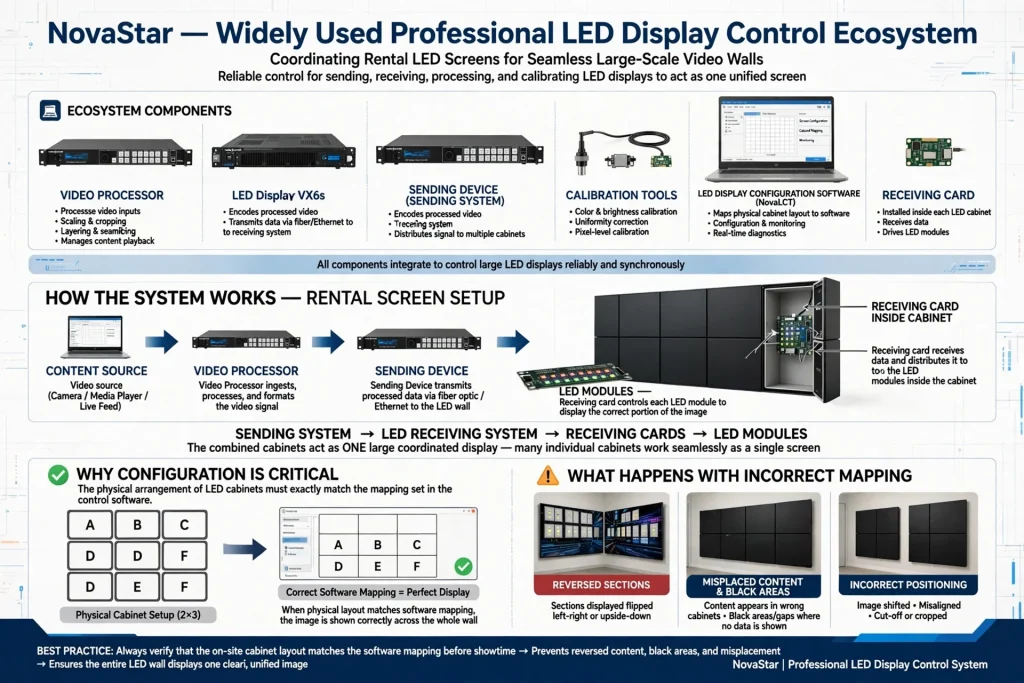
NovaStar is a widely used name in professional LED display control. Its ecosystem can include sending devices, receiving cards, video processors, calibration tools, and LED display configuration software.
In a rental screen setup, the receiving cards inside LED cabinets help control how the video data is displayed by the individual LED modules.
The sending system transfers processed video information to the LED receiving system. The receiving cards then distribute the required information across the LED modules.
This architecture allows a large LED video wall to behave as one coordinated display even though it consists of many individual cabinets.
Configuration is important because the physical arrangement of cabinets must match the mapping inside the control system. Incorrect mapping can result in reversed sections, misplaced content, black areas, or incorrect image positioning.
How Live Streaming and LED Display Outputs Work Together
One of the most useful aspects of professional event production is the ability to create different outputs from the same production environment.
The LED screen may require one resolution and aspect ratio, while the online stream may use another.
For example, a large LED wall at a conference might be a wide-format display designed to cover the stage. The streaming platform may require a standard video format for online viewers.
The production system can therefore create a suitable program feed for the LED display while simultaneously generating a stream output.
This is particularly important for hybrid events, where people attend physically and remotely.
The LED rental screen becomes part of the physical audience experience, while the encoder and streaming platform extend the event beyond the venue.
Streaming Encoders and Internet Connectivity
A streaming encoder converts the production video signal into a format suitable for transmission over the internet.
The encoder works with the event’s streaming platform and internet connection. Depending on the production setup, the stream may be delivered to platforms such as YouTube, Facebook, LinkedIn, a corporate website, or a private streaming service.
Internet reliability is extremely important. A high-quality LED wall can operate perfectly inside the venue, but an unstable internet connection can still interrupt the online stream.
For important UAE events, production teams may therefore plan dedicated internet connectivity, backup connections, network monitoring, and redundant equipment.
This is particularly relevant for conferences, government events, corporate announcements, product launches, and large-scale productions where interruption could affect both the audience and remote viewers.
Live Streaming for Conferences and Corporate Events
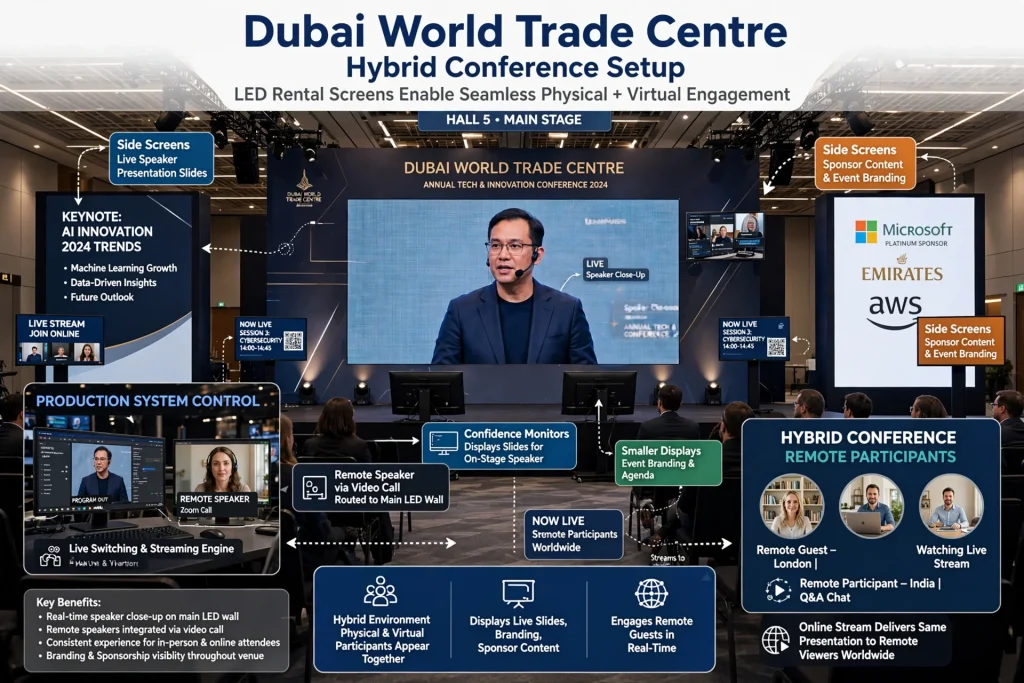
LED rental screens are particularly useful for conferences because they can display the live speaker, presentation slides, remote guests, event branding, and sponsor content.
A conference at Dubai World Trade Centre, for example, may have a main stage LED wall, side screens, confidence monitors, and smaller displays around the venue.
The production system can display a speaker’s close-up on the main LED wall while the online stream delivers the same presentation to remote participants.
Remote speakers can also be incorporated into the production. A video call or remote presentation can be routed through the production system and displayed on the LED wall.
This creates a hybrid conference environment where physical and virtual participants can appear together.
LED Rental Screens for Exhibitions
Exhibitions require a slightly different approach because visitors move around the venue and may see screens from different distances and angles.
At exhibitions in Dubai, LED rental screens can be used on exhibition stands, stage areas, networking zones, product demonstration areas, and large branded structures.
Live streaming can help exhibitors extend their presence beyond the exhibition floor. A company can broadcast product demonstrations, interviews, panel discussions, or keynote sessions to online viewers.
The LED screen can simultaneously show the presenter, product visuals, animation, and branded graphics.
For exhibition contractors and event agencies, working with an experienced LED Rental Screens Supplier can help coordinate the display requirements with the wider production system.
Pixel Pitch and Live Camera Content
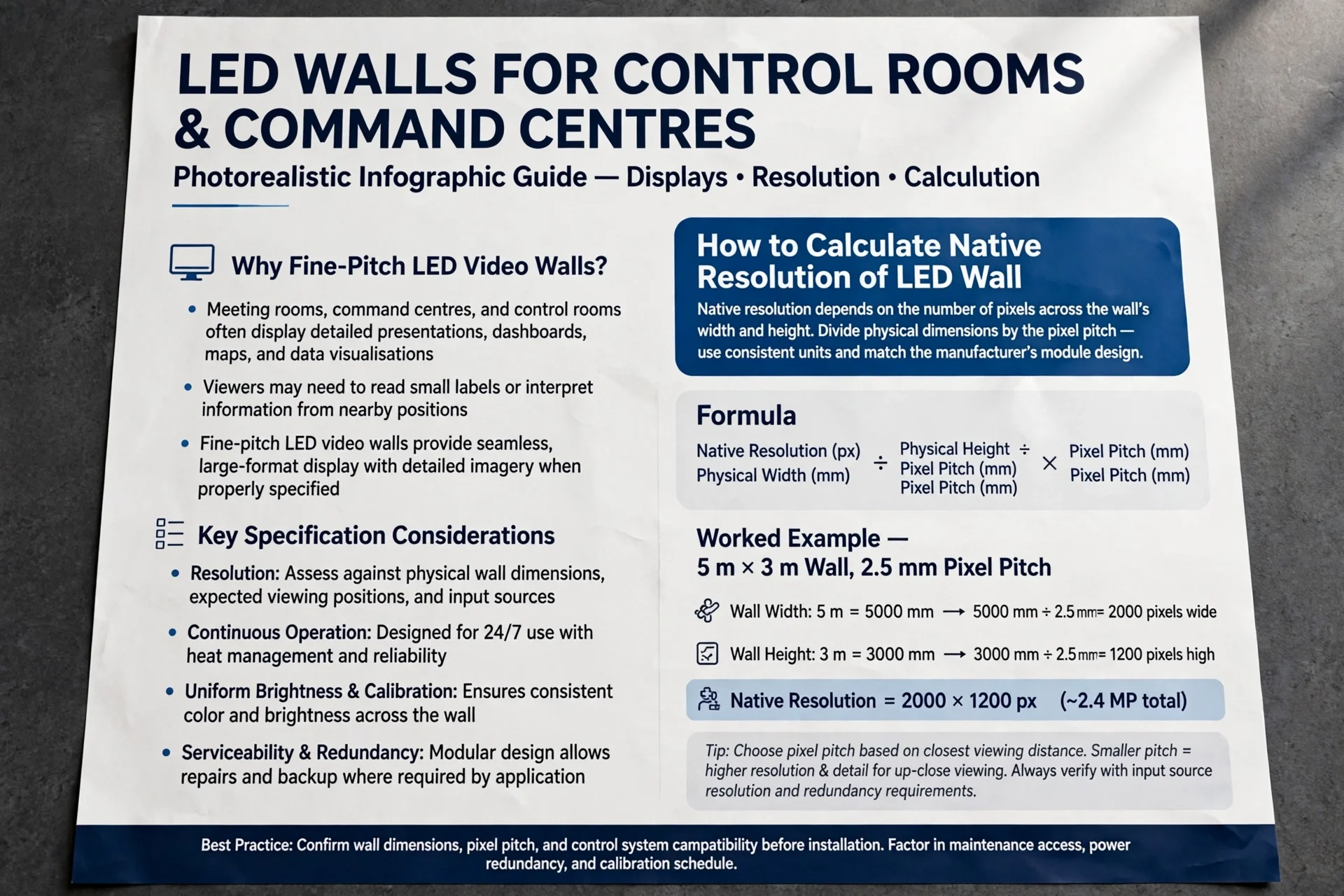
Pixel pitch is an important consideration when using LED screens for live camera feeds.
Pixel pitch refers to the distance between individual LED pixels. Smaller pixel pitch generally provides a higher pixel density and can be suitable when viewers are positioned close to the screen.
For conference rooms, indoor exhibitions, corporate stages, and close-viewing environments, fine-pitch LED displays can provide detailed images.
Larger outdoor screens may use a different pixel pitch because viewers are typically positioned farther away.
Choosing the appropriate pixel pitch depends on screen size, viewing distance, venue conditions, camera content, budget, and display requirements.
Refresh Rate and Camera Compatibility
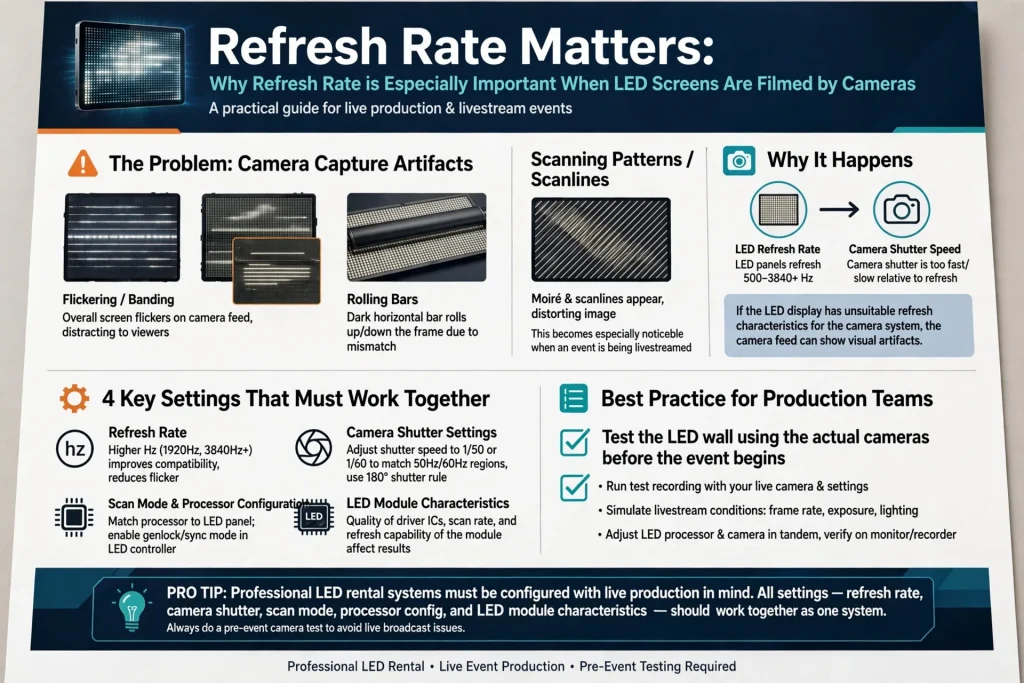
Refresh rate is especially important when LED screens are filmed by cameras.
If an LED display has unsuitable refresh characteristics for the camera system, the camera feed can show visual artifacts such as flickering, rolling bars, or scanning patterns.
This can become particularly noticeable when an event is being livestreamed.
Professional LED rental systems therefore need to be configured with live production in mind. Refresh rate, camera shutter settings, scan mode, processor configuration, and LED module characteristics should work together.
Production teams should test the LED wall using the actual cameras before the event begins.
Brightness for Indoor and Outdoor Streaming
Brightness requirements depend strongly on the environment.
An indoor conference room does not usually require the same brightness level as an outdoor event under direct sunlight.
An outdoor LED rental screen in Dubai may need considerably higher brightness to remain visible during daytime conditions. However, excessive brightness indoors can make the screen uncomfortable to view and can affect camera exposure.
Automatic brightness control, manual calibration, and environmental testing can help maintain appropriate visual performance.
For livestreamed events, brightness should also be evaluated through the cameras. A screen that looks acceptable to the audience may appear overexposed or uneven through a camera.
Colour Accuracy and Camera Feeds
Colour consistency matters when LED screens are used for live broadcasts.
Corporate logos, product colours, sponsor graphics, presentations, and skin tones should appear naturally on the LED wall.
LED calibration can help improve brightness and colour consistency between cabinets and modules. Without proper calibration, individual sections of a large LED wall may appear slightly different.
This becomes more noticeable when the screen is captured by professional cameras.
For brand launches and corporate events, production teams should test logos, product imagery, presentation slides, and live camera feeds before the audience enters the venue.
Low Latency in Live Event Production
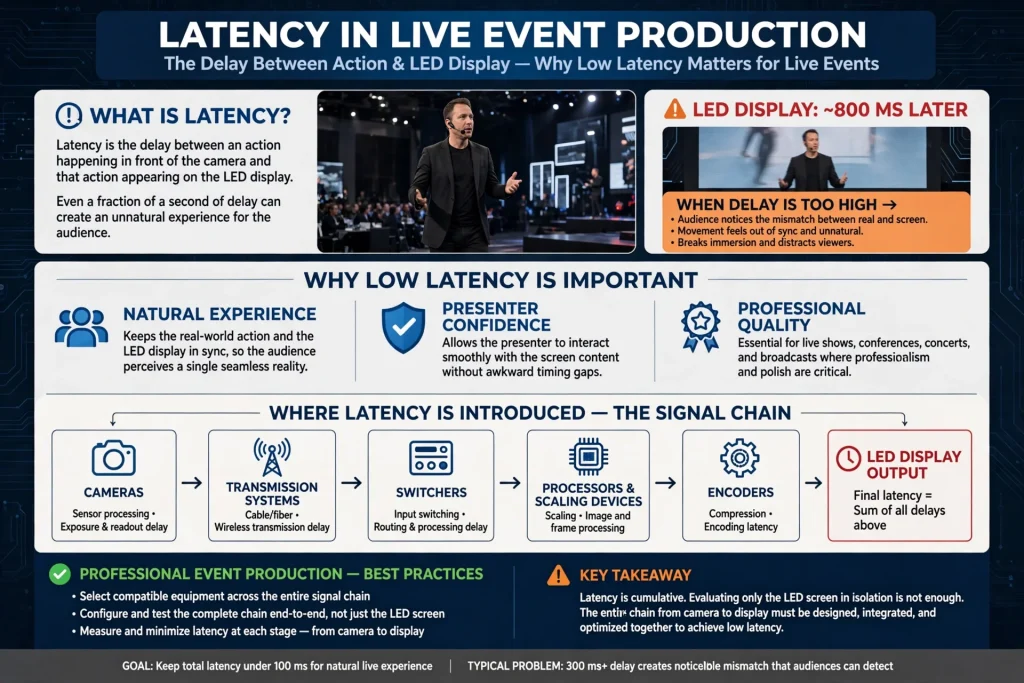
Latency is the delay between an action happening in front of the camera and that action appearing on the LED display.
Low latency is important for live events because excessive delay can create an unnatural experience.
For example, if a presenter moves across the stage and the LED screen displays the movement significantly later, the audience may notice the mismatch.
Latency can be introduced at several points, including cameras, transmission systems, switchers, processors, scaling devices, encoders, and display processing.
Professional event production therefore involves selecting compatible equipment and configuring the complete signal chain rather than evaluating the LED screen in isolation.
LED Screens for Concerts and Stage Events
Concerts and entertainment productions often use LED rental screens as a central part of the stage design.
Live camera feeds can show performers on large screens while additional graphics, animations, sponsor content, and visual effects are displayed around them.
In Dubai and Abu Dhabi, large event productions may use multiple LED surfaces across the stage. The production system needs to manage these displays while maintaining synchronization and consistent content.
Large screens can also be combined with side screens and auxiliary displays so that audiences positioned far from the stage can see the performance clearly.
Hybrid Events and Remote Speakers
Hybrid events have increased the importance of integrating live streaming with physical LED displays.
A speaker may be attending the event physically while another presenter joins remotely. Both can appear on the LED screen through the same production environment.
For example, a Dubai conference could feature a local presenter on stage and a remote speaker joining from another country. The remote participant’s video can be routed through the video switcher and displayed on the LED wall.
The online audience can receive a similar program feed through the streaming platform.
This approach makes the LED screen more than a visual backdrop. It becomes part of the communication system connecting participants across locations.
LED Rental Screens at UAE Event Venues
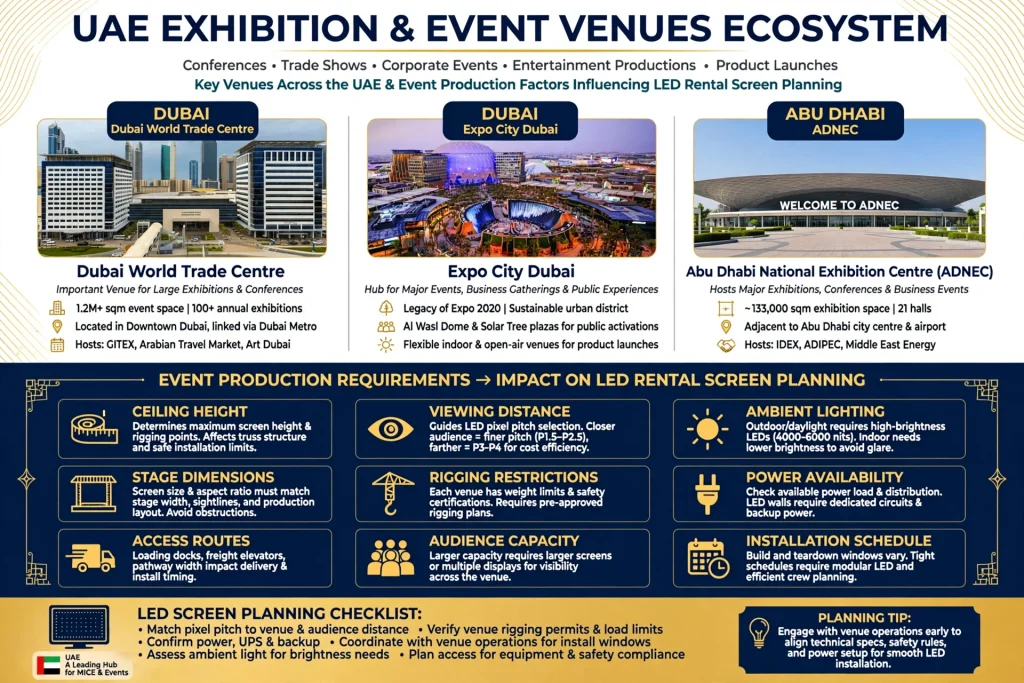
The UAE has a large ecosystem of exhibition and event venues that host conferences, trade shows, corporate events, entertainment productions, and product launches.
Dubai World Trade Centre is an important venue for large exhibitions and conferences. Expo City Dubai also provides spaces for major events, exhibitions, business gatherings, and public experiences.
In Abu Dhabi, the Abu Dhabi National Exhibition Centre, commonly known as ADNEC, hosts major exhibitions, conferences, and business events.
Event production requirements can vary significantly between venues. Ceiling height, viewing distance, ambient lighting, stage dimensions, rigging restrictions, power availability, access routes, audience capacity, and installation schedules can all influence LED rental screen planning.
Live Streaming at Outdoor UAE Events
Outdoor events introduce additional technical considerations.
Daylight affects screen visibility, while heat and environmental conditions can influence equipment operation. Event teams must also consider weather protection, power distribution, cable management, structural support, and safe installation.
Outdoor LED rental screens may be used for festivals, public celebrations, sports events, brand activations, concerts, and corporate functions.
When the event is livestreamed, the production team must manage both the physical display and the online broadcast. Camera exposure, screen brightness, internet connectivity, audio quality, and signal stability should all be tested before the event begins.
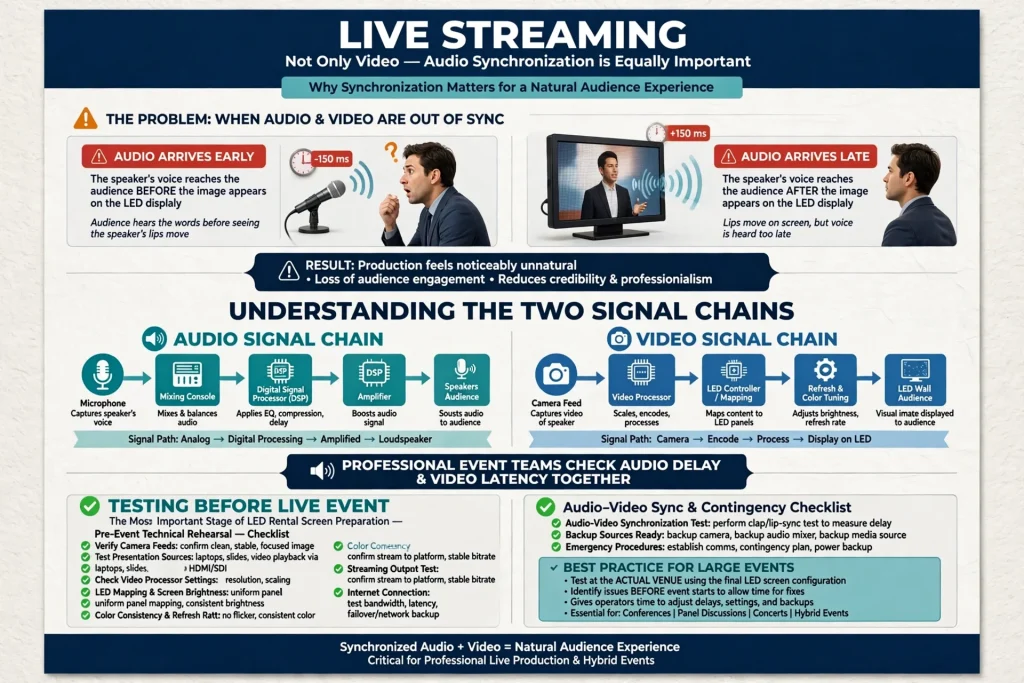
Audio and LED Video Must Stay Synchronized
Live streaming is not only about video.
Audio synchronization is equally important. If a speaker’s voice reaches the audience before or after their image appears on the LED display, the production can feel noticeably unnatural.
Audio signals may pass through microphones, mixing consoles, digital signal processors, amplifiers, and other equipment, while video follows a separate signal chain.
Professional event teams therefore check audio delay and video latency together.
For conferences, panel discussions, concerts, and hybrid events, synchronized audio and video are essential for a natural audience experience.
Testing Before a Live Event
Testing is one of the most important stages of LED rental screen preparation.
A proper technical rehearsal should test the entire signal chain rather than only turning on the LED wall.
Production teams can verify camera feeds, presentation sources, video processor settings, LED mapping, screen brightness, colour consistency, refresh rate, streaming output, internet connection, audio synchronization, backup sources, and emergency procedures.
For large events, testing should ideally take place at the actual venue using the final screen configuration.
This helps identify issues before the event starts and gives operators time to correct configuration problems.
Common Problems With Live LED Streaming
Several problems can occur when LED rental screens are connected to live production systems. Incorrect resolution can cause stretched or cropped content. Incorrect cabinet mapping can create misplaced images. Poor refresh configuration can produce camera flicker.
Other problems can include unstable signal cables, unsuitable converters, insufficient processing capacity, excessive brightness, colour inconsistencies, network interruptions, audio-video delay, and incorrect aspect ratios.
Many of these issues are not caused by the LED panels themselves. They can result from incompatibility or incorrect configuration elsewhere in the production chain.
This is why LED rental planning should consider the entire workflow from camera acquisition to screen output and online streaming.
Choosing an LED Rental System for Live Streaming
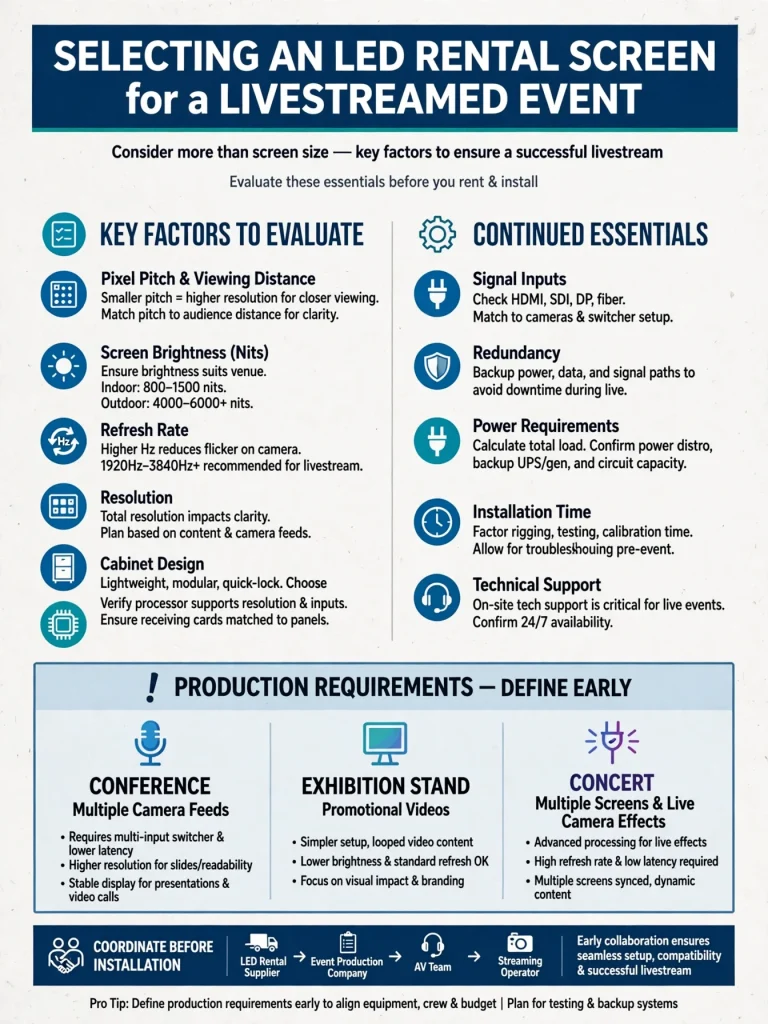
When selecting an LED rental screen for a livestreamed event, consider more than screen size.
The event team should evaluate pixel pitch, viewing distance, screen brightness, refresh rate, resolution, cabinet design, processor compatibility, receiving cards, signal inputs, redundancy, power requirements, installation time, and technical support.
The production requirements should also be defined early.
A conference requiring several camera feeds has different requirements from a simple exhibition stand showing promotional videos. A concert with multiple screens and live camera effects will require a more advanced production system.
The LED rental supplier, event production company, AV team, and streaming operator should ideally coordinate before installation.
Why Professional Integration Matters
A successful livestream depends on the entire production chain working together.
The LED cabinets, receiving cards, sending devices, video processors, cameras, switchers, encoders, audio equipment, network infrastructure, and streaming platform all have different technical requirements.
A professional event production team can coordinate these systems and test them before the audience arrives.
For UAE events, this is especially important when installations have tight setup schedules. Large exhibitions and conferences may provide only limited access time for booth and stage construction, making efficient testing and configuration essential.
The Future of Live Streaming and LED Rental Displays
LED rental technology is becoming increasingly integrated with modern event production. Higher-resolution displays, fine-pitch LED, improved processing, real-time graphics, virtual production, interactive content, remote presenters, and hybrid event platforms are creating more sophisticated experiences.
Live streaming is also becoming a standard part of many corporate and public events rather than an optional feature.
As businesses in Dubai, Abu Dhabi, and other UAE locations continue to invest in conferences, exhibitions, product launches, entertainment, and brand experiences, LED rental screens will remain an important part of physical and digital event communication.
The key is to treat the LED screen as one component of a complete live production ecosystem. When cameras, video processing, LED control, streaming, audio, networking, and screen configuration are planned together, event organisers can deliver a consistent experience to both the people in the venue and audiences watching remotely.
Conclusion
LED rental screens handle live streaming by becoming part of a larger video production and distribution workflow. Cameras capture the event, video switchers select and combine sources, processors prepare signals for the LED wall, sending and receiving systems distribute data to the LED cabinets, and streaming encoders deliver the production feed to online audiences.
For conferences, exhibitions, concerts, product launches, corporate events, and hybrid productions in Dubai and Abu Dhabi, this integration allows one event to reach audiences both inside and outside the venue.
The most reliable results come from planning the complete signal chain, checking pixel pitch and viewing distance, configuring refresh rate and brightness correctly, maintaining colour consistency, testing latency, securing reliable internet connectivity, and carrying out a complete technical rehearsal before the event begins.