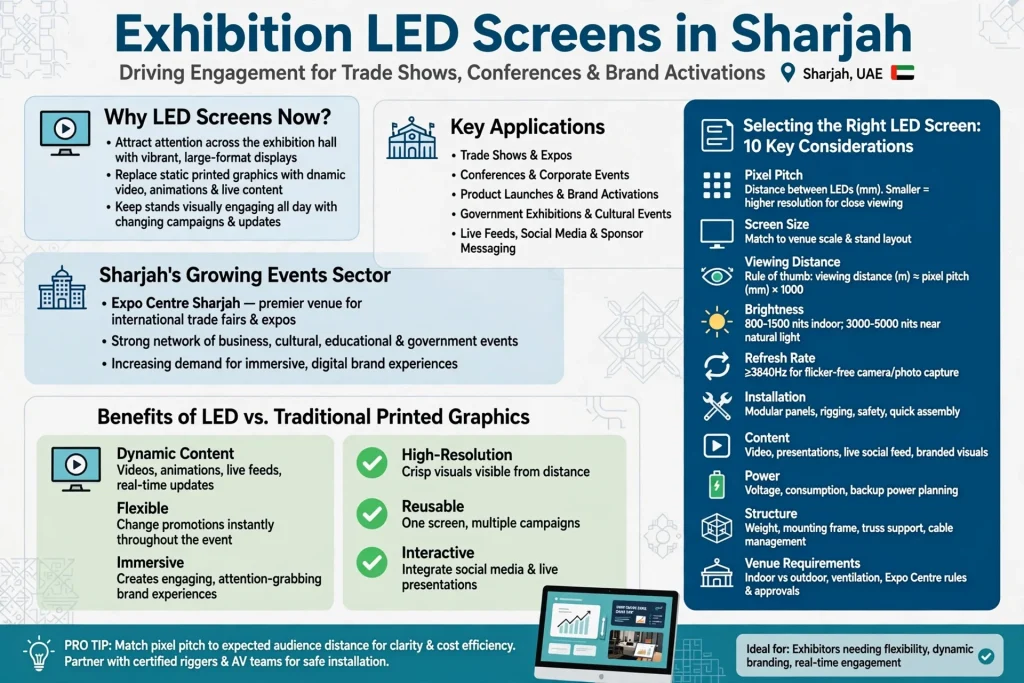
Exhibition LED screens have become an important part of modern trade shows, conferences, product launches, corporate events, government exhibitions, and brand activations in Sharjah. Large-format LED displays can attract attention from across an exhibition hall, present high-resolution promotional content, support presentations, and create immersive brand experiences.
Unlike traditional printed graphics, an LED screen can display videos, animations, product demonstrations, live feeds, presentations, social media content, sponsor messages, and changing promotional campaigns. This flexibility makes LED technology particularly useful for exhibitors who want their stand to remain visually engaging throughout an event.
Sharjah has a strong exhibition and events sector, supported by venues such as Expo Centre Sharjah and a growing network of business, cultural, educational, and government events. Selecting the right LED screen requires consideration of pixel pitch, screen size, viewing distance, brightness, refresh rate, installation, content, power, structure, and venue requirements.
Why Exhibition LED Screens Matter in Sharjah
An exhibition stand competes with many other displays for visitor attention. A static wall graphic can communicate a brand message, but an LED screen can create movement and provide content that changes throughout the event.
A well-positioned screen can be used to display a company introduction, product video, customer testimonials, project portfolio, promotional offers, corporate presentations, or live demonstrations.
For exhibitors in Sharjah, LED displays can be particularly useful at trade fairs where visitors move quickly between stands. A large, bright, properly configured display can establish a strong visual presence from a distance and help visitors identify the stand.
The screen should nevertheless be integrated into the overall exhibition stand rather than treated as a separate piece of equipment.
LED Screens for Exhibition Stands
Exhibition LED screens can be installed in different formats depending on the stand design. A screen may be positioned as a central backdrop, integrated into a reception wall, mounted above a product display, installed within a curved structure, or used as a digital feature wall.
The available stand footprint influences the appropriate screen size.
A small shell-scheme stand may require a compact LED display, while a large island stand can accommodate multiple screens or a larger video wall.
The exhibition stand designer, structural contractor, AV team, and LED screen provider should coordinate before installation to ensure that the screen fits the stand architecture and does not interfere with visitor movement.

Choosing the Right Pixel Pitch
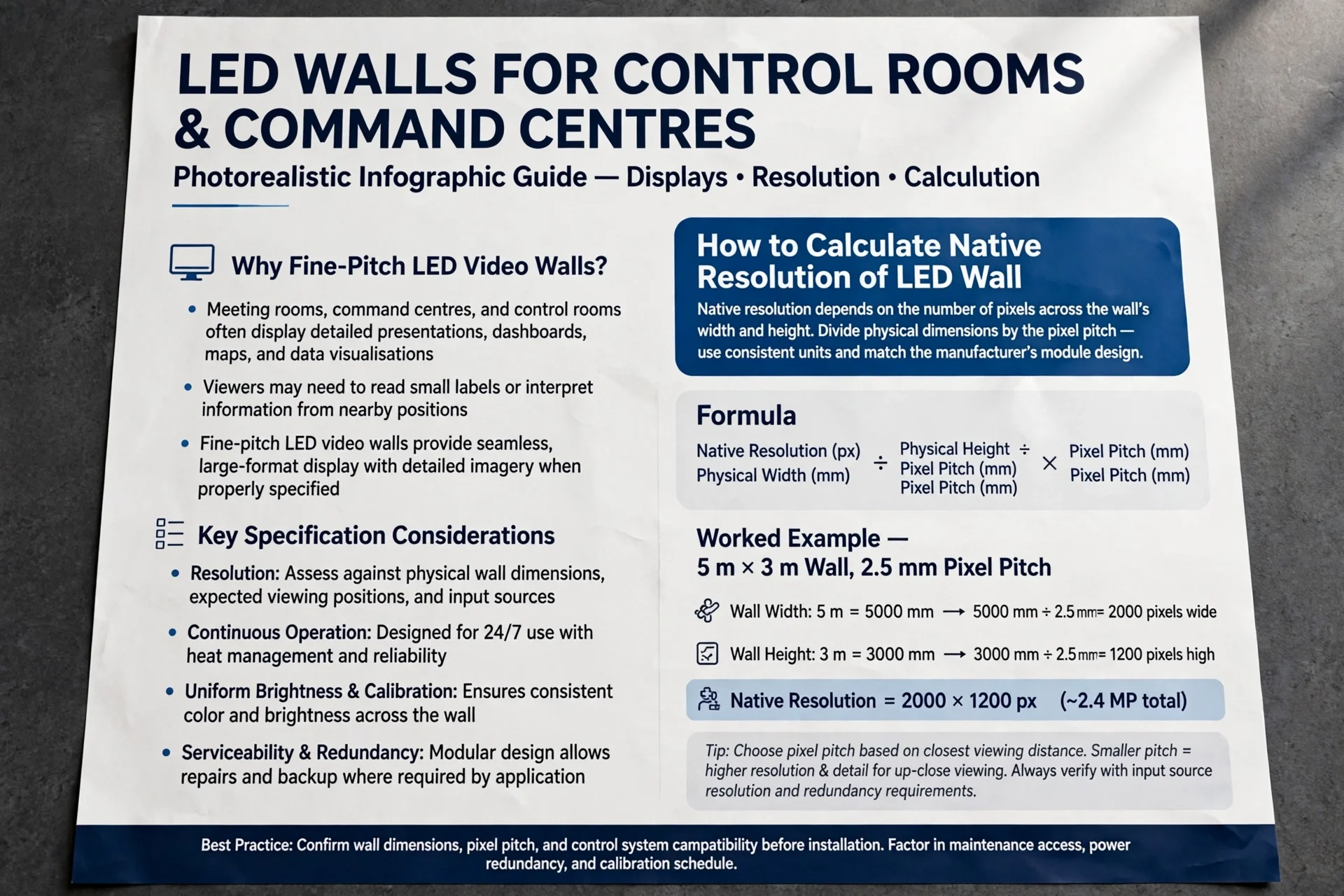
Pixel pitch is one of the most important specifications when selecting an exhibition LED screen.
It refers to the distance between the centres of adjacent LED pixels. A smaller pixel pitch generally allows viewers to stand closer to the screen while maintaining a sharper image.
Common indoor LED configurations may include fine-pitch options such as P1.5, P1.8, P2, P2.5, P3, or similar specifications.
The correct selection depends on viewing distance, screen dimensions, content type, budget, and camera requirements.
For a visitor standing only a few metres from a screen, a finer pixel pitch may provide a more detailed viewing experience. For a large screen viewed from further away, a larger pitch may be appropriate.
Pixel pitch should therefore be selected based on the actual exhibition environment rather than simply choosing the smallest available number.
Screen Size and Viewing Distance
Screen size should be considered together with viewing distance.
A screen that is too small may lose visual impact, while an unnecessarily large screen can consume valuable stand space and increase structural and power requirements.
Before choosing dimensions, determine where visitors are likely to stand and how far away the screen will be viewed.
The screen may need to display small text, charts, product specifications, or detailed images. In such cases, viewing distance becomes particularly important.
For promotional videos and bold branding, the screen may be designed primarily for long-distance visibility.
A professional exhibition AV plan should therefore evaluate screen size, content, viewing distance, and stand layout together.

Indoor LED Screens for Sharjah Exhibitions
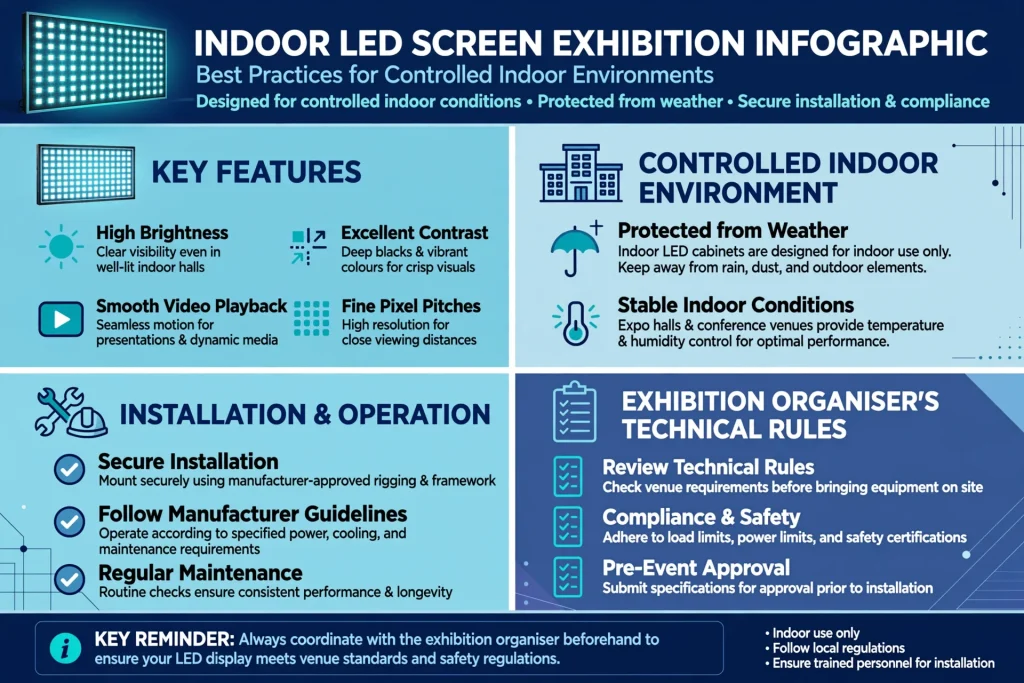
Most indoor exhibition environments use LED screens designed for controlled indoor conditions. These displays can provide high brightness, excellent contrast, smooth video playback, and fine pixel pitches.
Indoor LED cabinets are generally designed for applications where the display is protected from direct weather exposure.
Expo halls and conference venues can provide controlled environments, but the screen still needs to be installed securely and operated according to the manufacturer’s requirements.
The exhibition organiser’s technical rules should also be checked before bringing equipment into the venue.
LED Screens at Expo Centre Sharjah
Expo Centre Sharjah is an important venue for exhibitions, trade fairs, conferences, and business events in the emirate.
Exhibitors planning LED screens for events at the venue should review the event’s technical handbook and stand regulations before finalising the installation.
Important considerations can include maximum stand height, rigging permissions, electrical supply, access times, structural requirements, screen positioning, cable management, and safety procedures.
The exact requirements can vary between events, so exhibitors should confirm the latest organiser and venue requirements for their specific show.
LED Screens for Trade Shows
Trade shows often involve many exhibitors displaying products and services within the same hall. Digital displays can help a stand communicate more information without filling the entire space with printed graphics.
A trade show LED screen can rotate through different content throughout the day.
For example, a technology company might show product demonstrations in the morning, customer case studies later in the day, and corporate presentations during scheduled meetings.
The ability to change content provides flexibility that traditional graphics cannot offer.
LED Screens for Product Launches
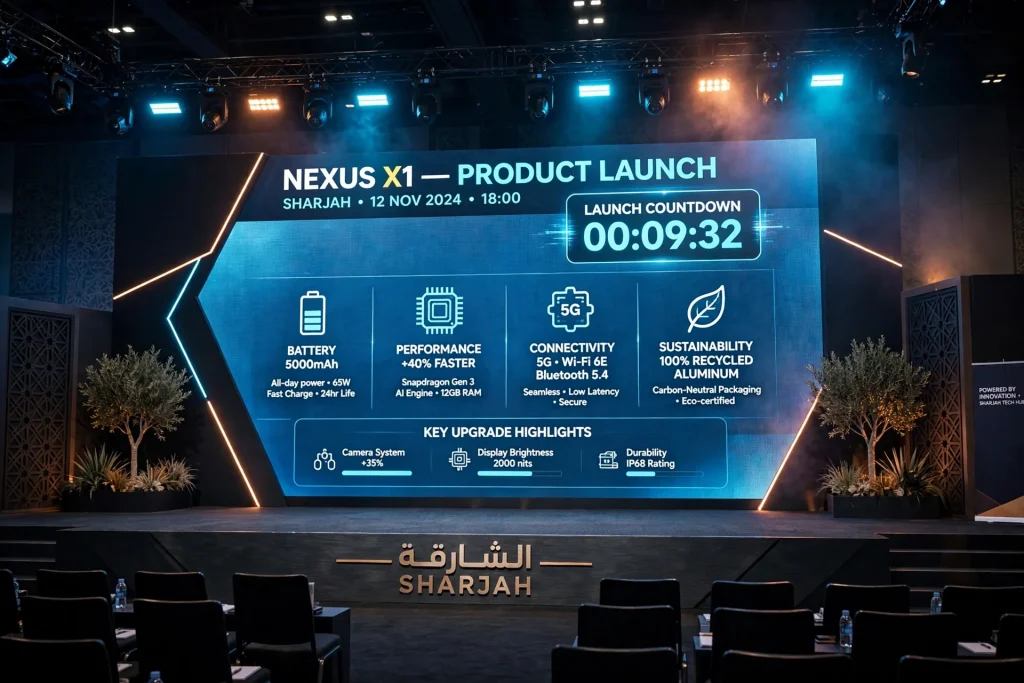
Product launches require strong visual communication. An LED display can provide a large digital backdrop for product videos, launch countdowns, animations, presentations, and branded visuals.
The content can be synchronised with stage lighting, sound, presentations, and other event technology.
For a product launch in Sharjah, the LED screen should be integrated into the stage design and viewing area.
The screen’s brightness, colour reproduction, refresh rate, and resolution should be appropriate for the content being displayed.
LED Screens for Corporate Events
Corporate events may include conferences, seminars, award ceremonies, annual meetings, training programmes, and business networking events.
LED displays can be used for speaker presentations, corporate branding, agenda information, sponsor logos, live camera feeds, videos, and event graphics.
Multiple screens may be used when the audience is large or when side displays are required for better visibility.
A central processor or video controller can coordinate content across multiple LED displays.
LED Screens for Government and Institutional Events
Sharjah hosts a variety of government, educational, cultural, and institutional events. LED screens can support presentations, ceremonies, public information campaigns, exhibitions, and official branding.
In these environments, content accuracy and visual consistency are particularly important.
The display should reproduce logos, Arabic and English text, charts, photographs, and video content clearly.
Screen placement should also consider accessibility and audience sightlines.
Brightness and Indoor Exhibition Lighting
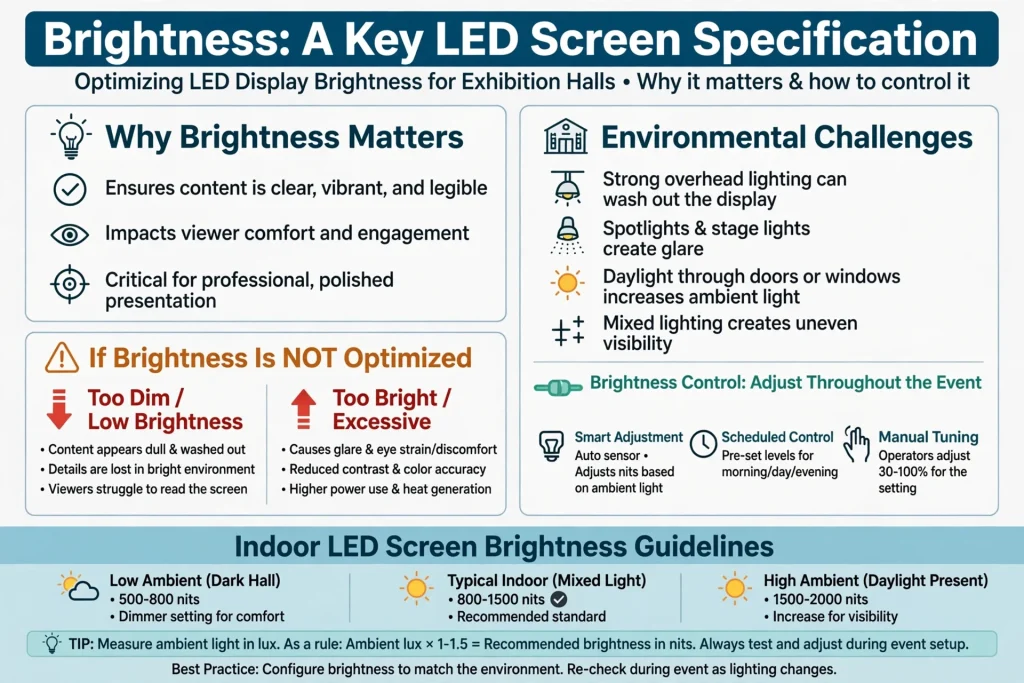
Brightness is another important LED screen specification. An exhibition hall may contain strong overhead lighting, spotlights, stage lighting, and daylight entering through doors or windows.
If the LED display is not bright enough for the environment, its content may appear dull.
However, excessive brightness can also be uncomfortable and can reduce visual quality.
Indoor LED screens should therefore be configured according to the ambient lighting conditions. Brightness control can allow the display to be adjusted throughout the event.
Refresh Rate for Exhibition LED Screens
Refresh rate becomes particularly important when LED screens are photographed or recorded by professional cameras.
A low or unsuitable refresh rate can produce visible flicker or scanning effects on camera.
This matters for exhibitions where brands create social media content, livestream presentations, record interviews, or photograph their stands.
A suitable high-refresh-rate LED system can provide smoother visual performance for both visitors and cameras.
The exact specification should be selected according to the content and filming requirements.
LED Screen Content for Exhibition Stands
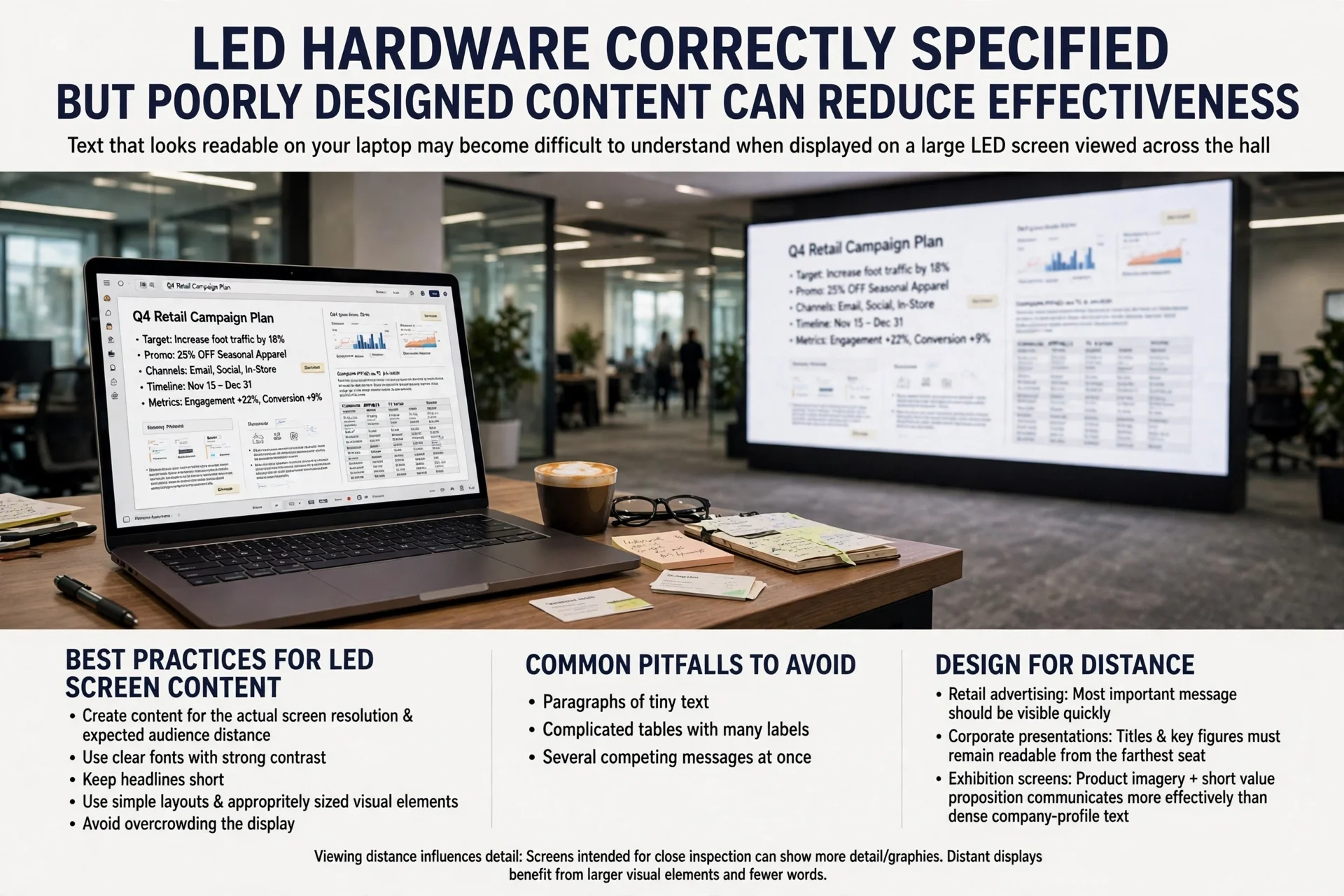
A high-quality LED screen cannot compensate for poor content.
Exhibition content should be designed for the screen’s aspect ratio and viewing distance. Text should be large enough to read quickly, while key messages should remain simple and visually clear.
Useful exhibition content can include:
- Product demonstrations
- Brand videos
- Corporate presentations
- Project portfolios
- Customer testimonials
- Animated graphics
- Product specifications
- Promotional campaigns
- Social media feeds
- QR codes
- Event schedules
The content should be planned around the visitor journey rather than simply displaying a long corporate video repeatedly.
LED Screens and Brand Visibility
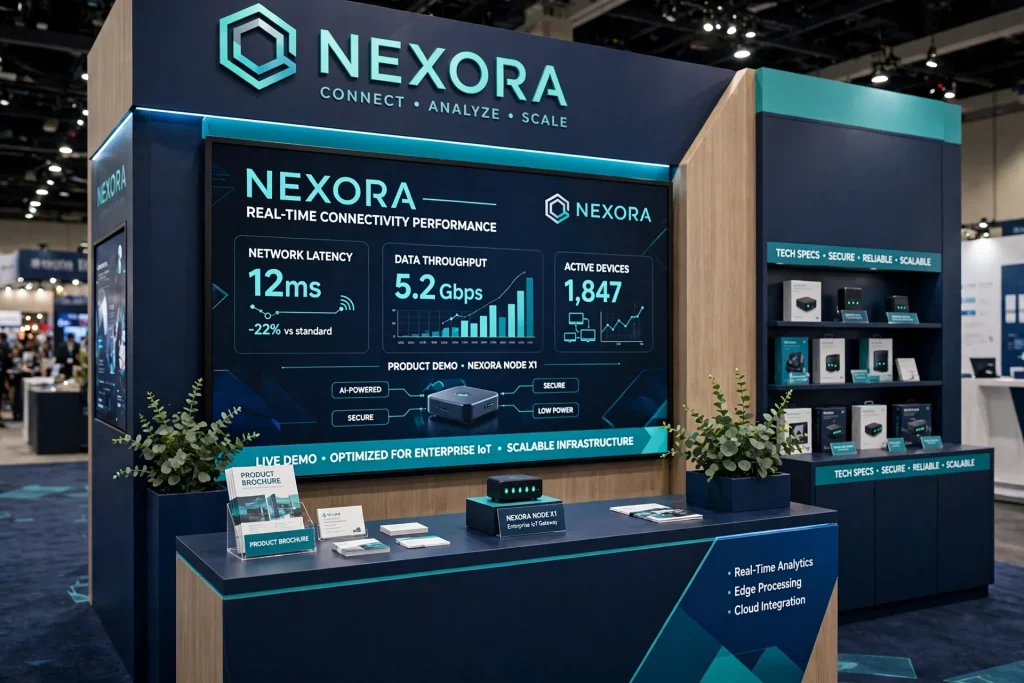
An exhibition stand is often a temporary brand environment. Every element, including the LED screen, should support the company’s visual identity.
Colours, typography, animation, logos, photography, and video should be consistent with the brand guidelines.
A digital display can also create different visual experiences throughout the day.
For example, a stand can use branded motion graphics when visitors are approaching and switch to detailed product demonstrations when a sales representative begins a discussion.
Curved LED Screens for Exhibitions
Curved LED screens can create a more immersive exhibition environment. They can be used to form curved backdrops, columns, feature walls, or creative architectural displays.
The screen modules and cabinets must be designed for the intended curve. Not every LED system can be installed in every curved configuration.
The structural frame must also support the screen safely.
Curved displays can be particularly effective for technology companies, automotive brands, luxury products, entertainment businesses, and companies looking to create a distinctive stand.
Transparent LED Screens
Transparent LED displays can be useful when the design requires visibility through the screen.
They may be incorporated into glass walls, retail-style displays, architectural partitions, or special exhibition structures.
The suitability of transparent LED technology depends on the application, ambient light, viewing distance, transparency requirement, and content.
These systems should be evaluated carefully because their visual characteristics differ from conventional indoor LED cabinets.
LED Screen Installation and Structure
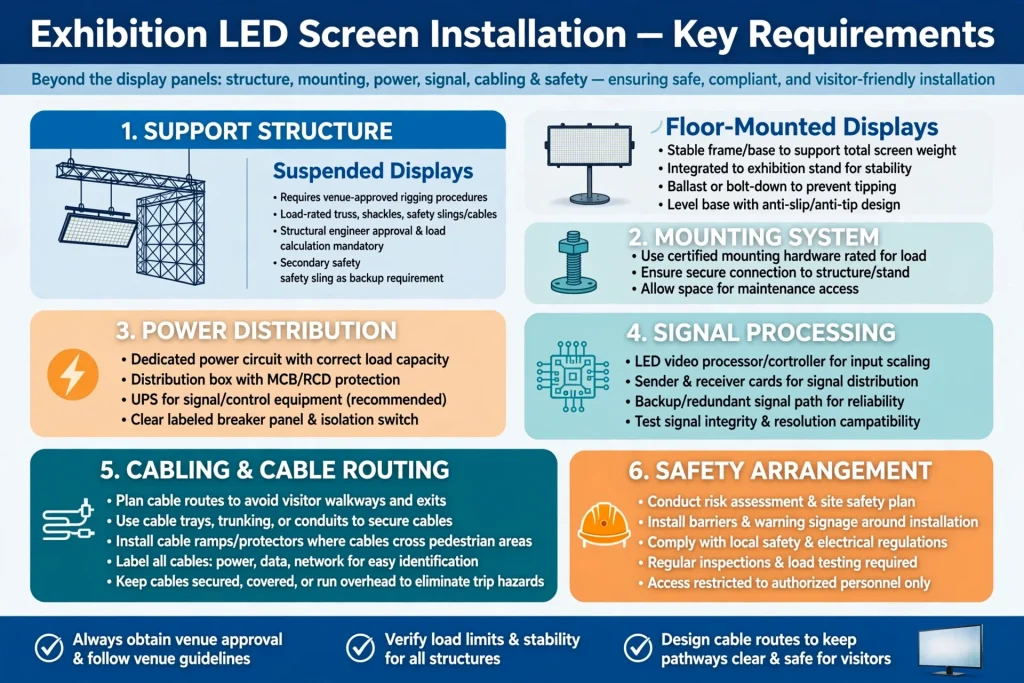
An exhibition LED screen requires more than the display panels themselves. A suitable structure, mounting system, power distribution, signal processing, cabling, and safety arrangement are also required.
The support structure must be appropriate for the screen weight and installation configuration.
For suspended displays, venue-approved rigging procedures may apply. For floor-mounted displays, the structure should be stable and properly integrated with the exhibition stand.
Cable routes should be planned so that they do not create trip hazards or interfere with visitor movement.
Power Requirements
Large LED displays can require significant electrical capacity. Power requirements depend on screen size, LED technology, brightness, operating conditions, and system design.
Exhibitors should confirm the available electrical supply with the event organiser before finalising the screen specification.
Power distribution should be designed appropriately, including suitable protection and cable management.
The screen supplier and exhibition contractor should coordinate power requirements early to avoid installation problems at the venue.
LED Screen Control Systems
An LED display normally requires a control system to process and distribute video signals.
Depending on the configuration, equipment may include video processors, sending cards, receiving cards, media servers, presentation systems, and signal converters.
For multi-screen exhibition installations, content may need to be synchronised across several displays.
The control system should be tested before the event opens. Spare signal cables, backup content, and appropriate technical support can also reduce downtime risk.
Maintenance and Technical Support
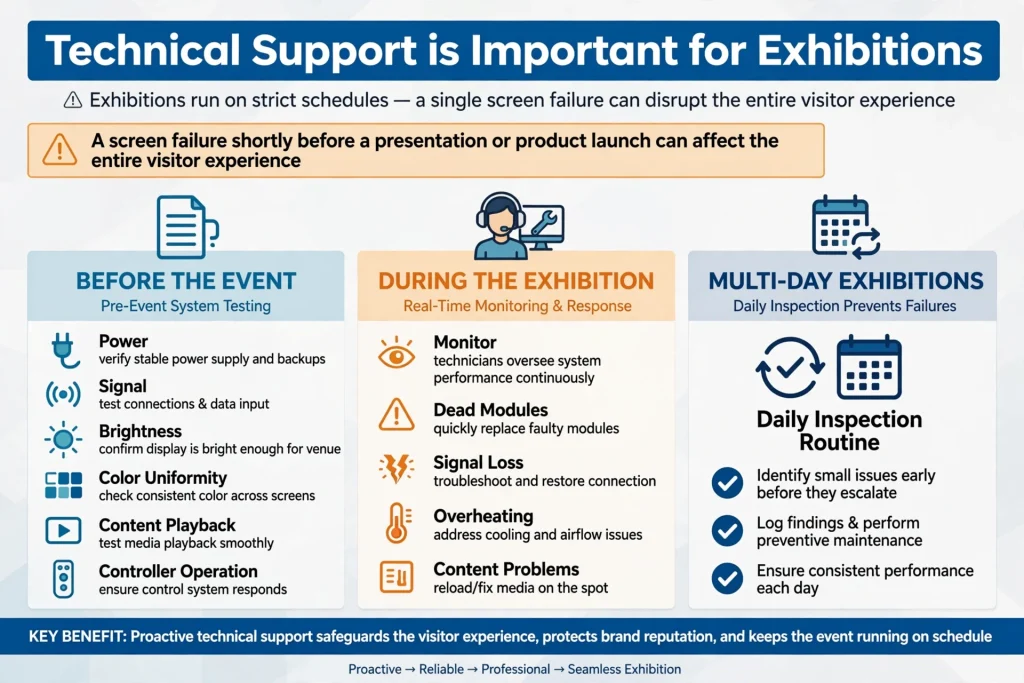
Technical support is important because exhibitions operate according to strict schedules. A screen failure shortly before a presentation or product launch can affect the entire visitor experience.
Before the event, the system should undergo testing for power, signal, brightness, colour uniformity, content playback, and controller operation.
During the exhibition, technicians may monitor the system and respond to issues such as dead modules, signal loss, overheating, or content problems.
For multi-day exhibitions, daily inspection can help identify small issues before they become major failures.
LED Screens and Exhibition Stand Design
The LED display should be considered during the stand design process.
The designer should allow sufficient space for the LED cabinets, supporting structure, ventilation, cable routing, power distribution, and access for maintenance.
The screen should not block emergency exits, reduce required walkways, or interfere with other stand elements.
Reception counters, product displays, seating areas, storage, lighting, and branding should all work together with the digital display.
A well-coordinated stand can make the screen appear integrated rather than simply attached to a wall.
Exhibition Areas in Sharjah
Sharjah’s commercial and cultural environment creates opportunities for LED screen applications across different types of events.
Important local areas and commercial destinations include Al Khan, Al Majaz, Al Nahda Sharjah, Al Qasimia, Al Taawun, Al Sajaa Industrial Area, and the wider Sharjah city area.
The exhibition and business environment also connects Sharjah with Dubai, Ajman, and other northern emirates.
For exhibitors attending events, the logistics of transporting LED cabinets, stands, cables, structures, and other AV equipment should be considered alongside the technical specification.
LED Screens for Al Majaz and Waterfront Events
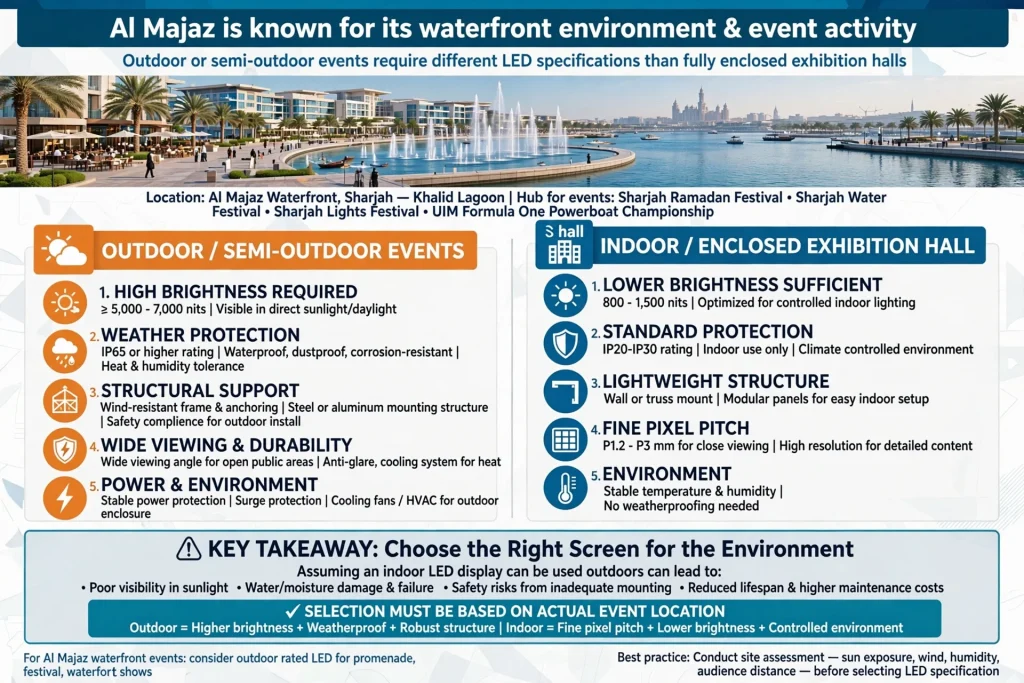
Al Majaz is known for its waterfront environment and event activity. Outdoor or semi-outdoor events may require LED technology with different environmental specifications from a fully enclosed exhibition hall.
Outdoor displays may require higher brightness, suitable weather protection, and appropriate structural support.
The screen specification should therefore be selected according to the actual event location rather than assuming that an indoor LED display can be used outdoors.
LED Screens for Sharjah Retail and Brand Activations
LED technology can also be used for temporary brand activations, shopping-centre promotions, retail launches, and promotional events.
In these applications, screen placement should focus on visitor flow and viewing distance.
Content should communicate the brand message quickly because visitors may only see the screen for a few seconds.
Motion graphics, short videos, product imagery, and strong calls to action can be effective when designed specifically for digital displays.
How to Choose an Exhibition LED Screens Supplier
Selecting an Exhibition LED Screens Supplier involves more than comparing screen rental or purchase prices.
Exhibitors should consider pixel pitch, screen size, brightness, refresh rate, cabinet design, installation method, power requirements, content support, technical assistance, safety, and venue compliance.
The supplier should understand exhibition environments and be able to coordinate with stand builders, event organisers, AV teams, and venue management.
For complex projects, it is useful to request technical specifications, screen dimensions, power requirements, installation drawings, and a clear scope of services before confirming the order.
Rental or Purchase: Which Exhibition LED Screen Approach?
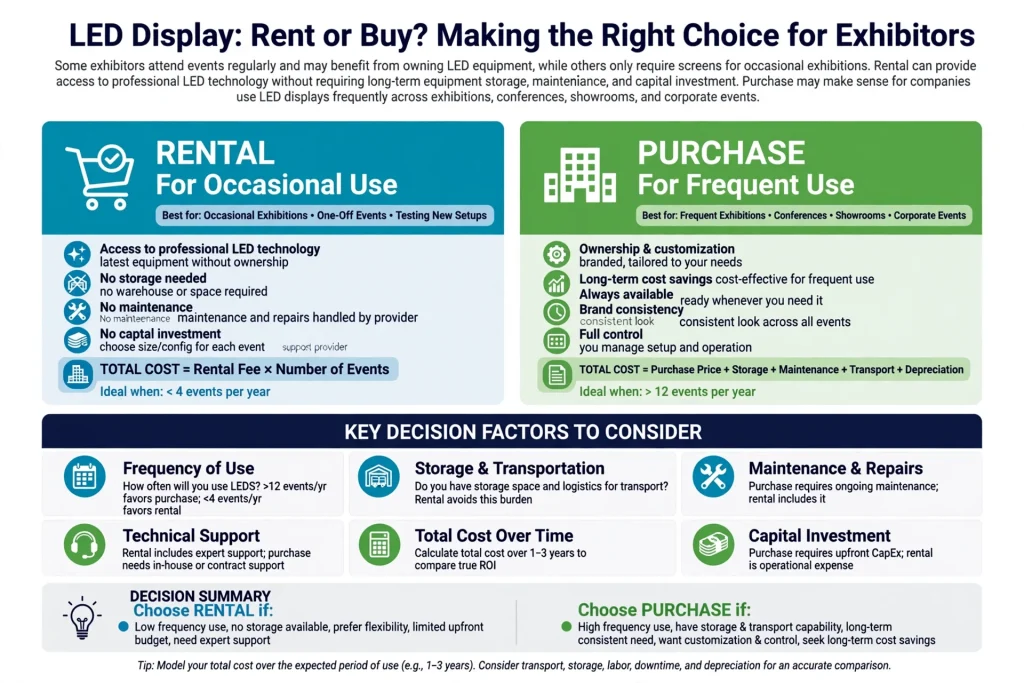
Some exhibitors attend events regularly and may benefit from owning LED equipment, while others only require screens for occasional exhibitions.
Rental can provide access to professional LED technology without requiring long-term equipment storage, maintenance, and capital investment.
Purchase may make sense for companies that use LED displays frequently across exhibitions, conferences, showrooms, and corporate events.
The decision should consider frequency of use, storage, transportation, maintenance, technical support, and the total cost over the expected period of use.
Common Mistakes When Using Exhibition LED Screens
One common mistake is selecting a screen based only on its size. Pixel pitch and viewing distance are equally important.
Another issue is using content designed for a different aspect ratio, resulting in stretched or cropped visuals.
Insufficient power planning can create installation delays, while poor cable management can create safety issues.
Other problems include inadequate brightness, low refresh rates for camera use, poor ventilation, insufficient technical testing, and failure to check venue regulations before installation.
These issues can usually be reduced through early planning and coordination.
How to Prepare for an LED Screen Exhibition
Exhibitors should confirm the screen requirements well before the event.
Start with the stand design and determine the available wall or floor area. Establish the viewing distance and choose an appropriate pixel pitch. Confirm the screen dimensions, mounting method, electrical supply, content resolution, control system, and installation schedule.
The final content should be tested on the actual screen or an equivalent system whenever possible.
The supplier should also confirm delivery, installation, dismantling, technical support, and responsibility for equipment during the event.
Final Thoughts
Exhibition LED screens can transform how brands communicate at trade shows, conferences, product launches, and corporate events in Sharjah. They provide flexible digital communication that can combine video, graphics, presentations, branding, live content, and interactive experiences.
The most effective installation is not necessarily the largest screen. It is the system that matches the stand size, viewing distance, content, venue, lighting conditions, power availability, structural design, and audience.
For exhibitions at Expo Centre Sharjah and other event locations, exhibitors should plan LED screens together with stand design, electrical services, AV equipment, content production, and venue requirements.
By selecting the appropriate pixel pitch, brightness, refresh rate, screen format, control system, and installation method, businesses can create a professional digital display that supports their exhibition objectives while remaining practical and reliable throughout the event.