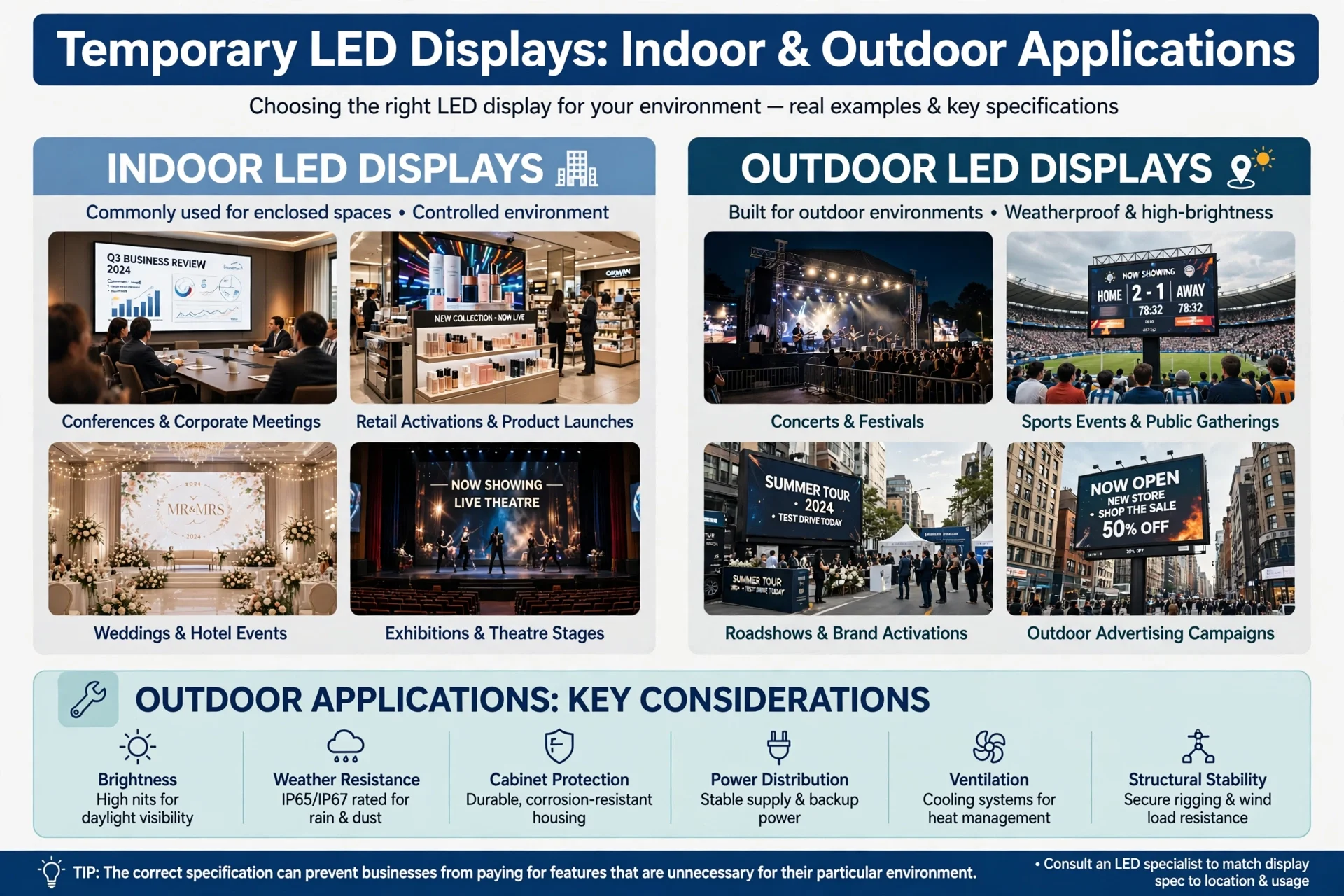
LED screens have become an important part of modern events, exhibitions, conferences, concerts and brand activations across the UAE. From large displays at Dubai World Trade Centre to outdoor event screens at Expo City Dubai and hospitality events in Abu Dhabi, LED technology helps businesses communicate through high-impact visual content.
One of the most important technical factors when selecting an LED display is brightness. A screen that is too dim can become difficult to read, while excessive brightness in an indoor environment can create glare, eye discomfort and poor image quality.
Understanding LED screen brightness helps event organisers, exhibition contractors, AV companies and businesses choose a display that matches the venue, viewing distance, ambient lighting and content requirements.
What Does LED Screen Brightness Mean?
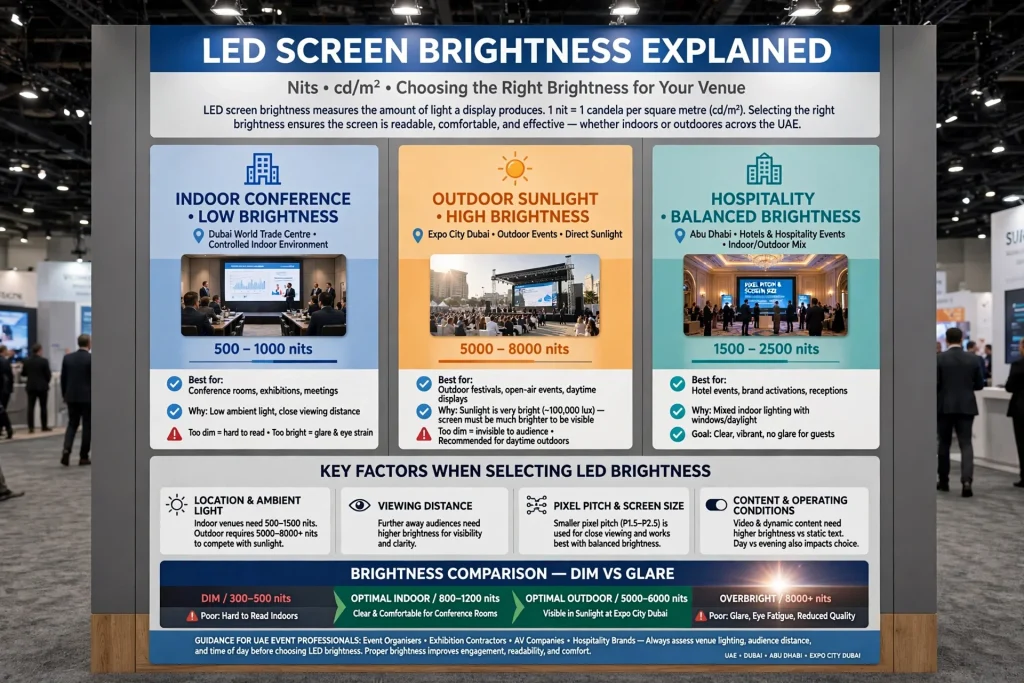
LED screen brightness refers to the amount of light produced by the display. It is normally measured in nits, with one nit equal to one candela per square metre (cd/m²).
The required brightness depends heavily on where the LED screen will be installed.
An indoor conference room with controlled lighting generally requires much less brightness than an outdoor screen exposed to direct sunlight. A display inside an exhibition hall may have completely different requirements from an LED screen installed for a daytime outdoor event.
Brightness should therefore be considered together with screen location, ambient light, viewing distance, pixel pitch, screen size, content and operating conditions.
What Are Nits in an LED Display?
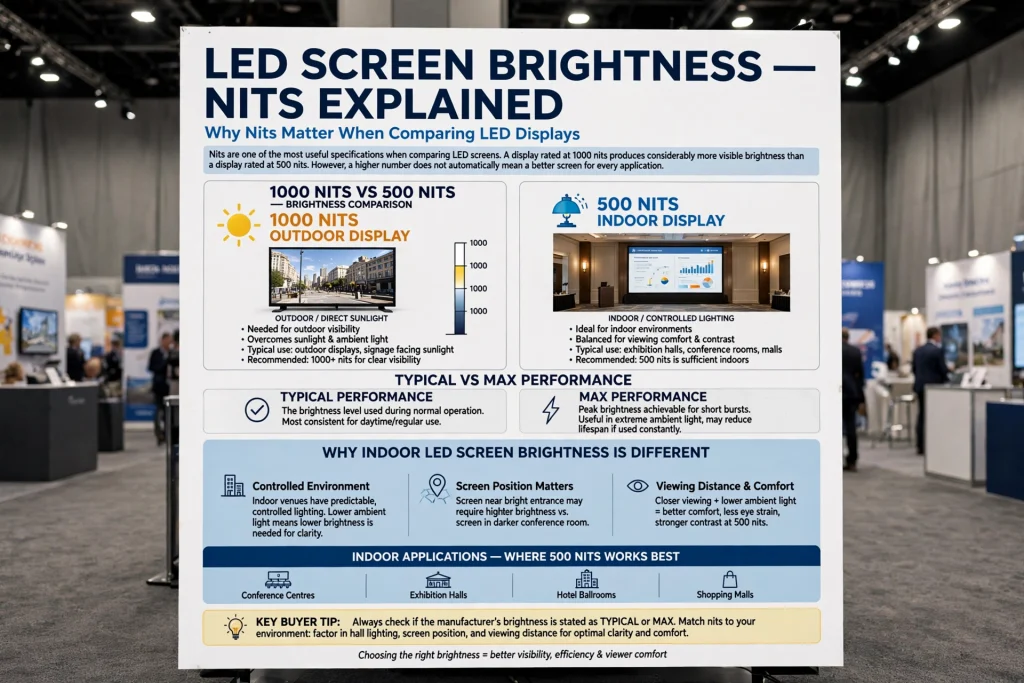
Nits are one of the most useful specifications when comparing LED screens.
For example, an LED display rated at 1,000 nits produces considerably more visible brightness than a display rated at 500 nits. However, a higher number does not automatically mean a better screen for every application.
An indoor LED display may not need extremely high brightness because the environment is controlled. An outdoor display, particularly one facing direct sunlight, requires significantly greater brightness so that images remain visible.
When comparing products, buyers should check the manufacturer’s specified brightness and understand whether the figure represents typical or maximum performance.
Why Indoor LED Screen Brightness Is Different
Indoor environments generally have controlled or partially controlled lighting.
Exhibition halls, conference centres, hotel ballrooms and shopping malls may use artificial lighting rather than direct sunlight. Because ambient light levels are lower and more predictable, indoor LED screens can operate at lower brightness levels.
This can improve viewing comfort while still providing strong contrast and clear images.
For businesses planning exhibition displays, understanding LED Screen Brightness for Indoor applications is particularly useful because the correct brightness depends on the hall lighting, screen position and viewing distance.
A screen positioned near a brightly illuminated exhibition entrance may require different settings from one installed inside a darker conference room.
Suitable Brightness for Indoor Events
There is no single brightness specification that works for every indoor event.
Indoor LED displays commonly operate in a lower brightness range than outdoor displays, but the appropriate setting depends on the venue.
Conference rooms, hotel ballrooms and auditoriums may benefit from moderate brightness that keeps presentations comfortable for extended viewing.
Exhibition halls can require higher settings because surrounding booths, spotlights and architectural lighting can increase ambient illumination.
Retail environments may require carefully balanced brightness to make promotional content visible without overpowering the surrounding interior design.
The screen should be bright enough to maintain visibility while avoiding unnecessary glare.
LED Screen Brightness for Outdoor Events
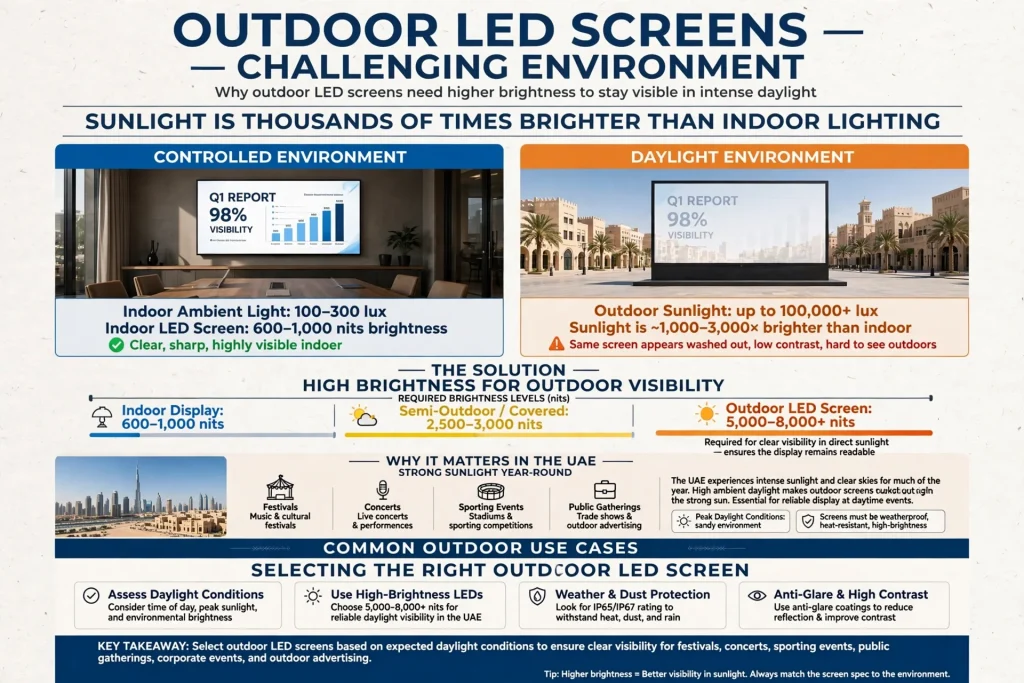
Outdoor LED screens face a much more challenging environment.
Sunlight can be thousands of times brighter than the lighting level found in an indoor room. A display that looks excellent inside a venue may appear washed out when placed outdoors during daylight.
Outdoor LED screens therefore use higher brightness levels to maintain visibility.
This is particularly important for outdoor events in the UAE, where strong sunlight can affect screen visibility for much of the year.
Outdoor screens used for festivals, concerts, sporting events, public gatherings, corporate events and outdoor advertising need to be selected according to the expected daylight conditions.
Direct Sunlight and Screen Visibility
Direct sunlight is one of the biggest challenges for outdoor LED displays.
If the LED screen does not produce enough luminance, colours may appear weak and dark areas can become difficult to see.
Content design also becomes important. Small text, thin fonts and low-contrast colour combinations may be difficult to read even when the display itself has strong brightness.
For outdoor events, the combination of sufficient brightness, good contrast, suitable pixel pitch and carefully designed content helps maintain visibility.
The screen’s orientation also matters. A display facing directly toward the sun may experience different visibility conditions from one positioned away from direct sunlight.
Dubai’s Outdoor Event Environment
Dubai hosts exhibitions, concerts, corporate events, sporting activities, festivals and promotional activations throughout the year.
Outdoor LED screens may be used around areas such as Dubai Marina, Downtown Dubai, Jumeirah, Palm Jumeirah and Expo City Dubai, depending on the event and venue requirements.
For outdoor installations, brightness should be considered alongside heat, sunlight, viewing distance and the expected duration of operation.
Event organisers should also consider the screen’s environmental protection, electrical system, structural installation and weather resistance rather than selecting a display based on brightness alone.
Abu Dhabi Outdoor LED Events
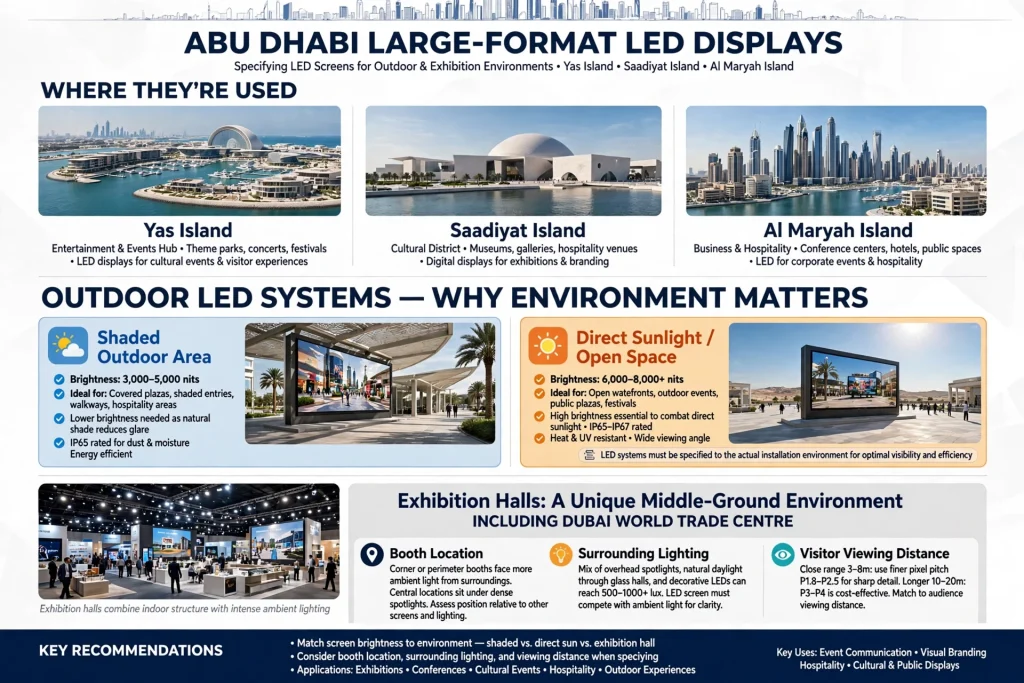
Abu Dhabi also uses large-format LED displays for exhibitions, conferences, cultural events, hospitality activities and outdoor experiences.
Areas such as Yas Island, Saadiyat Island and Al Maryah Island host venues and developments where digital displays may be used for event communication and visual branding.
Outdoor LED systems in Abu Dhabi should be specified according to the actual installation environment.
A screen positioned in a shaded outdoor area may have different brightness requirements from one installed in an open space exposed to direct sunlight.
LED Screens for Exhibition Halls
Exhibition halls create an interesting middle ground between indoor and outdoor environments.
Although the screen is technically indoors, exhibition lighting can be intense. Hundreds of spotlights, illuminated booths, architectural lighting systems and large digital displays can create a bright environment.
This means exhibitors should not automatically select the lowest-brightness indoor LED screen.
At venues such as Dubai World Trade Centre, screen brightness should be considered alongside booth location, surrounding lighting and visitor viewing distance.
A large LED wall positioned at the rear of an exhibition stand may require different settings from a smaller presentation screen inside a meeting area.
Brightness and Viewing Distance
Viewing distance is another important consideration.
A screen intended to be viewed from a few metres away needs different visual characteristics from a large outdoor screen viewed from 30 or 50 metres.
Brightness does not determine viewing distance by itself. Pixel pitch, screen size, content resolution and viewing angle also matter.
Large event screens often use a combination of appropriate pixel pitch and brightness to maintain image clarity at the expected viewing distance.
For example, a fine-pitch LED display may be suitable for close viewing at an indoor exhibition stand, while a larger-pitch outdoor display may be more appropriate for a concert audience located much farther away.
Pixel Pitch and Brightness Work Together
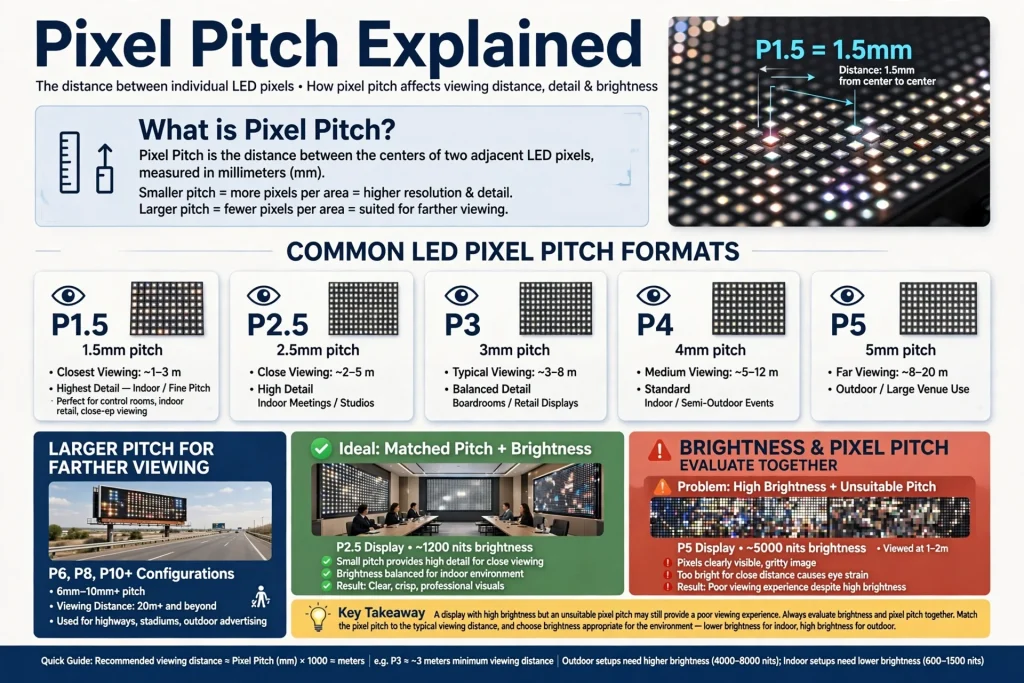
Pixel pitch refers to the distance between individual LED pixels.
Common LED display pixel pitches include formats such as P1.5, P2.5, P3, P4, P5 and larger outdoor configurations.
A smaller pixel pitch generally supports closer viewing and higher image detail. Larger pixel pitches are commonly used where viewers stand farther away.
Brightness and pixel pitch should therefore be evaluated together.
A display with high brightness but an unsuitable pixel pitch may still provide a poor viewing experience.
Brightness and Colour Accuracy
Brightness also affects how colours are perceived.
If an LED screen is operated at an excessively high level, bright colours can appear harsh and the visual presentation may become uncomfortable.
Professional LED displays allow brightness adjustment so that the system can be calibrated for the environment.
For corporate events, exhibitions and hospitality applications, colour consistency can be particularly important because the screen may display company logos, brand colours, product images and advertising campaigns.
Calibration helps maintain a consistent appearance across the LED modules.
Automatic Brightness Control
Modern LED display systems can use automatic brightness adjustment.
A light sensor can measure ambient conditions and allow the display to increase or decrease brightness according to the surrounding environment.
During daylight, the screen can operate at a higher brightness level. As the environment becomes darker, the system can reduce brightness.
This approach can improve viewing comfort and reduce unnecessary power consumption.
Automatic brightness control can be useful for LED displays that remain installed for long periods or operate throughout changing lighting conditions.
Brightness and Energy Consumption
Brightness has a direct relationship with power consumption.
Operating an LED screen at its maximum brightness continuously can consume more electricity than running it at an appropriate calibrated level.
For temporary events, energy planning is important because large LED walls can represent a significant electrical load.
Event organisers should work with the AV or LED supplier to understand the display’s electrical requirements, power distribution, control systems and backup arrangements.
Energy-efficient LED technology can help reduce operating requirements while maintaining the required visual performance.
HDR Content and LED Screen Brightness
High Dynamic Range, commonly known as HDR, is designed to provide a broader range between dark and bright areas.
For event screens, HDR-compatible content can create more detailed and visually impressive images when the LED display, processor and content are properly configured.
However, brightness alone does not create HDR-quality imagery.
The display’s contrast performance, colour reproduction, processing system and source content all contribute to the final result.
For professional events, the complete signal chain should be considered rather than focusing on one specification.
Brightness for Conference and Corporate Events
Conference events often involve presentations, speakers, product launches and video content.
An LED display in a conference room should provide clear text and graphics without producing excessive glare.
Brightness should be adjusted according to the room lighting.
For example, a large presentation screen in a ballroom may require a different brightness level from an LED backdrop used on a darker stage.
The content should also be designed for the viewing distance. Text should remain readable from the rear of the audience.
LED Screens for Concerts and Stage Events
Concerts and stage productions often require higher visual impact.
Large LED backdrops, side screens, stage banners and IMAG displays can show performers, graphics and live camera feeds.
Outdoor concerts require displays capable of operating in daylight when the event begins before sunset.
At night, brightness can usually be reduced to avoid overwhelming the audience.
Stage lighting and LED brightness must be coordinated because powerful lighting fixtures can change the visual balance of the entire stage.
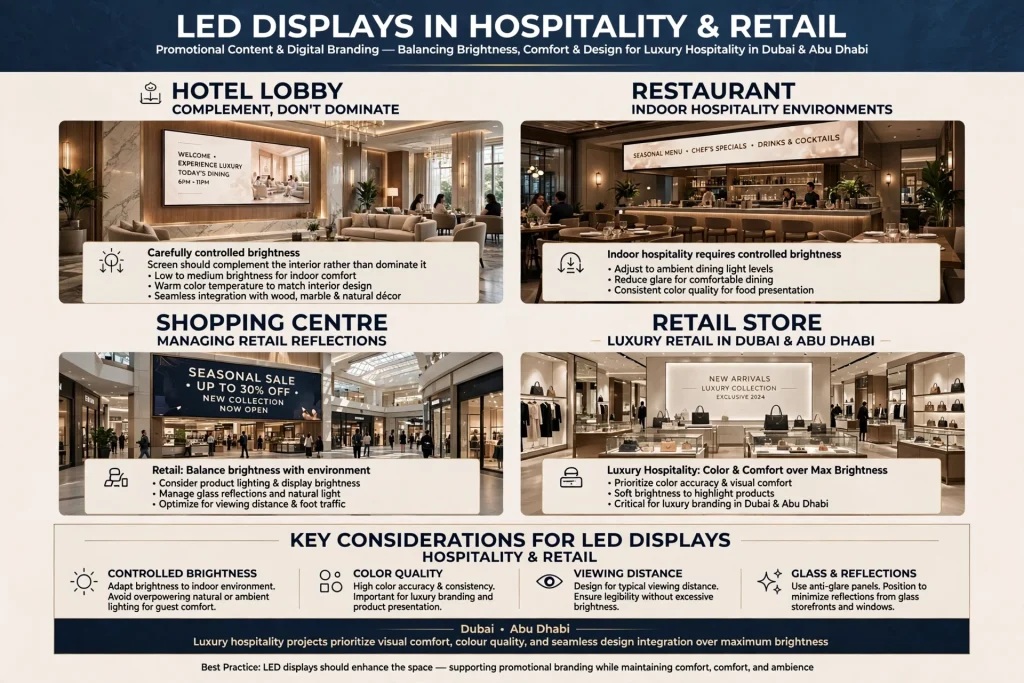
Brightness for Retail and Hospitality Displays
Hotels, restaurants, shopping centres and retail stores may use LED displays for promotional content and digital branding.
Indoor hospitality environments generally require carefully controlled brightness.
A screen installed in a hotel lobby should complement the interior rather than dominate it.
In retail environments, brightness should also be considered alongside product lighting, glass reflections and customer viewing distance.
For luxury hospitality projects in Dubai and Abu Dhabi, visual comfort and colour quality can be just as important as maximum brightness.
Brightness for Outdoor Advertising
Outdoor digital signage needs to remain readable throughout changing daylight conditions.
Billboards and large roadside LED displays may face direct sunlight during the day and operate at lower brightness during the evening.
Brightness control is therefore essential.
Outdoor advertising systems should also be designed around viewing distance, traffic speed, content duration and legibility.
Short messages, large typography and strong contrast generally work better than complex designs for audiences viewing the screen while travelling.
Heat Management in UAE Conditions
Brightness is particularly important to consider alongside heat in the UAE.
High operating brightness can increase the thermal load of an LED display.
Outdoor installations therefore require suitable ventilation, thermal management and equipment selection.
The display’s operating temperature range should be checked against the actual installation environment.
For permanent outdoor installations, cabinet construction, airflow, power supplies and maintenance access all contribute to reliable operation.
IP Rating for Outdoor LED Screens
Outdoor LED displays need protection against environmental conditions.
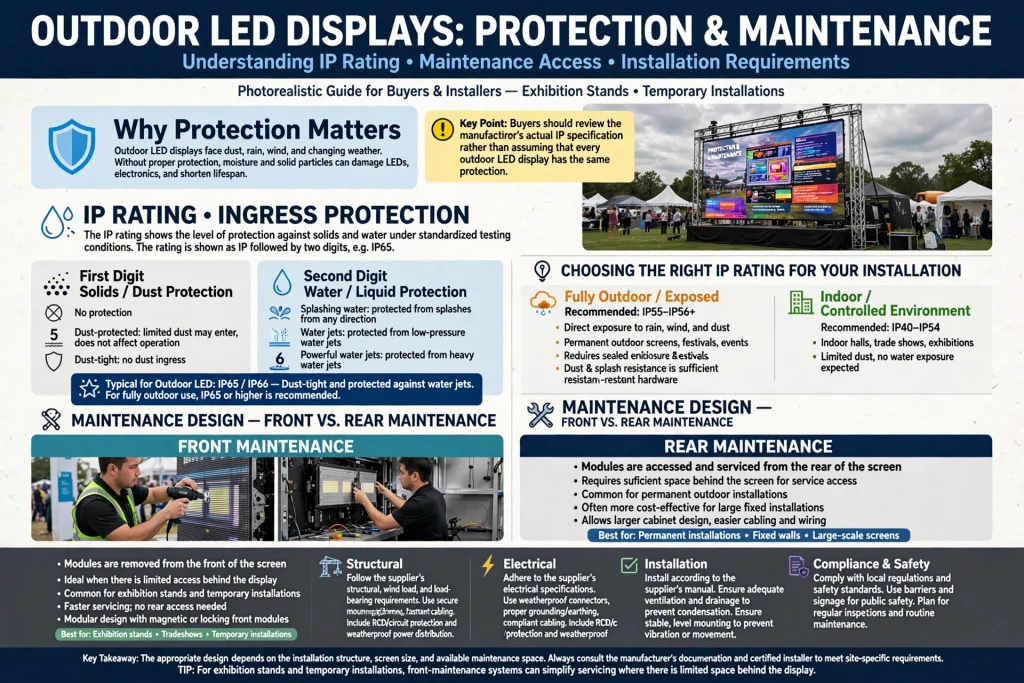
The IP rating, or Ingress Protection rating, indicates the level of protection against solids and water under defined testing conditions.
The required IP rating depends on whether the screen is installed outdoors, partially protected or in another environment.
Buyers should review the manufacturer’s actual IP specification rather than assuming that every outdoor LED display has the same protection.
An outdoor event screen should also be installed according to the supplier’s structural and electrical requirements.
Front Maintenance and Rear Maintenance
Maintenance design can influence the practicality of an LED display.
Some LED systems are designed for front access, allowing modules to be removed from the front of the screen.
Other systems require access from the rear.
For exhibition stands and temporary installations, front-maintenance systems can sometimes simplify servicing where there is limited access behind the display.
The appropriate design depends on the installation structure, screen size and available maintenance space.
LED Display Brightness Calibration
Brightness calibration should be performed according to the viewing environment.
Professional calibration can help balance luminance, colour and module consistency.
This is especially important for large LED walls because differences between modules can become visible when screens are viewed at close range.
Calibration should also be checked after maintenance or module replacement.
A professional LED display supplier can help establish suitable operating settings for the event environment.
Common LED Brightness Mistakes
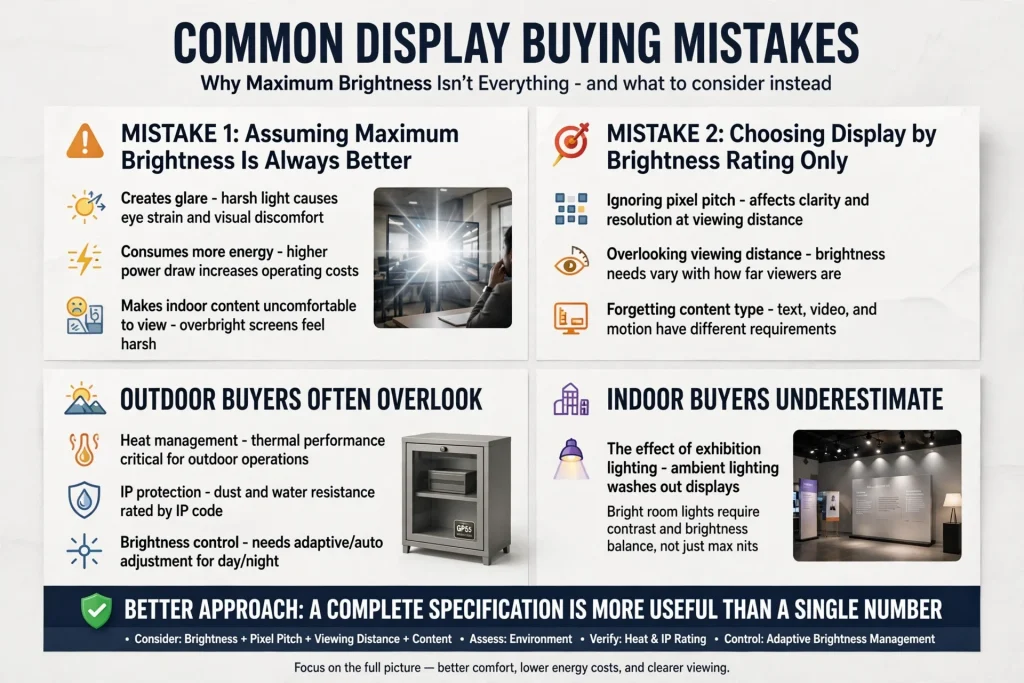
One common mistake is assuming that maximum brightness is always better.
It is not.
Excessive brightness can create glare, consume more energy and make indoor content uncomfortable to view.
Another mistake is selecting a display based only on its brightness rating without considering pixel pitch, viewing distance or content.
Outdoor buyers may also overlook heat management, IP protection and brightness control.
Indoor buyers sometimes underestimate the effect of exhibition lighting.
A complete specification is therefore more useful than focusing on a single number.
How to Choose the Right LED Screen Brightness
Start by identifying the installation environment.
Ask whether the screen will be indoors, outdoors, partially sheltered or exposed to direct sunlight.
Next, consider the ambient light level and viewing distance.
Then determine the required pixel pitch, screen size and content type.
For outdoor installations, review weather protection, thermal management, cabinet construction and brightness control.
For indoor events, consider glare, colour quality, surrounding lighting and viewing comfort.
Finally, confirm power requirements, maintenance access and control options with the LED supplier.
LED Screen Brightness for UAE Events
UAE events can involve very different environments, from controlled hotel conference rooms to brightly illuminated exhibition halls and outdoor venues exposed to strong sunlight.
This makes application-specific LED selection important.
Dubai exhibitions may require displays that balance indoor brightness with intense exhibition lighting. Outdoor events in Dubai or Abu Dhabi may require significantly higher brightness during daylight.
The correct approach is not to choose the brightest screen available. It is to choose a display capable of producing the required visibility under the actual conditions where it will operate.
Final Thoughts
LED screen brightness is an important part of event display planning, but it should never be evaluated in isolation.
Nits, ambient light, direct sunlight, pixel pitch, viewing distance, colour reproduction, content design, power consumption, thermal management and environmental protection all influence the final viewing experience.
For indoor conferences, hotel events and exhibition stands, controlled brightness can provide comfortable and professional visuals. For outdoor events, higher brightness and automatic adjustment can help maintain visibility under changing daylight conditions.
Whether an LED screen is being installed at Dubai World Trade Centre, an outdoor event in Dubai, a hospitality venue in Abu Dhabi or another UAE location, the best specification is the one matched to the real viewing environment.
Understanding these factors allows event organisers, exhibition contractors and businesses to create LED displays that remain clear, comfortable and visually effective throughout the event.